
Automotive Replacement Parts Buying Guide for High-Mileage Vehicle Repairs
High mileage changes the context around a failed part. Heat cycles, corrosion, hardened rubber, worn connectors, tired grounds, contaminated fluids, and movement in neighboring joints can damage a replacement or make diagnosis incomplete. Before ordering, measure the failed function and inspect the system that supplies, supports, cools, lubricates, or controls it.
The repair needs an economic horizon. A premium component can be sensible when labor access is difficult and the rest of the vehicle is sound; a modest targeted repair may be wiser when rust, transmission condition, or several near-term jobs limit remaining use. This guide helps define that scope without treating odometer mileage alone as proof that a vehicle is finished or that every adjacent part must be replaced.
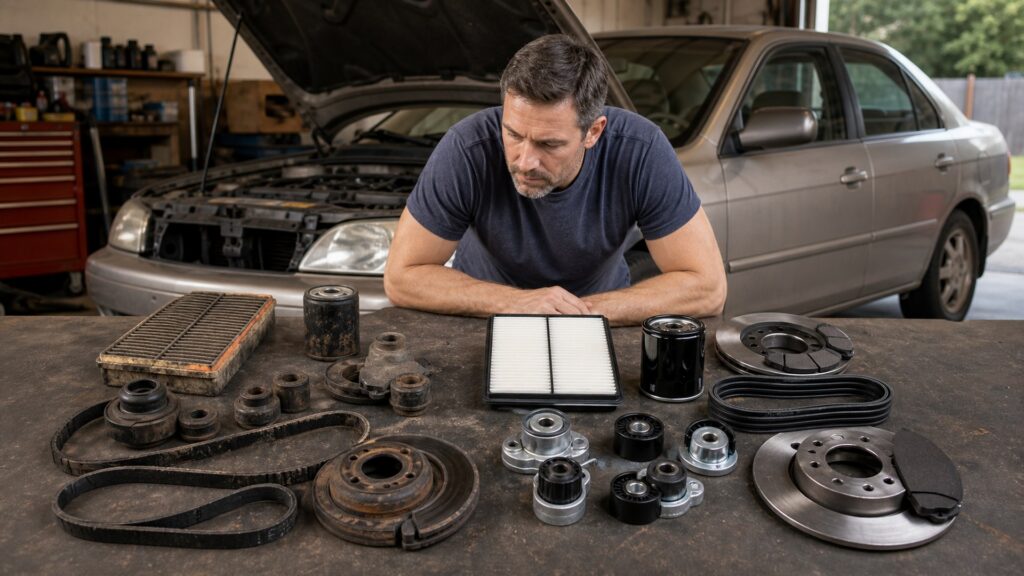
Buying framework
Repair the system at its current age
High-mileage work begins with condition evidence. Decide scope after diagnosis, not from the odometer alone.
Establish overall condition: Assess structure, corrosion, engine and transmission operation, fluids, brakes, tires, warning data, and upcoming inspection requirements before funding one isolated repair.
Confirm the root cause: Test power, ground, pressure, flow, compression, vacuum, temperature, mechanical play, leakage, and contamination as relevant instead of replacing the most visible symptom.
Inspect wear partners: Check mounts, hoses, connectors, fasteners, pulleys, joints, seals, mating surfaces, and paired components that can overload or misalign the new part.
Choose a service horizon: Define whether the vehicle needs one more season, several commuting years, or restoration-level life, then select quality and repair breadth that support that horizon.
Compare repair with replacement honestly: Include taxes, financing, insurance, depreciation, downtime, and unknown condition in another vehicle rather than comparing the invoice only with current market value.
Who this is for
Mileage alone does not set the answer
Condition, use, and repair access distinguish worthwhile repairs from escalating projects. Identify the vehicle's role.
Well-documented long-term vehicles: Complete records, controlled corrosion, stable fluid use, and sound structure can justify durable parts and preventive work while access is already open.
Essential budget transportation: Prioritize safety, legal operation, predictable starting, cooling, charging, braking, and common parts, preserving cash for the next measured failure.
Seasonal or low-mileage vehicles: Age-related seals, hoses, batteries, tires, fuel condition, and corrosion may matter more than annual distance; avoid assuming low recent mileage means low wear.
Project and restoration vehicles: Broader system refreshes may suit long ownership and planned disassembly, but originality, supplier continuity, and staged testing need deliberate control.
What to pay attention to
Part details that matter in an aged system
The replacement must tolerate the real environment around it. Inspect interfaces before choosing grade.
Root Cause & System Condition
Measured failure, adjacent wear, contamination, corrosion, electrical supply, and mating surfaces.
Remaining Life & Repair Economics
Labor access, part durability, downtime, vehicle condition, upcoming work, warranty, and realistic service horizon.
Material compatibility: Seal compounds, hose materials, coatings, bearing grease, plastics, and electrical insulation must suit current fluids, temperatures, corrosion exposure, and mating surfaces.
Dimensional tolerance: Wear in shafts, bores, splines, brackets, and housings can place a new standard-size component outside its intended fit, requiring measurement or machining.
Electrical supply requirements: Voltage drop, weak grounds, charging instability, overheated connectors, and harness resistance can imitate or destroy starters, alternators, pumps, motors, sensors, and modules.
Contamination sensitivity: Debris, metal, moisture, sludge, refrigerant oil, or incorrect fluid can ruin pumps, compressors, injectors, bearings, and control valves unless the system is cleaned correctly.
Updated design: A later bearing, gasket, tensioner, connector, vent, or cooling revision may address a known weakness, but companion parts and procedures must match the update.
Warranty conditions: High-mileage claims may require flushing, filters, professional installation, measurements, or related-component replacement; read requirements before work begins.
Avoid these traps
Repair habits that cause high-mileage comebacks
A fresh part cannot compensate for a damaged environment. Correct the conditions that shortened the old component's life.
Using mileage as the diagnosis: Odometer reading indicates exposure, not which part failed; measurements are still required before condemning an expensive assembly.
Replacing only the noisiest component: Movement or noise can travel through mounts and structures, while one worn joint may load another; isolate the source and inspect the complete path.
Installing clean parts into contamination: Metal, sludge, moisture, or deteriorated fluid can destroy the replacement rapidly unless lines, coolers, reservoirs, and mating systems are serviced.
Refreshing everything without priorities: Large parts lists can consume the budget while missing safety, rust, or powertrain risks; rank work by consequence, diagnosis, access, and service horizon.
Buying short-warranty parts for difficult labor: Low component cost loses value when replacement requires major disassembly, alignment, evacuation, programming, or several days without transportation.
Decision guidance
Set repair scope from condition and access
Choose targeted replacement, matched service, or broader refresh according to measured wear. Avoid automatic extremes.
If the surrounding system tests sound: Use a targeted quality replacement with required seals and hardware, then verify operation and preserve the diagnostic baseline.
If wear components share access: Replace measured or age-critical partners when labor overlap is substantial, such as belts, tensioners, seals, hoses, bearings, or mounts reached during the same disassembly.
If contamination caused failure: Clean or replace affected lines, reservoirs, coolers, filters, and fluids according to procedure before exposing the new pump, compressor, injector, or transmission component.
If the assembly is rebuildable: Compare reputable remanufacturing with new and recycled options, focusing on wear limits, updates, testing, core terms, warranty labor, and turnaround.
If structural or powertrain risks dominate: Limit spending to safe, necessary work while evaluating replacement; do not let sunk repair cost justify another unsupported major job.
Ownership & compatibility
Create a new maintenance baseline
A repaired older vehicle benefits from closer observation. Record what changed and what remains original.
Document measurements: Save scan data, pressure, compression, voltage drop, alignment, fluid condition, wear limits, old-part photos, and post-repair results with mileage.
Shorten the first recheck: Inspect leaks, fasteners, belt tracking, fluid level, temperature, electrical output, and warning data sooner than the normal interval after major work.
Track consumption and noise: Changes in oil, coolant, fuel, vibration, start time, charging voltage, or tire wear can reveal a developing system problem before another breakdown.
Maintain a prioritized list: Separate safety-critical, reliability, scheduled, and cosmetic work, updating parts availability, labor overlap, and the vehicle's service horizon after each repair.
FAQ
High-mileage repair questions
Use these answers to define a durable and proportionate repair.
Is a high-mileage vehicle worth repairing?
Should I replace related parts preventively?
Are premium parts worthwhile on an old car?
When should I choose a remanufactured assembly?
Why do replacement parts fail quickly on older vehicles?
Should hoses and seals be changed during major work?
How important are repair records at high mileage?
Can used parts make sense for an older vehicle?
What should I monitor after the repair?
Bottom line
Match the repair to remaining useful life
A high-mileage vehicle deserves measurement, not prejudice. Fix causes, protect new parts, and keep the scope economically coherent.
Measure the system: Prove failure and surrounding condition.
Use access wisely: Service justified wear partners.
Protect the horizon: Balance durability, safety, and future work.
Reading Shortcuts
Move directly to the decision you need to resolve.
Decision Reminders
Use these checks while narrowing the field.
- Test before ordering: Mileage is not diagnosis.
- Inspect wear partners: New parts need support.
- Remove contamination: Protect the replacement.
- Use labor access: Service justified items.
- Save measurements: Create a baseline.
- Recheck early: Catch installation problems.
Glossary Snippets
Terms that appear in listings, labels, and service information.
When to Use a Top 10 Review
Use rankings after requirements and exclusions are clear.
- Scan candidates: Find credible options.
- Compare strengths: See major tradeoffs.
- Build a shortlist: Choose what to inspect.
- Check availability: Confirm current offerings.
Already down to 2–3 options? A Comparison is usually the faster next step.
When to Use a Comparison
Compare directly when only a few candidates remain.
- Align versions: Compare equivalent configurations.
- Trace differences: Locate meaningful distinctions.
- Price the outcome: Include continuing costs.
- Verify uncertainty: Inspect unresolved details.
Still exploring? Start with a Top 10 to build a shortlist first.