
Autos Buying Guide for Families
A family vehicle succeeds when people, restraints, and cargo fit together, not when the specification sheet shows the largest cabin. Start with an occupied seating map: who sits where, which child seats need lower anchors or top tethers, who must reach the third row, and what gear still has to fit behind everyone. That exercise turns vague spaciousness into testable requirements.
Safety and convenience also need separate proof. Compare model-specific crashworthiness, crash-avoidance, headlights, rear visibility, and child-restraint access, then practice the repeated movements of family travel. A comfortable household budget completes the decision because insurance, energy, tires, maintenance, and financing continue long after the first school run.
Buying framework
Test the vehicle in its fully occupied state
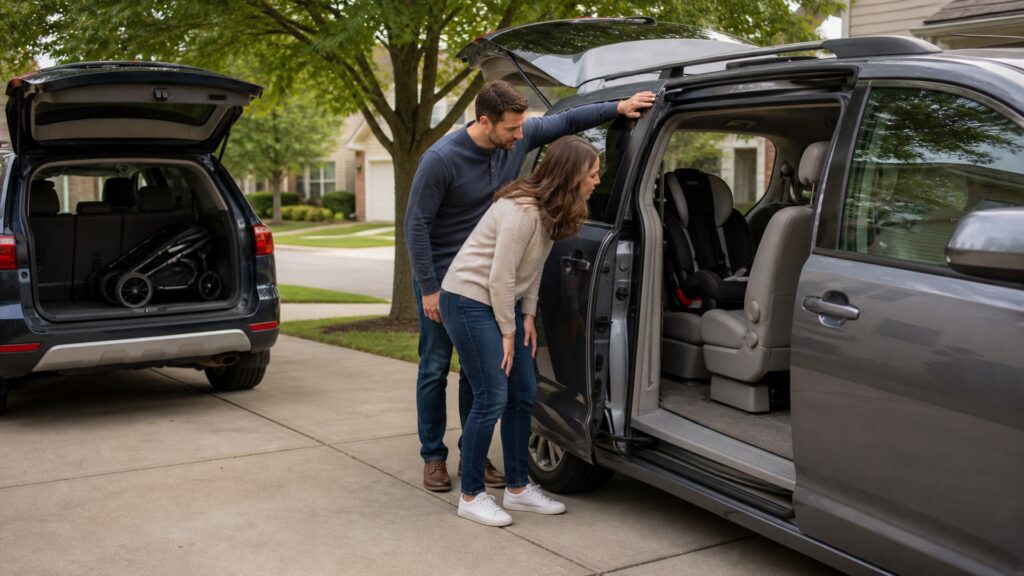
A family vehicle should be judged with every required seat installed and the cargo that travels with it. Empty-row flexibility can disappear once restraints, passengers, and daily bags occupy their real positions.
Draw the seating map: Assign each child restraint, adult, caregiver, and frequent passenger to a position, including top-tether and lower-anchor needs, before comparing cabins.
Load without folding needed seats: Place a stroller, school bags, groceries, sports equipment, and travel luggage behind the occupied rows so advertised maximum cargo figures cannot mislead.
Practice the hand movements: Buckle a child, tighten harnesses, reach the third row, close doors, and retrieve bags; awkward bending becomes a daily burden long after novelty fades.
Separate safety evidence: Review crashworthiness, front crash prevention, pedestrian detection, headlights, rear visibility, and LATCH ease because one award or star summary does not answer every family risk.
Protect the household budget: Compare financing totals, insurance, energy, tires, routine service, and expected holding period so extra capacity does not crowd out other priorities.
Who this is for
Family layouts require different solutions
The number and age of passengers change which doors, rows, and cargo spaces matter. A vehicle that works for two boosters may fail with rear-facing restraints or an adult who regularly reaches the third row.
One-child compact households: A sedan, hatchback, or small crossover may work well when the chosen restraint fits behind both front occupants and the stroller clears the cargo opening.
Multiple-restraint families: Prioritize verified three-across width or separate second-row seating, accessible top tethers, unambiguous belt routing, and enough front-seat travel after installation.
Caregiver and carpool households: Easy step-in height, wide rear doors, simple seat release, usable third-row access, and controls that occasional drivers understand can outweigh maximum cargo volume.
Road-trip families: Evaluate highway seat comfort, rear climate delivery, cabin noise, charging ports, luggage space with every passenger seated, and realistic fuel or charging stops.
What to pay attention to
Family-friendly details are physical
Trim and seating configuration matter as much as the model name. Inspect the exact second-row seat, wheel package, restraint hardware, and safety equipment you intend to buy.
Family Packaging & Access
Seat geometry, restraints, doors, row movement, cargo opening, and climate distribution govern ordinary loading.
Protection & Household Cost
Safety performance, assistance systems, payload, insurance, energy use, and maintenance shape long-term suitability.
Anchor and tether access: Lower anchors should be easy to locate and engage, while top-tether anchors need clear labels and routing that does not interfere with cargo or adjacent seating.
Rear-seat geometry: Cushion contour, belt buckle position, head restraint shape, and front-seat travel determine whether restraints sit correctly and adults remain comfortable.
Door and step-in dimensions: A broad opening helps rotate infant carriers and assist children, while a sensible sill and roof height reduce lifting and head-strike problems.
Occupied cargo area: Measure the floor, opening width, height, and space behind the final used row; confirm the liftgate can close over the actual stroller or travel load.
Climate and visibility: Rear vents, sun exposure, window line, camera coverage, and mirror views affect comfort and awareness when passengers or tall restraints block sightlines.
Load capacity: Payload must cover every occupant, accessory, and bag, which is especially important when a full cabin also carries a roof box, bikes, or hitch-mounted equipment.
Avoid these traps
Family-vehicle assumptions worth challenging
A family badge or large exterior does not guarantee accessible restraints, comfortable rows, or useful storage. Validate the configuration instead of trusting category shorthand.
Buying an unused third row: A third row can add weight, cost, and reduced cargo depth; choose it when passenger frequency justifies those tradeoffs rather than for rare hypothetical trips.
Using folded-seat cargo numbers: Maximum volume assumes seats are unavailable to people, so compare the compartment that remains behind the row your family will actually occupy.
Skipping restraint test fitting: Published anchor counts do not show buckle overlap, front-seat interference, tether routing, or hand access; install your approved seats according to both manuals before purchase.
Equating mass with complete safety: Vehicle size affects crash interactions, but families should still examine model-specific crashworthiness, crash avoidance, headlights, and restraint usability instead of relying on bulk alone.
Letting screens outrank ergonomics: Entertainment features cannot correct poor visibility, inaccessible climate controls, uncomfortable seats, or a liftgate that traps the stroller; solve physical tasks before selecting cabin technology.
Decision guidance
Choose the layout that removes daily friction
Start with the smallest vehicle that safely accommodates the occupied seating map and cargo. Move up only when a measured access, capacity, or route requirement remains unsolved.
If one row handles everyone: Compare sedans, hatchbacks, and two-row crossovers for restraint fit, front-seat clearance, cargo opening, and parking needs rather than assuming raised ride height is necessary.
If adults need frequent third-row access: Minivan sliding doors, a center aisle, or second-row mechanisms usable with restraints may be more valuable than an SUV's ground clearance or towing image.
If weather and rough access matter: A crossover or SUV may provide clearance and available all-wheel drive, but tires, visibility, stopping grip, and step-in height still need direct evaluation.
If long trips dominate: Prioritize supportive seats in every occupied row, quiet airflow, reachable storage, stable highway behavior, and luggage capacity before paying for peak power or oversized wheels.
If purchase cost is tight: A well-inspected used family vehicle with suitable restraints and strong safety performance can beat a newer cramped trim; reserve funds for immediate maintenance and tires.
Ownership & compatibility
Plan for growing passengers
Family compatibility changes as rear-facing seats become forward-facing restraints, boosters, and eventually adult-size passengers. Keep manuals and revisit the seating map at every transition.
Recheck every restraint change: Vehicle and child-seat manuals control approved positions, lower-anchor limits, tether use, and belt routing; repeat installation checks when a seat or passenger stage changes.
Budget for loaded wear: Frequent short trips, full passenger loads, roof carriers, and stop-and-go driving can accelerate tire, brake, and fluid demands, so follow the appropriate maintenance schedule.
Preserve a clean, functional cabin: Use removable liners where safe, protect vents and restraint hardware from debris, and choose cleaning methods compatible with airbags, sensors, screens, and upholstery.
Prepare for teen-driver costs: Before adding a young driver, compare insurance quotes, controls, visibility, crash-avoidance behavior, and the difficulty of maneuvering the vehicle rather than simply handing down the largest option.
FAQ
Family vehicle questions
Answer these before the household commits to a seating layout.
How many LATCH positions do I need?
Should I bring child seats to the test drive?
Is a three-row SUV better than a minivan?
How do I compare family safety ratings?
Can three child seats fit across one bench?
How much cargo space is enough?
Do families need all-wheel drive?
Which convenience features are genuinely useful?
What should families inspect on a used vehicle?
Bottom line
Make the occupied cabin the deciding test
A strong family vehicle allows correct restraint installation, comfortable access, and useful cargo space at the same time. Independent safety evidence and a sustainable household cost should confirm that physical fit, not compensate for a poor layout.
Install first: Test every required restraint in its planned position.
Load every row: Judge cargo with passengers actually seated.
Grow the plan: Anticipate changing bodies, duties, and insurance costs.
Reading Shortcuts
Jump to the part that matches your current decision.
Decision Reminders
Keep these checks beside your shortlist.
- Bring every restraint: Fit the real equipment.
- Keep seats upright: Measure occupied cargo.
- Open every door: Practice loading movements.
- Check exact ratings: Match year, trim, and lamps.
- Review payload: Count people and accessories.
- Plan the next stage: Children and duties change.
Glossary Snippets
Useful terms you may encounter while shopping.
When to Use a Top 10 Review
Use a ranked list after defining your budget, body style, and must-have equipment.
- Broaden the field: Survey credible candidates.
- See tradeoffs: Compare strengths quickly.
- Build a shortlist: Choose test-drive targets.
- Check availability: Confirm current trims.
Already down to 2–3 options? A Comparison is usually the faster next step.
When to Use a Comparison
Use a head-to-head review once two or three vehicles satisfy your nonnegotiables.
- Match configurations: Compare equivalent trims.
- Trace equipment: Locate key features.
- Price ownership: Estimate recurring costs.
- Plan the drive: Test unresolved differences.
Still exploring? Start with a Top 10 to build a shortlist first.