
Beauty Devices Buying Guide for Anti-Aging
Choosing beauty devices marketed for anti-aging for appearance-focused anti-aging device routines without age-reversal promises requires separating red LED, near-infrared light, and microcurrent instead of trusting a broad front-label promise.
This guide connects radiofrequency, treatment schedule, facial contact, and conductive gel to concrete use. It avoids medical diagnosis and unsupported efficacy guarantees.
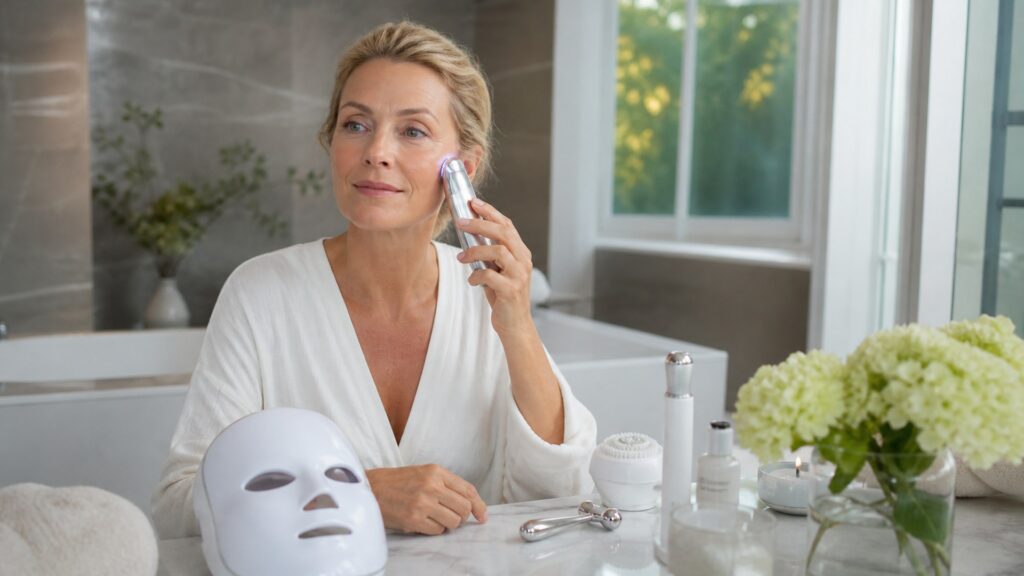
Buying framework
Set the decision around the real use
Start with red LED and near-infrared light.
Define the visible goal: Anti-aging is a marketing umbrella, so the buyer must translate it into a specific appearance goal such as temporary toning, surface texture, or visible firmness.
Distinguish mechanisms: Red-light, microcurrent, and radiofrequency devices use different mechanisms and should not be blended into one promise of reversing age.
Follow use clearances: Manufacturer directions and contraindications control session length, placement, eye clearance, and compatible skin products.
Accept schedule reality: A schedule that cannot be sustained makes even a well-built device poor value for this title angle.
Who this is for
Identify the buyer pattern
Profiles change microcurrent priorities.
The baseline builder: You want a low-contact LED routine with fixed sessions.
The targeted user: You prefer hands-on microcurrent or radiofrequency treatment and careful placement.
The frequent user: You already maintain skincare and need device compatibility with that sequence.
The cautious comparer: You compare evidence, contraindications, and ownership burden before aesthetics.
What to pay attention to
Read the characteristics that change use
Specifications connect radiofrequency to use.
Mechanism & Claim Scope
Light, current, heat, dose, contact, and the exact cosmetic claim.
Routine & Evidence Quality
Schedule, product compatibility, photography conditions, cleaning, and replacement needs.
Interpret technical claims: Wavelength or current specifications matter only when connected to the device design, dose instructions, and credible evidence for the claimed cosmetic use.
Contact and coverage: Facial fit and contact consistency influence whether masks, probes, or panels cover the intended areas evenly.
Product compatibility: Conductive gels and device-safe skincare may be required; ordinary serums are not automatically compatible substitutes.
Evaluate observations: Standardized lighting and timing are necessary before personal before-and-after impressions can be interpreted responsibly.
Reject reversal promises: No home device should be purchased on a guaranteed age-reversal or medical-treatment claim.
Avoid these traps
Avoid the attractive wrong shortcut
Shortcuts distort treatment schedule decisions.
Following the headline: Reject microcurrent as proof. Inspect eye clearance instead.
Stacking the same mechanism: Reject radiofrequency as proof. Inspect before-and-after lighting instead.
Ignoring the full routine: Reject treatment schedule as proof. Inspect replacement electrodes instead.
Buying beyond usable frequency: Reject facial contact as proof. Inspect charging stand instead.
Decision guidance
Choose the branch that fits
Choose through facial contact conditions.
If comfort is the constraint: Prioritize treatment schedule here. Defer replacement electrodes when it conflicts.
If performance is the constraint: Prioritize facial contact here. Defer charging stand when it conflicts.
If upkeep is the constraint: Prioritize conductive gel here. Defer claim evidence when it conflicts.
If the concern exceeds shopping: Prioritize eye clearance here. Defer red LED when it conflicts.
Ownership & compatibility
Plan for repeat ownership
Ownership depends on conductive gel upkeep.
Clean handling: Maintain eye clearance carefully. Recheck charging stand over time.
Storage discipline: Maintain before-and-after lighting carefully. Recheck claim evidence over time.
Replacement planning: Maintain replacement electrodes carefully. Recheck red LED over time.
FAQ
Questions before purchase
Resolve remaining eye clearance questions.
How should buyers interpret red LED?
How should buyers interpret near-infrared light?
How should buyers interpret microcurrent?
How should buyers interpret radiofrequency?
How should buyers interpret treatment schedule?
How should buyers interpret facial contact?
How should buyers interpret conductive gel?
How should buyers interpret eye clearance?
How should buyers interpret before-and-after lighting?
Bottom line
Keep the final priorities visible
Finish with before-and-after lighting evidence.
First priority: Lead with red LED. Confirm facial contact last.
Second priority: Lead with near-infrared light. Confirm conductive gel last.
Final check: Lead with microcurrent. Confirm eye clearance last.
Reading Shortcuts
Navigate appearance-focused anti-aging device routines without age-reversal promises.
Decision Reminders
Use a short final screen.
- Role: Define the visible goal.
- User: The baseline builder.
- Specification: Interpret technical claims.
- Tradeoff: Contact and coverage.
- Branch: If comfort is the constraint.
- Ownership: Clean handling.
Glossary Snippets
Key category language.
When to Use a Top 10 Review
Rank only after applying the guide filters.
- Role filter: Define the visible goal.
- Angle filter: Distinguish mechanisms.
- Format filter: Interpret technical claims.
- Use filter: Clean handling.
Already down to 2-3 options? A Comparison is usually faster.
When to Use a Comparison
Compare only equivalent finalists.
- Same job: Define the visible goal.
- Visible tradeoff: Contact and coverage.
- User match: The baseline builder.
- Ongoing burden: Storage discipline.
Still exploring? Start with a Top 10 first.