
Beauty Products Buying Guide for Long-Term Value
Long-term beauty value is not the lowest price per milliliter. A large bottle can be wasteful when the pump dispenses too much, the formula changes before it is finished, or the texture makes regular use unpleasant. A cheap foundation in the wrong undertone may never produce one successful wear.
This guide measures value through usable applications. It considers dose, frequency, shade and finish match, package durability, labeled use period, tool maintenance, refill availability, and routine overlap. The objective is not extreme frugality; it is spending on products that remain useful from the first application to the last.
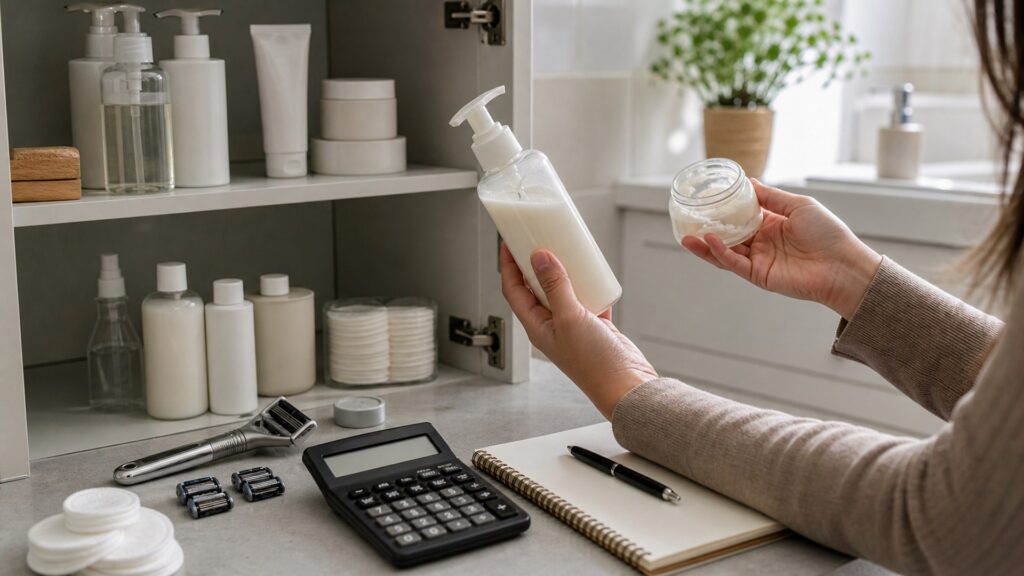
Buying framework
Measure value in successful applications
Value starts with suitability, then incorporates dose, packaging, and required accessories.
Count successful uses: A cheap wrong shade or unpleasant texture has near-zero value, while a smaller well-matched product may be finished.
Estimate dose and frequency: Compare net quantity with the amount used per application and realistic weekly use.
Inspect package protection: Pumps, tubes, compacts, and caps affect breakage, evaporation, contamination, and uncontrolled dispensing.
Price the ecosystem: Include brushes, blades, refill cartridges, sharpeners, removers, and proprietary replacements required over time.
Who this is for
Find the spending pattern
Daily consumables, occasional color, durable tools, and variety shopping create different cost patterns.
The daily finisher: You empty cleanser, lotion, shampoo, or base regularly; larger sizes can help when storage and use period remain realistic.
The occasional color user: Powder, lipstick, or glitter may last for years in theory but be discarded first; buy a finishable shade and quantity.
The tool investor: You expect brushes, dryers, or devices to last; prioritize cleanability, replaceable wear parts, cord or hinge quality, and warranty terms.
The variety shopper: Duplicate serums, palettes, and stylers divide use until none is finished. Value improves by reducing role overlap before seeking discounts.
What to pay attention to
Read the package and replacement system
These specifications determine how much formula or tool life reaches the user.
Usable Quantity & Finish Rate
How dose, frequency, shade match, and labeled use period determine what is actually consumed.
Package & Replacement System
How pumps, compacts, tools, refills, and proprietary parts affect continued use.
Dose per application: Wide openings and loose powders can waste product; metered pumps and controllable pans help produce repeatable use.
Shade and finish match: Complexion and color products deliver value only when undertone, coverage, texture, and wear are acceptable.
Package durability: Hinges, caps, pumps, seals, and compact construction protect the usable formula through repeated handling.
Refill availability: A refill system has value only when cartridges remain available, cost less meaningfully, and avoid locking the buyer into an unsuitable format.
Tool serviceability: Replaceable pads, blades, filters, or heads can extend life, but proprietary parts and difficult cleaning may increase ownership cost.
Avoid these traps
Avoid false economies
Bulk, failed applications, refill claims, and backups can make a bargain more expensive.
Buying the biggest size: Volume is wasted when the product is occasional, unstable after opening, awkward to store, or disliked before it is finished.
Ignoring failed applications: Wrong-shade foundation and messy liner cost money every time they require removal and reapplication.
Treating refills as automatic savings: Compare refill price, quantity, availability, packaging waste, and compatibility rather than trusting the word refillable.
Keeping duplicate backups: Stored products still age and occupy use opportunities; a discount is not value when several unopened substitutes already exist.
Decision guidance
Choose by finish rate and ownership burden
The right branch depends on frequency, shade sensitivity, tool ownership, or cabinet overlap.
If use is daily and predictable: Compare cost per application and consider a larger size only when dispensing, storage, and labeled use period support finishing it.
If the product is shade-sensitive: Buy the best verified match in a modest quantity; color accuracy usually outweighs bulk savings.
If the purchase is a tool: Evaluate cleaning, replacement parts, failure points, warranty, and the cost of required accessories before rewarding a low price.
If the cabinet contains overlap: Finish or remove duplicates first, then buy the single role that remains genuinely uncovered.
Ownership & compatibility
Protect what you intend to finish
Opening records, careful storage, and maintenance protect usable life.
Mark opening dates and inventory: A simple log prevents forgotten backups and clarifies real finish rates.
Protect fragile formats: Store pressed powders, glass bottles, and pump products to reduce drops, heat, moisture, and cap damage according to label directions.
Maintain reusable tools: Appropriate washing, drying, blade or head replacement, and cord inspection preserve performance and reveal when replacement is safer than continued use.
FAQ
Long-term value questions
These answers address bulk size, cost per use, refills, tools, sales, shade, concentration, replacement, and waste.
Is the largest beauty product always the best value?
How do I calculate cost per use?
Are refillable beauty products cheaper over time?
Do expensive beauty tools last longer?
Should I stock up during a sale?
How does shade matching affect value?
Is concentrated product always more economical?
When should a beauty product be replaced?
How can I reduce waste without compromising hygiene?
Bottom line
Buy what can be used well and finished
Long-term value belongs to products that fit, survive, and get used.
Value begins with suitability: A product must match shade, finish, routine role, and technique before price matters.
Measure usable applications: Dose, frequency, package protection, and finish rate reveal more than container size.
Include ownership costs: Refills, tools, maintenance, removal, and duplicate inventory belong in the final comparison.
Reading Shortcuts
Navigate long-term value across consumable beauty categories.
Decision Reminders
Keep the final screen concise.
- Role: Define count successful uses first.
- Use conditions: Model the daily finisher.
- First specification: Prioritize dose per application.
- Second specification: Check shade and finish match separately.
- Decision branch: Apply if use is daily and predictable selectively.
- After opening: Plan mark opening dates and inventory.
Glossary Snippets
Terms for dose per application.
When to Use a Top 10 Review
Rank after screening dose per application.
- Defined role: Filter by count successful uses.
- Angle fit: Require genuine long-term value across consumable beauty categories fit.
- Format filter: Screen dose per application.
- Ownership screen: Check mark opening dates and inventory.
Already down to 2-3 options? A Comparison is usually the faster next step.
When to Use a Comparison
Compare only equivalent finalists.
- Equivalent role: Match count successful uses.
- Visible tradeoff: Contrast shade and finish match.
- User match: Model the daily finisher.
- Ongoing burden: Compare protect fragile formats.
Still exploring? Start with a Top 10 to build a shortlist first.