
Beauty Products Buying Guide: How to Choose the Right Ones
A useful beauty routine is not measured by the number of bottles on a shelf. It works because each cleanser, leave-on formula, complexion product, hair treatment, or body-care step has a defined job and a format the user will apply consistently. Shopping becomes clearer once those jobs are separated.
This guide starts with routine architecture, then switches to the criteria that belong to each product type. Contact time matters for cleansers and moisturizers; shade and finish matter for makeup; application area and buildup matter for haircare; package design and usable quantity affect nearly everything. The aim is a smaller, more coherent set rather than a universal checklist forced across Beauty.
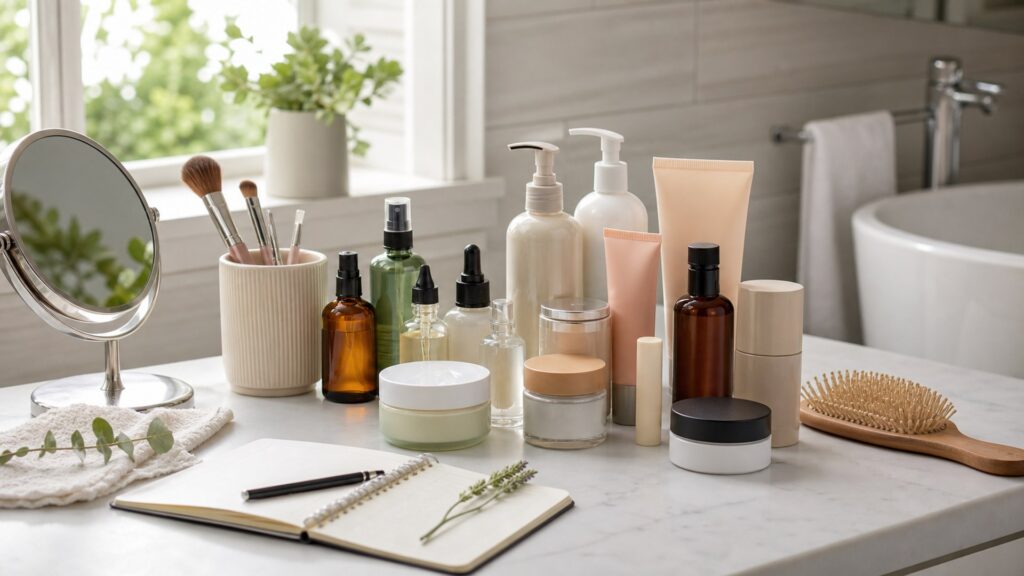
Buying framework
Map the routine before comparing formulas
A cart should answer distinct needs rather than accumulate attractive but overlapping products. Begin with where a product goes, what it does, and how long it remains there.
Assign one primary job: Name the gap first: remove sunscreen and makeup, add moisture, even complexion tone, cleanse the scalp, or soften body skin. Products with no unique job are usually duplicate spending.
Separate application areas: Facial skin, eyelids, lips, scalp, hair lengths, hands, and the rest of the body encounter different formats and use conditions. Check that the label identifies the intended area and method.
Account for contact time: A rinse-off wash has a brief role; a moisturizer, foundation, styling cream, or fragrance remains for hours. Residue, finish, scent, and tolerance deserve more weight as contact becomes longer.
Design the sequence: Picture the actual order of application. A dense oil under a water-based complexion product, several sticky leave-ons, or multiple rich hair stylers may create slip, pilling, shine, or buildup even when each item is acceptable alone.
Who this is for
Identify the cabinet you are really building
Different beauty shoppers need different forms of discipline. The useful profile is based on where time and product complexity concentrate, not on an aspirational label.
The deliberate minimalist: You want a repeatable cleanser, moisturizer, basic hair wash, body cleanser, and a small color edit. Favor versatile finishes, reliable pumps or tubes, and package sizes that will be emptied before curiosity replaces them.
The complexion-focused shopper: Most decisions involve primer, base, concealer, powder, blush, or setting products. Undertone, coverage, oxidation during wear, compatibility between layers, and hygienic applicators matter more than adding another skincare-adjacent claim.
The hair-and-scalp planner: Your routine changes with wash frequency, scalp needs, curl pattern, chemical services, or heat styling. Distinguish scalp-applied cleansers and treatments from conditioners and stylers intended mainly for mid-lengths and ends.
The category explorer: You enjoy skincare, makeup, haircare, body care, and tools. Use a written inventory and add only one unfamiliar variable at a time, so finish problems, sensitivity, or redundant roles can be traced instead of guessed.
What to pay attention to
Read characteristics in the context of the product
The same word can signal different consequences across Beauty. A rich finish may be desirable in a night cream, cumbersome in a scalp serum, and deliberately luminous in makeup.
Formula, Format & Contact
Judge gels, creams, oils, powders, sticks, and sprays by application area, spread, contact time, and the finish left behind.
Packaging, Match & Routine Fit
Consider dispensing control, air and finger exposure, shade matching, usable quantity, and how the product sits beside existing steps.
Vehicle and spread: Fluid serums cover a small facial area with little product, thick butters need warming and pressure, powders require controlled pickup, and sprays trade precision for speed. Match the vehicle to the area and application habit.
Finish and residue: Matte, satin, dewy, tacky, glossy, or powdery results are not abstract marketing language when they affect makeup wear, hair movement, clothing contact, or willingness to reapply.
Shade behavior: For complexion products, compare depth and undertone in relevant light and allow the formula to settle before deciding. Coverage level and finish can change how forgiving a near match appears.
Dispenser design: A pump can meter lotion cleanly, a squeeze tube helps control thicker products, and a jar permits direct access but repeated finger contact. Droppers should dispense without touching skin or hair.
Net quantity in context: Compare the amount used per application and likely frequency, not package size alone. A daily body lotion and an occasional highlighter can have radically different sensible quantities.
Avoid these traps
Common ways a beauty cart loses coherence
Most disappointing cabinets are not caused by one obviously bad product. They develop when the buyer compares unlike categories by one rule or keeps purchasing new versions of an already-filled role.
Using one quality signal everywhere: Ingredient count, fragrance, natural positioning, prestige packaging, or price cannot judge cleanser, foundation, shampoo, and body lotion equally. Define what successful use looks like for that exact product first.
Buying several solutions for one step: Three hydrating leave-ons or multiple smoothing stylers may compete for the same place in the sequence. Choose one, observe the result, and identify a new unmet need before expanding.
Ignoring the delivery system: A good formula in an awkward dropper, oversized jar, messy loose powder, or uncontrollable spray can be difficult to dose and keep tidy. Packaging is part of use, not merely decoration.
Treating volume as value: Large sizes help only when the product is used frequently and stored as directed. Occasional color cosmetics, unstable formulas, or products that require clean repeated access may be better in a finishable size.
Decision guidance
Choose according to the gap, then the category
Once the missing role is clear, the following branches keep broad Beauty shopping from collapsing into generic advice.
If the gap is cleansing: Select for the application area, what must be removed, and rinse behavior. Facial makeup removal, scalp oil and styling residue, and daily body washing are separate jobs; one cleanser need not perform all three.
If the gap is a leave-on step: Prioritize comfortable contact, controllable dosing, and a finish compatible with the next layer or with clothing and hair. Introduce the product without simultaneously changing several neighboring steps.
If the gap is visual color or coverage: Test shade depth, undertone, coverage, and finish before ingredient storytelling or package aesthetics. Then check how the base, concealer, powder, and cheek products behave together rather than in isolation.
If the cabinet already feels crowded: Pause purchasing and sort by application area and primary job. Empty, replace, or remove overlaps before searching for an additional product; organization often reveals that the need is technique, not another formula.
Ownership & compatibility
Keep the routine usable after opening
Beauty products are handled repeatedly in warm bathrooms, at vanities, and around water. Simple hygiene and storage habits protect the value of a carefully chosen set.
Mark the opening date: Where a product provides period-after-opening or expiration information, record when it entered use and follow the label. Do not rely on memory across similar jars, tubes, and compacts.
Control repeated contact: Wash and fully dry reusable brushes, sponges, scoops, and tools as appropriate for their materials. Avoid touching dropper tips to skin, and use clean hands or a clean implement with open jars.
Respect the package and storage directions: Close caps and pumps promptly, keep water out of containers, and follow any printed temperature or light guidance. A display location is not useful when it exposes a formula to conditions the label says to avoid.
FAQ
Questions that cross beauty categories
These answers address routine-building choices that remain after individual product roles have been separated.
How many beauty products does a complete routine need?
Should every product in a routine come from the same brand?
Is a shorter ingredient list always better?
How can I tell whether two products are redundant?
Does expensive packaging mean the formula is better protected?
What is the best way to test a new routine combination?
How should I compare package sizes?
Can one texture preference guide every beauty purchase?
When should I stop troubleshooting products and seek professional help?
Bottom line
Build by function, not by shelf space
The right Beauty purchases form a sequence of distinct jobs. Compare each category with its own vocabulary, then keep only formats and quantities that fit real use.
First priority: Identify the application area and one primary job before looking at claims, price, or packaging.
Second priority: Match vehicle, contact time, finish, shade behavior, and dispenser to how the item will actually be applied.
Final filter: Choose a finishable quantity, introduce one variable at a time, and maintain hygienic storage after opening.
Reading Shortcuts
Use these jumps to move from routine design to concrete product checks.
Decision Reminders
Keep these distinctions visible while comparing a cart or cabinet.
- Area first: Face, scalp, hair lengths, lips, and body are not interchangeable.
- Contact matters: Give longer-wear formulas more scrutiny for finish and tolerance.
- Shade is a specification: Depth, undertone, coverage, and settling belong in the decision.
- Packages change use: Dose control and repeated contact affect daily practicality.
- Quantity is contextual: Judge size by applications and frequency, not visual bulk.
- One change at a time: Keep neighboring steps stable while evaluating a new addition.
Glossary Snippets
Useful label language for comparing products across beauty categories.
When to Use a Top 10 Review
A ranked list is most useful after the guide has narrowed the product role and format.
- Use it after defining the role: Rankings are clearer once you know the missing routine job.
- Filter by the right category criteria: A makeup list needs different checks from a cleanser or styler list.
- Confirm the format: Remove picks whose vehicle, finish, or dispenser conflicts with use.
- Shortlist a finishable size: Avoid rewarding oversized packaging automatically.
Already down to 2–3 options? A Comparison is usually the faster next step.
When to Use a Comparison
Use a head-to-head when two products claim the same routine role but differ in formula, finish, or packaging.
- Compare equal jobs: Put two products head-to-head only when they occupy the same routine role.
- Normalize quantity: Look beyond package shape to usable amount and expected applications.
- Contrast finish and delivery: Decide which texture and dispenser better match the sequence.
- Break ties with ownership: Storage, applicator cleaning, and realistic replacement can decide close options.
Still exploring? Start with a Top 10 to build a shortlist first.