
Body Fragrance Buying Guide: How to Choose the Right One
The right body fragrance is not simply the scent that impresses during its first minute on a blotter. A useful choice still feels appropriate after the opening fades, at the distance other people experience it, and during the settings where it will actually be worn.
Test one candidate at a time on clean skin when appropriate, then observe opening, heart, dry-down, projection, comfort, clothing interaction, and longevity without repeatedly smelling the application point. Concentration labels provide context, but formula and dose shape real performance.
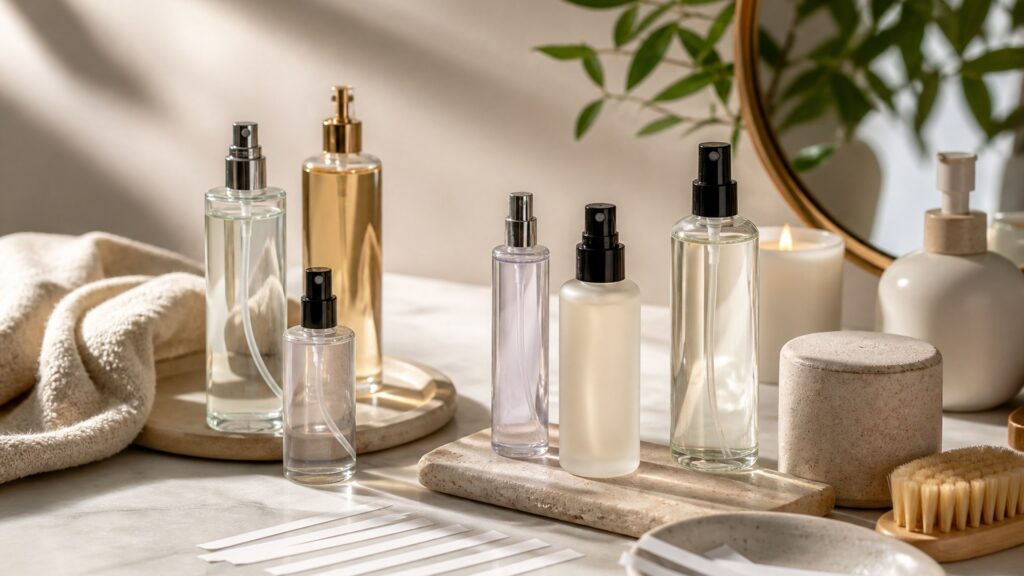
Selection framework
Define the wearing situation before the note list
Setting, desired presence, climate, schedule, and sensitivity establish a more useful brief than a favorite ingredient alone.
Describe the atmosphere: Choose a few concrete words—quiet, crisp, warm, airy, formal, playful—and connect them to places and times rather than marketing families.
Set a projection boundary: Decide whether the scent should remain close, be noticeable at conversation distance, or announce itself more broadly. Shared spaces usually reward restraint.
Plan a complete trial: Sample on paper for initial screening, then on skin if suitable. Wear the finalist through its full dry-down before comparing bottles.
Wearer profiles
Match fragrance behavior to the person wearing it
Application habits, schedule, sensory tolerance, and willingness to reapply affect which formula becomes practical.
The subtle wearer: Prioritize a comfortable close scent and a controllable sprayer. A smaller bottle may prevent accidental overapplication and preserve freshness.
The long-day wearer: Observe how the fragrance changes after commuting, indoor work, meals, and weather transitions rather than demanding only maximum duration.
The fragrance explorer: Discovery sizes and decants allow several full wears. Delay a large bottle until novelty gives way to repeated voluntary use.
What to examine
Treat labels as clues, not performance promises
Concentration, note pyramids, and bottle size help organize testing but cannot replace wearing the formula.
What paper reveals
A blotter helps screen the opening and compare candidates without covering the skin, but it does not reproduce body heat, skin chemistry, or clothing contact.
What skin reveals
A full wear exposes development, comfort, projection, longevity, and whether the scent remains appealing after the most attention-grabbing opening notes disappear.
Concentration context: Parfum, eau de parfum, eau de toilette, and mist labels suggest formulation style, yet two products with the same label may project and last differently.
Sprayer output: A fine consistent mist supports controlled dosing. Test whether the cap, atomizer, and bottle shape remain manageable with the intended number of sprays.
Package size: Compare cost per milliliter with realistic use, shelf life after opening, storage conditions, and travel needs instead of assuming the largest bottle is best value.
Testing mistakes
Avoid judging an entire fragrance in the first spray
Crowded counters, fatigued smell perception, and rushed decisions distort comparison.
Testing too many: Limit the number smelled in one session, use separate labeled blotters, step into neutral air, and revisit later instead of forcing a winner.
Chasing maximum strength: More projection and duration are not automatically better. An overpowering fragrance may conflict with work, transit, dining, or scent-sensitive company.
Buying for one note: A listed note may be brief, abstract, or interpreted differently within the blend. Evaluate the complete development rather than a familiar word.
Purchase decision
Choose the bottle only after repeat wear
A fragrance earns a place when its full arc, dose, setting, and price remain satisfying beyond the sample’s novelty.
Choose a sample: Start here when the formula is new, expensive, seasonally uncertain, or difficult to test locally. Several normal wears produce better evidence.
Choose a smaller bottle: This suits rotation, travel, changing tastes, and fragrances used only for particular settings. Lower volume can be better value when it gets finished.
Choose a full bottle: Buy larger only after repeated comfortable wears, a stable application plan, suitable storage, and confidence that the scent will be reached for regularly.
Wear and storage
Control dose and protect the formula
Application, heat, light, air exposure, and surrounding people all influence long-term satisfaction.
Apply deliberately: Begin with fewer sprays than expected, especially in enclosed spaces. Add only after learning projection and duration under normal conditions.
Watch skin response: Stop use if irritation or other concerning symptoms occur, and follow product labeling. Avoid applying to broken or freshly irritated skin.
Store consistently: Keep the bottle upright, closed, and away from direct sunlight and major temperature swings. Inspect changes in odor, color, leakage, or atomizer function.
FAQ
Body-fragrance buying questions
These answers focus on complete wear, controlled projection, and sensible bottle selection.
How should I test a body fragrance before buying?
Does a higher fragrance concentration always last longer?
What bottle size offers the best value?
Final check
Choose the fragrance you enjoy after the opening
The strongest evidence is a comfortable full wear repeated in the life the bottle is meant to join.
Revisit the dry-down: Smell the skin or clothing later at a normal distance and decide whether the remaining character still feels intentional and pleasant.
Check the setting: Confirm that the chosen dose respects workplaces, transit, meals, close seating, and scent-sensitive people who may share the space.
Check the volume: Select the smallest bottle that supports realistic use, then store it correctly and record the spray count that works.
Reading Shortcuts
Move directly to the general selection decision stage you need.
Decision Reminders
Keep the evidence for general selection visible while comparing.
- Role: The body fragrance serves the named task.
- Proof: The trial observes comfortable projection, stable dry-down, suitable longevity, and no skin irritation.
- Care: Store the bottle upright away from heat, sunlight, and humid bathroom air.
Glossary Snippets
Useful language for comparing body fragrances.
When a Top 10 List Helps
Use rankings to discover credible body fragrances, then screen them for general selection.
- The format is undecided: A broad list reveals plausible forms and price levels.
- A shortlist is needed: Rankings narrow discovery but do not replace fit testing.
Have finalists already? Open the comparison section.
When a Direct Comparison Helps
Compare finalists after establishing their suitability for general selection.
- Two candidates remain: Side-by-side evidence exposes meaningful tradeoffs.
- An upgrade is uncertain: Compare whether added cost corrects the original weakness.
Still exploring? Start with the Top 10 section.