Box vs M-Files: Which Cloud Document Management System Is Better?

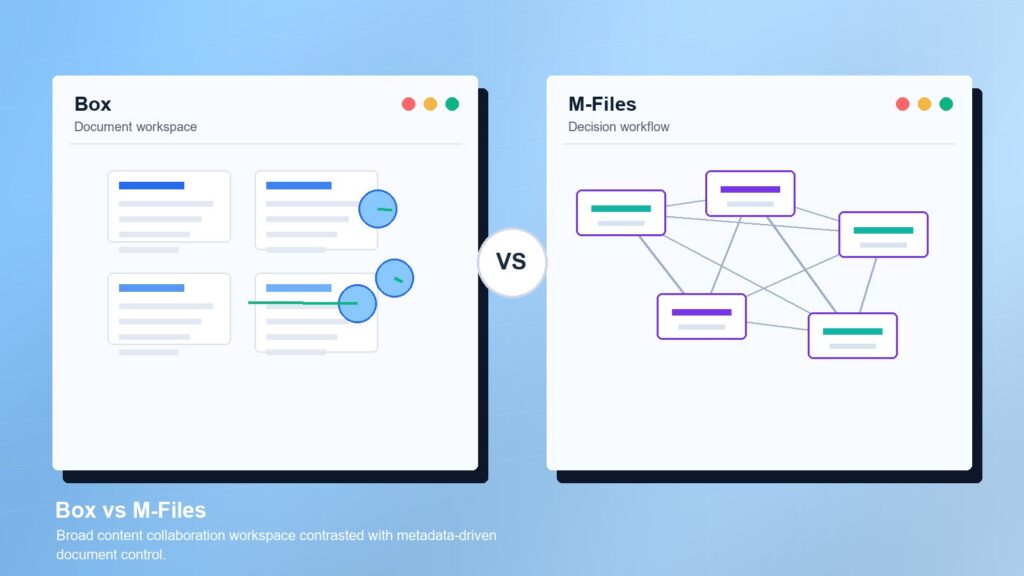
Box and M-Files overlap in cloud document management, but they push buyers toward different habits. Box is a broad content-collaboration workspace for teams, clients, apps, and governed sharing. M-Files is stronger when metadata, document context, retrieval, workflow routing, and information governance decide whether users can trust the system.

By: Review Streets Research Lab
Updated: September 8, 2026
Approx. 10-12 min read
Box vs M-Files business comparison image

Head-to-head

Box vs M-Files: Which Cloud Document Management System Is Better?

M-Files is the stronger choice when metadata and document context matter most. Box remains better for broad collaboration and external content workflows.

Box comparison image

Box

Box is stronger when the organization wants governed external sharing, app-connected content workflows, granular permissions, retention planning, and a broad cloud workspace for business documents.

Score 8.7/10 Best for secure cloud content collaboration Focus Collaboration Why buy Fit
  • Strong governed external collaboration
  • Good workflow and integration reach
  • Broad fit for shared content operations
VS
M-Files comparison image

M-Files

M-Files is stronger when the organization wants metadata-led document control, search, workflow routing, information governance, version discipline, and easier retrieval across content locations.

Score 8.8/10 Best for metadata-driven information management Focus Metadata Why buy Fit
  • Strong metadata-driven document control
  • Good search and workflow routing
  • Useful for knowledge-heavy teams
Metric
Box
M-Files
Winner
Governance
Policy-rich collaboration
Metadata-driven control
M-Files
Workflow
App-connected approvals
Smart workflow routing
M-Files
Search
Content workspace search
Strong metadata search
M-Files
Sharing
Strong external sharing
Permission-aware sharing
Box
Adoption
Needs workspace rules
Needs metadata model
Box
Best fit
Broad content collaboration
Intelligent document control
M-Files
Real-world context
M-Files wins when users need to find and govern documents by what they are, not only where they sit. Box remains a strong choice when collaboration breadth and external sharing drive the project.

Why people choose it

  • Strong governed external collaboration
  • Good workflow and integration reach
  • Broad fit for shared content operations

Why people choose it

  • Strong metadata-driven document control
  • Good search and workflow routing
  • Useful for knowledge-heavy teams
Winner: M-Files M-Files wins for Cloud Document Management Systems buyers who prioritize metadata-driven control, retrieval, and information governance. Box is the better default when broad content collaboration matters more.
Read FAQs

Deep dive

What actually matters in this matchup

This matchup is about where document order should come from. We weighted metadata, search, governance, workflow routing, external collaboration, permissions, user adoption, migration cleanup, and whether the buyer needs a content hub or an information-management layer. That keeps the choice practical.

Information model: M-Files is stronger when documents need context such as customer, project, document type, status, or owner. Box is easier to understand as a shared content workspace, but folders alone may not solve retrieval problems. That keeps the choice practical. That matters during rollout.

Collaboration reach: Box has the advantage when many people need a place to co-manage active content with clients, vendors, and internal teams. M-Files can support collaboration, but its biggest value comes from making information easier to classify. That keeps the choice practical.

Search quality: M-Files pulls ahead when search depends on metadata and relationships rather than folder names. Box search can work well in a clean content workspace, but the system still relies heavily on disciplined organization and permissions. That keeps the choice practical.

Governance behavior: Both platforms can support governance, but M-Files has the stronger case when classification and document context drive policy. Box remains compelling when governance is tied to broad collaboration, external sharing, and app-connected content workflows. That keeps the choice practical. That matters during rollout.

Rollout risk: M-Files requires careful metadata design so users trust the model. Box requires clear workspace, sharing, and retention rules. Buyers should demo with messy real files, not polished sample folders, before choosing either system. That keeps the choice practical. That matters during rollout.

Final choice: Choose M-Files when document value depends on metadata, search, workflow routing, and context. Choose Box when the organization mainly needs a secure cloud content hub for collaboration, external sharing, and integrated document work. That keeps the choice practical. That matters during rollout.

Methodology

How we evaluated the matchup

This review weighs document-management fit against practical adoption, governance, workflow, and migration realities.

Scope: We evaluated Box and M-Files as cloud document management options for buyers deciding between broad content collaboration and metadata-driven information management. Scores use official product information and workflow analysis. That keeps the choice practical. That matters during rollout. That keeps the buying decision grounded.
What we compared: The review weighs metadata design, search behavior, workflow routing, permission control, external collaboration, retention planning, integrations, governance needs, migration cleanup, administrator ownership, and whether users need documents organized by folder or context. That keeps the choice practical.

Interpretation: M-Files wins because metadata-led organization can solve retrieval and governance problems that folders leave behind. Box stays strong when active collaboration and external sharing are more important than metadata structure. That keeps the choice practical. That matters during rollout.
Buyer checks: Before choosing, verify current plans, metadata tools, workflow options, search behavior, external-sharing rules, permission controls, integrations, migration support, retention requirements, administrator workload, and how users will classify documents after launch. That keeps the choice practical. That matters during rollout.

FAQ

Box vs M-Files: common questions

Is Box better than M-Files?
Box is better when the buyer needs broad cloud content collaboration, secure sharing, app integrations, and a familiar content workspace. M-Files is better when metadata, search, document context, workflow routing, and governance lead the decision. That keeps the choice practical. That matters during rollout.
Where does M-Files beat Box?
M-Files beats Box when documents must be found and governed by context instead of folder location. Metadata, classifications, relationships, and information-management discipline are the clearest reasons to put M-Files ahead. That keeps the choice practical. That matters during rollout. That keeps the buying decision grounded.
Which is better for collaboration?
Box is usually better for broad collaboration across departments, clients, vendors, and app-connected workflows. M-Files can support collaboration, but its strongest advantage is organizing information so people can retrieve and govern it. That keeps the choice practical. That matters during rollout. That keeps the buying decision grounded.
Which is better for search?
M-Files is better when search depends on metadata, relationships, and document context. Box can search content well, but buyers should test whether folders, permissions, and naming rules are enough for their needs. That keeps the choice practical. That matters during rollout. That keeps the buying decision grounded.
Which platform needs more setup planning?
M-Files needs careful metadata and governance planning. Box needs workspace, permission, and external-sharing rules. The bigger setup risk depends on whether the company struggles more with classification or collaboration sprawl. That keeps the choice practical. That matters during rollout. That keeps the buying decision grounded.
Can small teams use M-Files?
Yes, small teams can use M-Files when documents are knowledge-heavy and retrieval matters. A simple team that mainly needs shared folders and external links may find Box easier to justify. That keeps the choice practical. That matters during rollout. That keeps the buying decision grounded.
What should buyers demo first?
Use messy real documents, duplicate names, one external collaborator, one approval route, and one search-by-context scenario. The better platform should make the correct document easier to find and govern. That keeps the choice practical. That matters during rollout. That keeps the buying decision grounded.
Is this review based on hands-on testing?
No. This review uses official product information, public documentation, and document-management workflow analysis. Buyers should confirm current pricing, plan limits, integrations, security features, implementation support, and contract terms with each vendor. That keeps the choice practical. That matters during rollout. That keeps the buying decision grounded.

Key Takeaways

  • M-Files wins on metadata control.
  • Box wins broad collaboration moments.
  • Search needs real test files.
  • Folders alone can break down.
  • Metadata design needs ownership.
  • Choose context or workspace breadth.

Verdict

The Better Default for Metadata-Driven Control

M-Files is the stronger default when documents need context, smarter retrieval, workflow routing, and information governance.

#1 Winner

M-Files

M-Files wins because metadata-driven document control answers retrieval and governance problems that simple folder structures often leave unresolved.

  • Stronger metadata model
  • Better context-driven search
  • Good workflow and governance fit

Runner-up

Jump to the Head-to-Head

Tip: Ask users to find the right file without knowing its folder. If context wins that test, M-Files deserves the lead.

Where to Buy

Use the official Box and M-Files pages to confirm current plans, demos, security details, and implementation options.

Vendor terms, demos, pricing, and feature availability change regularly. Some links may earn a commission and never affect rankings.

Accessories You’ll Want

  • Metadata model draft (defines document type, customer, project, status, owner, and retention fields)
  • Search test folder (uses messy real files to evaluate retrieval before migration)
  • External sharing policy (keeps collaboration rules visible while testing Box-style workflows)
  • Classification owner list (names who maintains metadata after launch)
  • Workflow route map (connects approval steps to metadata and document status)

Tip: Use the same sample documents in every demo so differences in workflow, search, permissions, and cleanup are easy to see.