
Brake Components Buying Guide for Aftermarket Part Selection
Aftermarket brake parts range from traceable OE-equivalent service lines to poorly documented marketplace kits. Price tier, ceramic wording, coating color, or drilled appearance does not prove fit, behavior, completeness, or support.
Verify the brake package first, then compare documented construction, included hardware, instructions, seller and manufacturer identity, warranty, and complete installed cost. Inspect everything before disabling the vehicle and keep evidence until the repair is verified.
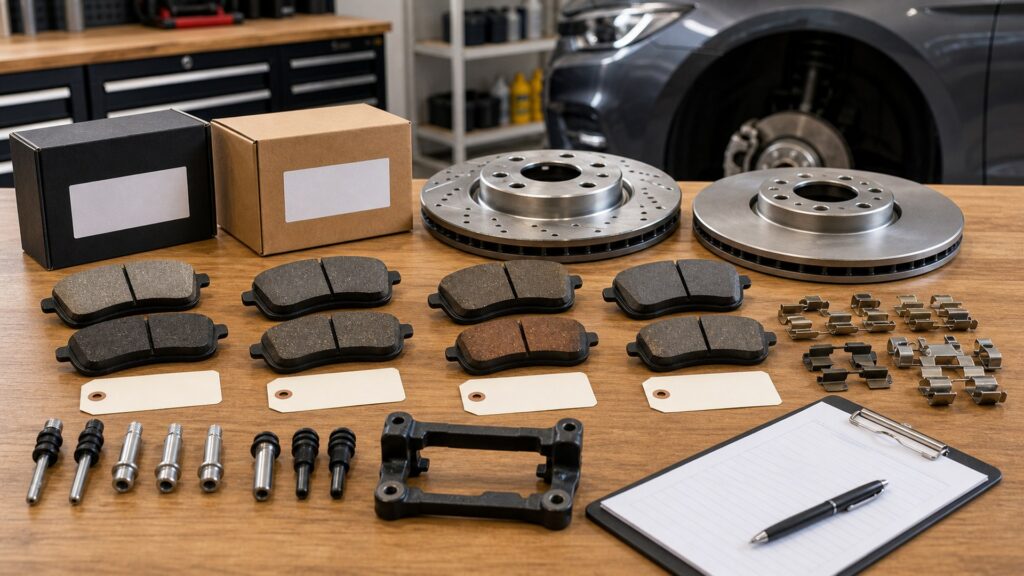
Buying framework
Compare traceable parts for one verified application
Aftermarket brake quality cannot be reduced to economy, premium, ceramic, or drilled. First prove the application, then compare construction, kit content, instructions, supplier support, and the complete installed system.
Lock the application: Use VIN, build or brake code, axle, side, original parts, dimensions, sensors, parking brake, caliper and hose interfaces. Record every catalogue qualifier so price comparisons do not mix different brake packages.
Define the operating target: Describe commuting, cold starts, towing, mountains, corrosion, dust sensitivity, noise expectations, wheel finish, storage, and legal or warranty constraints. Avoid selecting track or heavy-duty marketing for a use the supplier does not support.
Evaluate product evidence: Compare published dimensions, material or compound family, rotor construction, coating, hardware, certification where relevant, traceable manufacturer and seller, installation instructions, technical support, warranty, and return policy. Treat unsupported claims as advertising.
Compare complete kit content: List pads or shoes, rotors or drums, clips, shims, springs, sensors, fasteners, seals, lubricant instructions, calipers, hoses, and fluid. A cheap kit can become expensive after separate hardware, shipping, cores, and repeated labor.
Plan verification and recourse: Inspect packaging, labels, lot or serial marks, finish, machining, casting, hardware, and dimensions before installation. Preserve receipts and boxes until fit, pedal, leaks, warnings, road test, and bedding are confirmed.
Who this is for
Aftermarket priorities depend on the use and support risk
A daily commuter, corrosion-region owner, tow vehicle, budget repair, and enthusiast should not rank the same features.
Daily commuters: Prioritize verified fit, consistent cold response, predictable modulation, manageable noise and dust, corrosion-resistant hardware, local availability, and support. A documented mid-tier line may be a better choice than an unfamiliar kit with ambitious performance claims.
Rust-belt and coastal owners: Look for suitable non-friction coatings, protected hardware, serviceable bleeders, intact boots, and clear corrosion-preparation instructions. Coating does not correct a scaled hub, seized slide, damaged shield, line corrosion, or contaminated friction surface.
Towing and mountain users: Use parts explicitly supported for the exact vehicle and duty, with compatible friction and heat behavior, rotors or drums within specification, correct fluid, and complete inspection. Marketing cannot increase vehicle ratings or replace downshift and trailer-brake planning.
Price-sensitive older-vehicle repairs: Protect fitment, safety, traceability, and complete scope before trimming brand or finish features. Compare installed cost and downtime; a low-price caliper without bracket or a pad set without sensors can create a second order.
Performance-oriented street drivers: Compare supported temperature range, cold response, noise, dust, rotor wear, pedal behavior, bedding, wheel clearance, and legal road use. Avoid mixing compounds on an axle or assuming drilled appearance proves heat capacity or shorter stopping.
What to pay attention to
Evidence behind the aftermarket label
Useful product data describe what fits, what is included, how it is installed, and who supports it.
Product & Application
Catalogue qualifiers, geometry, friction, rotor or drum construction, caliper supply, hardware, sensors, and traceability.
Support & Total Cost
Instructions, certification, seller, returns, warranty, cores, labor, consumables, verification, and downtime.
Catalogue application detail: Prefer listings with VIN or code qualifiers, production breaks, axle and side, rotor or drum dimensions, pad or shoe shape, caliper and hose interfaces, sensor, parking brake, and original-number cross references. Verify against the vehicle.
Friction material and geometry: Review supported use, compound family, backing plate, shims, slots, chamfers, scorching or molding claims only where documented, wear indicators, and nominal thickness. Material names alone do not establish noise, dust, wear, or stopping outcomes.
Rotor or drum construction: Compare correct dimensions, mass where published, vane or solid design, directionality, balance, casting traceability, machining, coating location, parking-brake surface, minimum thickness or discard diameter, and installation or bedding instructions.
Caliper supply and remanufacturing: Determine new versus remanufactured, included bracket, piston and seal materials, slides, boots, bleeder, parking mechanism, coating, core condition rules, bench or pressure testing claims, warranty, and the process for a defective unit.
Hardware and sensor completeness: Count clips, springs, pins, shims, sensors, caps, seals, washers, bolts, and lubricants. Confirm which included items actually apply to the vehicle and which one-time or vehicle-specific pieces must come from another source.
Traceability and seller support: Look for identifiable manufacturer, part and lot data, technical documents, authorized distribution where represented, seller identity, stocked replacements, fitment help, return window, shipping damage process, and clear counterfeit or marketplace risk controls.
Warranty and installed cost: Read duration, wear, corrosion, commercial use, installation, proof, return, labor, shipping, and core terms. Add hardware, fluids, tools, machining, labor, calibration, downtime, and possible repeat installation to the purchase price.
Avoid these traps
Aftermarket shortcuts that confuse price tier with suitability
A polished box and broad fitment list do not prove exact interfaces, complete hardware, or supported behavior.
Buying from a generic compatibility banner: Marketplace fit labels may omit brake code, production date, axle, sensor, or parking-brake variation. Cross-check manufacturer catalogue data, original components, and dimensions; resolve conflicts before opening installation packaging.
Assuming ceramic means premium: Compound labels cover broad formulations and do not guarantee cold response, low noise, low dust, long life, or rotor friendliness. Evaluate the exact line's documented application and intended use instead of ranking one material word.
Choosing drilled or slotted rotors by appearance: Surface features can change noise, wear, crack sensitivity, and bedding and may not suit every road use. Use a traceable application supported by the maker; styling does not prove thermal capacity or shorter stops.
Ignoring what the kit omits: Missing clips, sensors, shims, fasteners, bracket, hose washers, or drum hardware can halt the repair or encourage unsafe reuse. Build a line-by-line parts list before comparing totals.
Treating warranty length as quality proof: A long term may exclude wear, corrosion, noise, labor, commercial use, shipping, or improper installation. Read claim requirements and supplier support, then judge product evidence and installed outcome separately.
Decision guidance
Choose the most supportable complete option
The best aftermarket selection fits the exact system, documents its construction, includes the required scope, and has credible recourse.
If two pad sets fit and differ mainly by line: Compare intended use, compound documentation, shims, slots, chamfers, sensor provisions, hardware, bedding, noise or dust expectations, warranty, availability, and seller support. Do not infer rank from price alone.
If corrosion is the main ownership problem: Favor documented coatings and new service hardware while budgeting hub and bracket preparation, shields, lines, boots, parking components, and suitable lubricant. Coated rotors cannot protect a neglected caliper or hydraulic system.
If a remanufactured caliper is considered: Inspect supplier reputation, core eligibility, bracket inclusion, piston, boots, slides, bleeder, finish, testing, warranty, and exchange speed. Compare a new caliper's total cost when a poor core could create delay or repeat bleeding.
If the cheapest complete kit is attractive: Verify that every component is traceable, correctly applied, dimensionally supported, and supplied with instructions and recourse. Price missing sensors, hardware, shipping, tools, labor, bedding, and failure downtime before declaring savings.
If performance claims drive the choice: Ask for the supported road application and relevant test or technical documentation. Confirm cold and wet behavior, noise, dust, rotor wear, legal use, wheel clearance, fluid, tires, and bedding; reject unverifiable stopping-distance promises.
Ownership & compatibility
Preserve evidence until the repair proves itself
Packaging, lot data, measurements, and installation records make returns and future diagnosis possible.
Inspect before disassembly: Compare received parts with catalogue data and original components, including dimensions, sensor, hardware, side, finish, damage, and package quantity. Resolve errors while the vehicle remains usable and return eligibility is strongest.
Record the installed system: Save manufacturer, line, part number, lot or serial, seller, axle and side, included hardware, fluid, torque source, technician, date, mileage, measurements, road test, bedding instructions, and photographs.
Follow the claim process: Contact the seller or manufacturer before machining, modifying, discarding, or returning a suspected defective part. Keep proof of purchase, packaging, measurements, fault evidence, installation record, maintenance, and authorization.
Evaluate actual behavior: After prescribed bedding, track noise, dust, pedal consistency, wear, rotor condition, corrosion, heat, and mileage under the real duty cycle. Use the result for the next purchase without generalizing one line to an entire brand.
FAQ
Aftermarket brake-part FAQ
Answers about compounds, coated rotors, kits, remanufactured calipers, sellers, warranties, and quality evidence.
Are aftermarket brake parts as good as original equipment?
Do ceramic brake pads always make less noise and dust?
Are coated rotors worth buying?
Should I buy a complete brake kit?
Are remanufactured calipers reliable?
How can I avoid counterfeit brake parts?
Do premium rotors shorten stopping distance?
What should an aftermarket brake warranty cover?
What records should I keep for aftermarket parts?
Bottom line
Buy documented fit and support
Aftermarket value comes from exact application, credible construction evidence, complete kit content, proper installation, and recourse—not a tier name.
Prove the application: Match VIN, codes, original parts, dimensions, sensors, axle, and side.
Compare evidence: Review compound, construction, traceability, instructions, and support.
Price the complete repair: Include hardware, fluid, cores, tools, labor, testing, and downtime.
Preserve recourse: Inspect early and save packaging, lots, receipts, measurements, and records.
Reading Shortcuts
Confirm measurements before ordering.
Decision Reminders
Checks to complete before committing.
- Confirm application: Cross-check vehicle and installed-system evidence.
- Diagnose first: Let abnormal wear guide inspection.
- Keep axle consistency: Use the specified paired-service scope.
- Follow procedures: Respect torque, fluid, electronics, and bedding.
- Protect friction: Prevent unsuitable chemical or fluid contact.
- Verify release: Confirm pedal, leaks, warnings, and operation.
Glossary Snippets
Terms used in this decision.
When to Use a Top 10 Review
Use rankings after fitment and repair scope are documented.
- Fitment confirmed: Filter with codes and measurements.
- Scope identified: Compare the complete required repair.
- Evidence visible: Rank construction, hardware, and support.
- Procedure covered: Include tools, fluid, testing, and records.
Already down to 2–3 options? A Comparison is usually faster.
When to Use a Comparison
Compare finalists for the same verified application.
- Application data: Match each dimension and interface.
- Included content: List hardware, sensors, and companion parts.
- Service evidence: Review instructions, traceability, and warranty.
- Installed outcome: Price labor, consumables, testing, and downtime.
Still building a shortlist? Start with a Top 10.