
Brake Components Buying Guide for High-Mileage Vehicle Repairs
High mileage does not explain every worn brake part. Uneven pads, repeat pulsation, heat, pull, leaks, or a sticking parking brake can reveal accumulated faults in slides, pistons, hoses, lines, hubs, bearings, hardware, or prior work.
Inspect and measure the whole system, then separate required safety work from supported preventive and deferred items. Plan corrosion contingencies and downtime before disassembly, and turn the completed repair into a documented baseline.
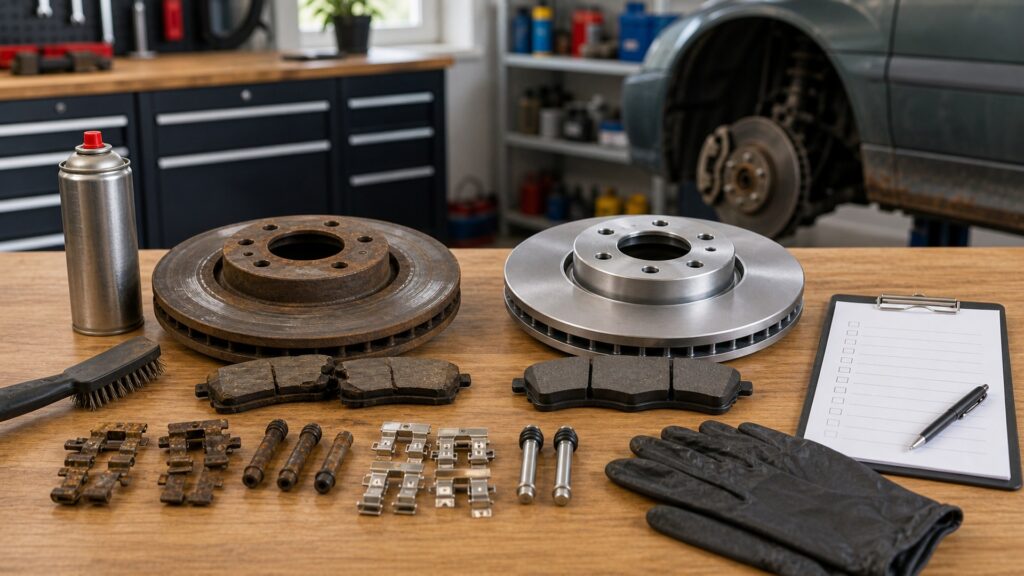
Buying framework
Inspect beyond the worn pad
On a high-mileage vehicle, friction wear may be the visible end of corrosion, seized motion, hose restriction, hub variation, fluid neglect, parking-brake faults, or repeated prior repairs.
Document symptoms and history: Record mileage, prior brake work, fluid service, noise, pull, vibration, pedal behavior, warning lights, overheating, parking-brake operation, storage, climate, towing, and recent tire or hub work. Stop driving when braking is compromised or a leak is present.
Perform a whole-system inspection: Measure every pad or shoe and rotor or drum position; inspect calipers, slides, boots, hoses, lines, bleeders, master-cylinder area, hubs, bearings, shields, cables, fluid, sensors, fasteners, mounting faces, and tires.
Read the wear pattern: Compare inner and outer, leading and trailing, left and right, front and rear. Taper, one-sided wear, heat marks, rust bands, cracking, glazing, or fluid contamination can identify binding, misalignment, restriction, leakage, or inactivity.
Define repair tiers: Separate must-correct safety faults, required companion items, preventive work made efficient by access, and unrelated future concerns. Price broken fasteners, cores, lines, bearings, electronic procedures, and alternate transportation before disassembly.
Verify the restored system: Use exact torque, fluid, bleeding, parking-brake, electronic, wheel, road-test, and bedding procedures. Recheck temperatures, leaks, pedal, warnings, pull, noise, and movement after the initial service interval specified by the parts or vehicle maker.
Who this is for
Mileage combines with environment and repair history
A clean highway vehicle, urban short-trip car, rust-belt truck, neglected project, and long-stored vehicle need different scopes.
Highway-mileage vehicles: Pads may wear evenly while wheel bearings, hoses, fluid, seals, and suspension accumulate cycles. Check heat-related rotor condition, tire and hub interfaces, long warranty-mileage exposure, and whether predictable downtime is worth broader preventive service.
Urban stop-and-go vehicles: Frequent low-speed braking, short trips, moisture, parking-brake cycles, and limited cooling can accelerate friction and corrosion. Evaluate slides, abutments, rear brake contribution, electronic parking mechanisms, fluid condition, and uneven axle wear.
Rust-belt and coastal vehicles: Expect seized bleeders, corroded lines and fittings, swollen or damaged boots, stuck hardware, shield failure, hub-face scale, parking-cable resistance, and core problems. Plan extraction, line work, replacement hardware, and extra time before the vehicle is disabled.
Unknown-history used vehicles: Verify every brake package and previous part, inspect workmanship and mixed components, scan warnings, test fluid, and establish baseline measurements. Receipts or new-looking pads do not prove rotors, calipers, hoses, torque, or bedding were correct.
Long-stored or seasonal vehicles: Surface corrosion may clear, but deep rust, seized pistons or cables, contaminated fluid, aged hoses, tire deterioration, rodent damage, and stuck parking brakes require inspection. Recommission under the exact storage and service guidance before road use.
What to pay attention to
Condition evidence that expands or narrows the repair
High mileage is not a diagnosis; measurements and component motion determine what can remain in service.
Condition & Cause
Position wear, rotor or drum limits, calipers, hoses, fluid, lines, hubs, bearings, corrosion, and parking brake.
Scope & Recovery
Fitment, hardware, cores, fasteners, electronics, bleeding, testing, parts availability, and downtime.
Position-by-position friction thickness: Measure and label inboard, outboard, left, right, leading, or trailing positions as applicable. Remaining thickness, taper, cracks, glazing, separation, contamination, and wear-indicator state reveal both service timing and possible mechanical faults.
Rotor and drum condition: Measure thickness or diameter, runout where specified, scoring, lips, rust bands, cracks, heat spots, glazing, and parking surfaces. Compare with minimum, discard, machining, and paired-replacement rules; appearance alone cannot establish serviceability.
Caliper motion and sealing: Check piston operation under the prescribed method, slide travel, boots, seals, bracket corrosion, abutments, bleeder integrity, leakage, parking lever or motor, and pad support. Replace or rebuild only under supported procedures and parts availability.
Hoses, lines, and fluid: Inspect routing, flex cracks, swelling, chafing, corrosion, fittings, clips, leaks, and possible internal restriction. Use the exact fluid and bleeding sequence; contamination can require a different scope than ordinary fluid renewal.
Hub, bearing, and mounting face: Bearing play, flange damage, corrosion, debris, runout, and wheel torque can create rotor variation or repeat pulsation. Clean and measure as directed rather than using new rotors to mask a hub or bearing problem.
Parking-brake system: Inspect cables, levers, actuators, shoe linings, drums or drum-in-hat surfaces, adjusters, springs, anchors, warning logic, and hold or release. Long inactivity and road contamination can seize components even when service braking feels normal.
Parts availability and repair downtime: Confirm exact fitment, complete hardware, caliper cores, hose and line supply, sensors, fasteners, wheel bearings, scan functions, machine-shop or line-fabrication capacity, warranty, and alternate transport before dismantling an aging system.
Avoid these traps
Old-vehicle shortcuts that repeat the repair
Age and mileage increase the value of diagnosis, not the justification for replacing everything blindly.
Calling all uneven wear normal for mileage: Mileage does not explain a seized slide, restricted hose, leaking piston, corroded abutment, misalignment, or hub fault. Map the pattern, measure it, and correct the mechanism before fitting new friction.
Replacing every component without evidence: Broad replacement can add cost, introduce fitment or installation errors, and obscure the original fault. Use measurements and procedures to distinguish failed, mandatory companion, access-efficient, and serviceable items.
Opening hydraulics without a line plan: Old fittings and lines can twist, break, or expose broader corrosion. Inspect first, confirm line material and fabrication capability, fluid, bleeders, hoses, plugs, tools, and transportation before disconnecting a caliper or wheel cylinder.
Reusing marginal fasteners and hardware: Corroded clips, rounded bolts, stretched one-time fasteners, damaged hose seals, seized bleeders, and weak springs can defeat new parts. Identify replacements and extraction contingencies before the vehicle is supported and immobile.
Judging value from vehicle market price alone: Brake repair cost should be compared with forward utility, safety, total condition, known upcoming work, downtime, and replacement cost. A low market value does not authorize an incomplete safety repair or automatically require disposal.
Decision guidance
Match repair scope to measured system condition
A high-mileage repair should correct the active failure and leave a documented plan for related wear.
If wear is even and hardware moves correctly: Use the vehicle procedure to decide pad or shoe, rotor or drum, hardware, sensor, and fluid scope. Preserve acceptable calipers and hydraulics when measurements, inspection, and verification support continued service.
If one pad or wheel is much hotter: Investigate piston return, slides, abutments, hose restriction, parking brake, bearing, and installation. Do not road-test aggressively or replace only friction material; find the cause of drag and confirm temperature behavior after repair.
If corrosion blocks normal service: Escalate to a shop equipped for extraction, line fabrication, heat or cutting controls, electronic diagnosis, and structural inspection when needed. Budget shields, lines, hoses, brackets, cables, fasteners, hubs, and cores based on inspection.
If pulsation returns after prior rotor work: Verify rotor and hub runout, flange cleanliness, bearing condition, wheel and fastener torque, friction deposits, caliper operation, and tire or suspension effects. Repeated rotor replacement without measurement can repeat the complaint.
If total vehicle condition is marginal: Obtain a complete safety and condition assessment, then compare the required brake repair and near-term work with the vehicle's remaining usefulness and replacement options. Any chosen repair must still meet the controlling safety procedure.
Ownership & compatibility
Turn the repair into a baseline
High-mileage ownership improves when measurements and deferred findings are recorded instead of rediscovered at the next noise.
Create an axle condition map: Save thickness and condition by position, rotor or drum measurements, runout, caliper and slide findings, hose and line condition, fluid, hub or bearing observations, parking-brake operation, tire condition, and photographs.
Track root-cause corrections: Record seized parts, restrictions, corrosion cleanup, mounting-face work, line repair, caliper replacement, hardware, fluid, electronic procedures, torque sources, road-test result, bedding, and follow-up temperature or wear checks.
Schedule deferred work explicitly: List serviceable but aging hoses, lines, shields, cables, bearings, fluid, tires, opposite axle, and fasteners with inspection dates and trigger conditions. Do not let a deferred item become an undocumented assumption.
Watch early wear trends: Reinspect after the specified bedding or follow-up period and later at condition-based intervals. New taper, heat, pull, fluid loss, warning, noise, or pedal change indicates that the restored baseline has shifted.
FAQ
High-mileage brake repair FAQ
Answers about uneven wear, calipers, hoses, rotors, corrosion, fluid, parts scope, and vehicle value.
Should high-mileage vehicles receive complete brake replacement?
What does one worn inner pad usually mean?
Should old brake calipers be replaced preventively?
How can a brake hose cause uneven braking?
Why does rotor pulsation sometimes return quickly?
What extra problems does corrosion create during brake work?
Does dark brake fluid prove the whole system needs replacement?
Is a costly brake repair worthwhile on an older car?
What records should follow a high-mileage brake repair?
Bottom line
Repair the accumulated cause, not only the mileage
High-mileage brake work succeeds when inspection separates normal wear from binding, corrosion, hydraulic faults, and mounting problems.
Map every position: Measure friction, rotors or drums, heat, wear, and related components.
Plan for age: Anticipate lines, bleeders, fasteners, cores, sensors, and downtime.
Correct the mechanism: Resolve slides, pistons, hoses, hubs, bearings, and parking brakes.
Save the baseline: Record repair scope, deferred findings, testing, bedding, and follow-up.
Reading Shortcuts
Confirm measurements before ordering.
Decision Reminders
Checks to complete before committing.
- Confirm application: Cross-check vehicle and installed-system evidence.
- Diagnose first: Let abnormal wear guide inspection.
- Keep axle consistency: Use the specified paired-service scope.
- Follow procedures: Respect torque, fluid, electronics, and bedding.
- Protect friction: Prevent unsuitable chemical or fluid contact.
- Verify release: Confirm pedal, leaks, warnings, and operation.
Glossary Snippets
Terms used in this decision.
When to Use a Top 10 Review
Use rankings after fitment and repair scope are documented.
- Fitment confirmed: Filter with codes and measurements.
- Scope identified: Compare the complete required repair.
- Evidence visible: Rank construction, hardware, and support.
- Procedure covered: Include tools, fluid, testing, and records.
Already down to 2–3 options? A Comparison is usually faster.
When to Use a Comparison
Compare finalists for the same verified application.
- Application data: Match each dimension and interface.
- Included content: List hardware, sensors, and companion parts.
- Service evidence: Review instructions, traceability, and warranty.
- Installed outcome: Price labor, consumables, testing, and downtime.
Still building a shortlist? Start with a Top 10.