
Car Care & Detailing Buying Guide for Maintenance Wash Supplies
Maintenance washing is repeated contact with paint, glass, trim, wheels, tires, and protective films. A method that looks acceptable once can create cumulative marring, residue, water spots, or towel contamination over a year. Soil load, finish sensitivity, water hardness, shade, drainage, and available drying time should therefore determine the supplies—not a fixed shopping bundle.
Design one normal routine and one escalation path for heavier contamination. Specify prewash, contact media, wheel tools, rinse or rinseless solution, drying towels or filtered air, and laundry treatment as one system. Keep dirty zones separate and follow product dilution and dwell instructions. The best maintenance kit removes current soil efficiently while leaving the surface, protection, tools, and wash area ready for the next cycle.
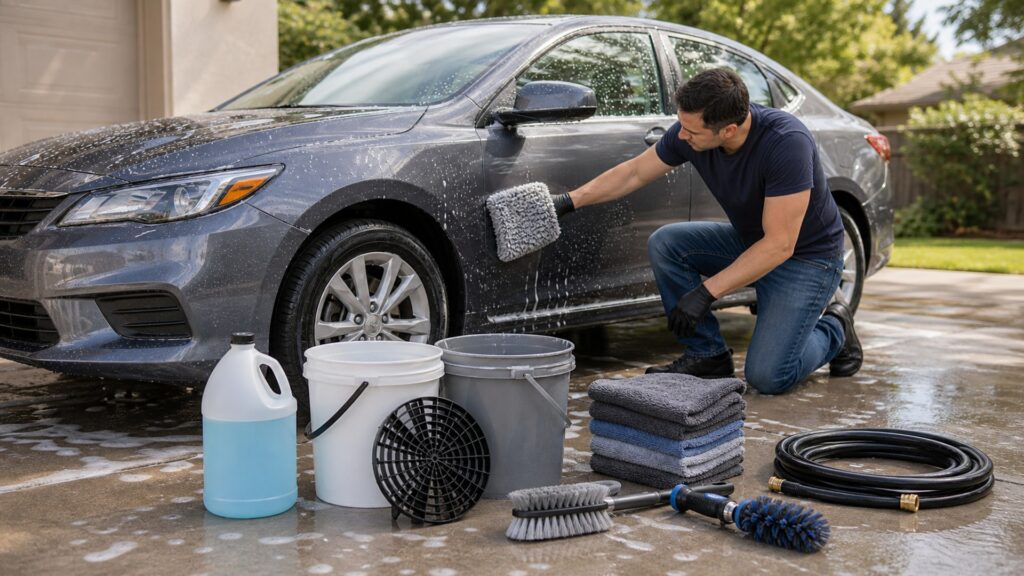
Buying framework
Build the purchase around the real job
Define the outcome, constraints, and verification steps before comparing products. Let build the purchase around the real job shape the comparison.
Soil assessment: Begin by documenting loose dust, road film, mud, salt, insects, sap, mineral deposits, wheel fallout, and oily contamination before choosing contact.
Surface inventory: Make a separate decision about gloss paint, matte finish, wrap, coating, wax, plastic, rubber, glass, polished metal, wheel finish, and damaged areas.
Water strategy: Before shopping, establish hose flow, pressure, rinseless capacity, hard-water behavior, shade, temperature, and where every wash liquid will travel.
Media sequence: Use a test to settle prewash, top-down contact, lower-panel tools, wheel and tire separation, rinse, drying, and final inspection.
Cleanup loop: Complete the plan with towel collection, bucket and sprayer rinsing, chemical storage, equipment drying, and replenishment immediately after use.
Who this is for
Different users need different priorities
Frequency, environment, skill, vehicle design, and tolerance for downtime change the best choice. Let different users need different priorities shape the comparison.
Apartment or water-limited washer: This use pattern rewards rinseless chemistry, measured solution, multiple clean media, contained runoff, indoor-safe process, and a realistic dirty-towel route.
Driveway routine owner: This owner should prioritize controlled hose use, local runoff compliance, shade timing, separate wheels, hard-water management, and quick drying.
Coated-vehicle maintainer: For this situation, compare residue-conscious shampoo, compatible drying aid, gentle decontamination, coating inspection, and products that do not mask behavior.
Winter and heavy-soil driver: This project needs thorough pre-rinse, salt and grit removal, underbody access where appropriate, more clean media, and frequent contamination checks.
What to pay attention to
Specifications that change the result
Published numbers matter only when they connect to fit, performance, safety, and repeatable use. Let specifications that change the result shape the comparison.
Soil & Surface Safety
Soil load, finish type, protection, dwell, lubrication, agitation, wheel segregation, water pressure, and runoff.
Drying & Media Care
Water hardness, towel absorption, blower safety, drying aid, laundry chemistry, storage, inspection, and replacement.
Dilution by task: Read listings for wash-bucket, foam, pump-sprayer, rinseless pre-treat, clay lubricant, and panel-wipe ratios without treating them as interchangeable.
Dwell and drying limits: Confirm the published details for maximum time, temperature, sunlight, wetting, agitation, and rinse instructions that prevent staining or dried chemistry.
Contact-media construction: Compare evidence covering fiber type, pile, backing, seams, absorbency, release of particles, safe pressure, and dedicated surface role.
Wheel-cleaner suitability: Treat as essential acidic, alkaline, neutral, iron-reactive, or solvent behavior against wheel finish, coating, hardware, brakes, and current temperature.
Water-removal capacity: Look beyond headline claims to towel size and absorption, blower filtration and intake, crevice water, towel saturation, lubrication, and paint contact.
Laundry compatibility: Require documentation of detergent residue, fragrance, softener, bleach, water temperature, soil grouping, washer cleanliness, drying heat, and sealed storage.
Avoid these traps
Shortcuts that create avoidable problems
A plausible product can still fail when preparation, interfaces, or operating limits are ignored. Let shortcuts that create avoidable problems shape the comparison.
Using one mitt everywhere: This fails when buyers overlook brake dust, grit, tire dressing, and lower-panel road film migrate to paint when tools are not separated.
Letting soap dry: The hidden problem is concentrated surfactants and minerals can stain, streak, or require extra contact after sunlight and wind shorten working time.
Applying excessive pressure: Avoid assuming that lubrication and clean media cannot prevent marring when trapped particles are dragged firmly across sensitive finishes.
Ignoring towel laundry: This shortcut can cause softener, overloaded machines, oily dressing towels, high heat, and damp storage reduce absorbency or contaminate future washes.
Assuming beading means clean: Correct the plan by checking surfactant film, toppers, minerals, oils, and bonded contamination can alter water behavior without proving protection condition.
Decision guidance
Turn the evidence into a shortlist
Use conditional choices instead of treating one configuration as universally best. Let turn the evidence into a shortlist shape the comparison.
Light dust with water restrictions: Choose this path only after confirming a well-lubricated rinseless process using enough clean media and a pre-treatment appropriate to the contamination.
Moderate road film: This option fits when a rinse-based wash with prewash dwell, gentle contact, thorough rinsing, and rapid drying before minerals concentrate.
Heavy mud or granular grit: Prefer this approach if copious safe removal before contact rather than forcing a waterless or minimal-solution method beyond its soil capacity.
Sensitive matte or wrapped finish: Escalate the project when explicitly approved non-glossing chemistry and soft media, with hidden testing and avoidance of abrasive spot correction.
Persistent roughness or spotting: Delay purchase until you resolve diagnosis of bonded particles or mineral deposits followed by targeted decontamination instead of stronger routine shampoo.
Ownership & compatibility
Keep the system dependable after purchase
Maintenance, records, updates, inspection, and storage determine whether the initial result lasts. Let keep the system dependable after purchase shape the comparison.
Media condition: After installation or use, track staining, embedded particles, rough edges, loss of absorbency, lint, odor, and surface roles after every laundry cycle.
Concentrate control: Preserve a record of purchase date, lot, label, dilution math, dispenser accuracy, freezing or heat exposure, leakage, and shelf-life guidance.
Protection response: Routine care should include clean wetting and drying behavior, slickness only when meaningful, contamination, defects, and the date of any topper or decontamination.
Seasonal adjustment: Recheck the system whenever pollen, insects, wildfire ash, winter salt, heat, water restrictions, and shortened daylight as conditions change.
FAQ
Maintenance wash questions
Resolve method, media, drying, laundry, and runoff choices before assembling the recurring wash kit.
Is rinseless washing safe for every soil level?
How many wash mitts or towels should I use?
Does pH-neutral mean a shampoo is always safe?
Should wheels be washed before paint?
What causes drying-towel streaks?
Can a leaf blower safely dry a vehicle?
How should microfiber towels be washed?
Do ceramic toppers belong in every wash?
How can I reduce wash-water pollution?
Bottom line
Make the final choice defensible
The strongest purchase connects the requirement, evidence, and verification plan without adding unsupported complexity. Let make the final choice defensible shape the comparison.
Soil-matched cleaning: Anchor the purchase to enough pre-removal and lubrication before any paint contact.
Separated media roles: Protect the result through wheels, lower panels, interiors, drying, and delicate finishes never sharing contamination.
Complete reset: Leave room for laundered towels, clean equipment, stored chemistry, and a record of new surface issues.
Reading Shortcuts
Move directly to the decision you need to resolve.
Decision Reminders
Use these checks while narrowing the field.
- Identify the exact application: Names alone do not prove fit.
- Read primary instructions: Limits and steps matter.
- Test before full commitment: Small trials expose mismatch.
- Budget the complete system: Accessories and labor count.
- Protect safety functions: Convenience never overrides control.
- Keep records: Future diagnosis needs evidence.
Glossary Snippets
Terms that appear in listings, labels, and service information.
When to Use a Top 10 Review
Use rankings after requirements and exclusions are clear.
- Scan candidates: Find credible options.
- Compare strengths: See major tradeoffs.
- Build a shortlist: Choose what to inspect.
- Check availability: Confirm current offerings.
Already down to 2–3 options? A Comparison is usually the faster next step.
When to Use a Comparison
Compare directly when only a few candidates remain.
- Align versions: Compare equivalent configurations.
- Trace differences: Locate meaningful distinctions.
- Price the outcome: Include continuing costs.
- Verify uncertainty: Inspect unresolved details.
Still exploring? Start with a Top 10 to build a shortlist first.