
Car Care & Detailing Buying Guide for Paint and Finish Care
Paint care starts by identifying the finish and the condition on top of it. Clear coat, single-stage paint, matte surfaces, wraps, paint-protection film, and repaired panels can respond differently to cleaners, solvents, clay, heat, polish, and coatings. Diagnose contamination and defects before selecting a product.
Use a staged process that preserves material: wash safely, remove targeted contamination, inspect again, and correct only when the improvement justifies abrasion. Protection then needs compatible preparation, temperature, humidity, leveling, and cure. The right system is not the most aggressive or longest-lasting claim; it is the one that produces an even finish and remains maintainable in the owner's real environment.
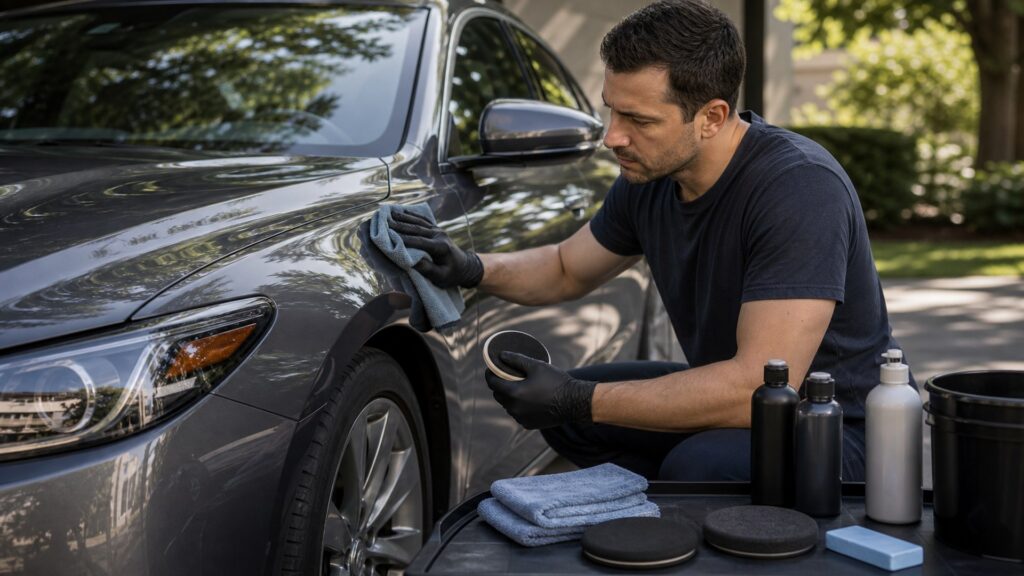
Buying framework
Separate surface condition from paint defects
Cleaning and correction solve different problems. Work from reversible steps toward material removal.
Identify the finish: Confirm factory or repainted panels, clear coat or single stage, matte or satin areas, wrap, film, decals, exposed edges, and manufacturer restrictions.
Classify what is visible: Distinguish loose soil, organic residue, mineral deposits, tar, ferrous particles, overspray, oxidation, wash marring, scratches, etching, and coating defects.
Decontaminate selectively: Use suitable chemistry before mechanical media, control dwell and panel temperature, lubricate contact, and inspect whether the defect remains after residue removal.
Measure before correction: Use lighting, test spots, paint-history knowledge, edge awareness, and thickness measurements where meaningful to set a conservative abrasive limit.
Choose maintainable protection: Match wax, sealant, coating, or film maintenance to preparation time, environment, water behavior, appearance, repairability, and future wash process.
Who this is for
Paint goals require different systems
A daily driver's finish plan differs from a preserved specialty vehicle. Choose the improvement level and maintenance burden deliberately.
Daily outdoor vehicles: Prioritize contamination resistance, easy safe washing, water-spot management, trim compatibility, and protection that can be renewed without extensive climate control.
Garage-kept enthusiasts: Inspection lighting, decontamination, measured polishing, longer preparation, and controlled cure may support higher correction and more demanding protection.
Matte or wrapped vehicles: Use products explicitly approved for the surface, avoid gloss-altering abrasives or fillers, protect seams and edges, and follow the finish maker's wash guidance.
Recently repaired paint: Confirm body-shop cure and product restrictions before waxing, sealing, polishing, or coating; repaint hardness, texture, and thickness may differ across panels.
What to pay attention to
Paint-care variables behind the label
Product category alone does not predict finish quality. Match chemistry and abrasives to the exact surface and working conditions.
Finish Diagnosis & Correction
Coating type, repaint history, contamination, defect visibility, paint thickness, test spot, abrasive combination, and acceptable improvement.
Protection & Maintenance
Preparation, application environment, cure, chemical compatibility, wash technique, water spotting, storage, and renewal schedule.
Cleaning strength and residue: Evaluate intended contamination, dilution, dwell, rinse requirement, panel-temperature limit, existing-protection impact, and whether surfactant or solvent film remains.
Chemical decontamination target: Fallout, mineral, tar, adhesive, and organic removers use different chemistry; confirm surface limits and neutralization or rinsing instructions.
Abrasive behavior: Compound and polish cut depends on abrasive technology, pad, machine motion, speed, pressure, cycle, paint hardness, temperature, and residue control.
Pad construction: Foam density and profile, microfiber or wool fiber, backing size, heat behavior, edge design, and cleaning frequency influence cut, finish, and control.
Protection installation window: Check preparation, flash or haze cue, leveling time, layer interval, temperature, humidity, lighting, cure, water avoidance, and high-spot correction procedure.
Finish compatibility: Require explicit direction for matte paint, wraps, film, fresh paint, unpainted trim, glass, polished metal, and coated surfaces rather than assuming overspray is harmless.
Avoid these traps
Paint-care actions that create new defects
Good intentions can remove gloss or finite coating thickness. Stop and reassess whenever the finish responds unexpectedly.
Polishing contamination: Abrasives can drag bonded particles across paint and obscure whether chemistry would have removed the problem with less material loss.
Chasing every deep scratch: If a defect catches a fingernail or approaches a color or primer layer, complete removal may require unsafe thinning; improve appearance without promising erasure.
Working on hot panels: Heat and direct sun shorten dwell and leveling windows, dry chemicals, increase spotting, and make polishing or coating behavior inconsistent.
Using one pad too long: Saturated abrasives, removed paint, residue, and heat change cut and finish; clean, rotate, or replace pads before performance becomes unpredictable.
Coating without inspection light: Missed residue and high spots can harden into uneven appearance, so inspect overlapping angles within the product's correction window.
Decision guidance
Choose a finish plan by condition and risk
Preserve sound paint and accept limits on damaged areas. Protection should follow the achievable finish, not hide poor preparation.
If paint is healthy but dirty: Use a safe wash and targeted decontamination, then choose simple compatible protection without adding unnecessary correction.
If light marring reduces clarity: Test a mild polish and finishing pad on one representative area, inspect removal and haze, then decide whether broader correction is justified.
If defects vary by panel: Map repaints, thin edges, deep scratches, etching, and oxidation, using different treatment or accepting residual defects rather than forcing one aggressive combination.
If the finish is matte or wrapped: Follow its manufacturer, use approved non-glossing care, test seams and edges, and avoid conventional compounds, clay, or solvents unless specifically allowed.
If long-term coating is desired: Budget decontamination, correction, controlled application, cure, maintenance products, and future spot repair; installation quality matters more than headline duration.
Ownership & compatibility
Maintain the finish without restarting correction
Good wash technique preserves the achieved result. Observe protection and contamination rather than polishing on a calendar.
Use a low-contact wash sequence: Remove loose soil first, provide adequate solution and clean media, work in sections, rinse thoroughly, and dry without dragging contaminated towels.
Treat deposits promptly: Bird residue, insects, minerals, tree contamination, fuel, and road chemicals become harder to remove and may etch when heat and time increase exposure.
Track correction history: Record panels, machine, pad, polish, passes, thickness readings, defects retained, repainted areas, and edge cautions for the next detailer.
Renew based on performance: Clean the surface and assess water behavior, contamination, appearance, and product directions before topping or replacing protection with another system.
FAQ
Paint and finish care questions
Clarify finish type, contamination, polishing limits, and protection before treatment.
How can I tell whether paint has clear coat?
Should I clay the paint before polishing?
Can polishing remove every scratch?
What is a paint correction test spot?
Are ceramic-style coatings permanent?
Can standard polish be used on matte paint?
How should water spots be removed?
How long should repainted panels cure before protection?
Do I need a paint thickness gauge?
Bottom line
Preserve the finish through staged decisions
Paint responds best when contamination, defects, and protection are treated separately. Correction should remain conservative and documented.
Identify the surface: Know finish type, repairs, and restrictions.
Escalate carefully: Clean and decontaminate before abrasion.
Protect the result: Apply, cure, and maintain a compatible system.
Reading Shortcuts
Move directly to the decision you need to resolve.
Decision Reminders
Use these checks while narrowing the field.
- Work on cool panels: Control dwell and leveling.
- Decontaminate before polishing: Do not grind embedded material.
- Protect edges: Coating can be thinner.
- Clean pads frequently: Residue changes performance.
- Inspect multiple angles: High spots hide in poor light.
- Record correction history: Future work needs context.
Glossary Snippets
Terms that appear in listings, labels, and service information.
When to Use a Top 10 Review
Use rankings after requirements and exclusions are clear.
- Scan candidates: Find credible options.
- Compare strengths: See major tradeoffs.
- Build a shortlist: Choose what to inspect.
- Check availability: Confirm current offerings.
Already down to 2–3 options? A Comparison is usually the faster next step.
When to Use a Comparison
Compare directly when only a few candidates remain.
- Align versions: Compare equivalent configurations.
- Trace differences: Locate meaningful distinctions.
- Price the outcome: Include continuing costs.
- Verify uncertainty: Inspect unresolved details.
Still exploring? Start with a Top 10 to build a shortlist first.