
Car Care & Detailing Buying Guide for Weekend Wash Routines
A useful weekend wash removes the week's contamination without creating the defects that later require polishing. Soil level, paint temperature, wheel contamination, road salt, water hardness, local runoff rules, and access to shade determine whether a hose, pressure washer, rinseless method, or limited spot clean fits the vehicle.
Build a sequence that can be repeated when time is limited: prepare clean tools, treat wheels separately, remove loose dirt, wash with lubricated media, rinse or wipe as directed, and dry before minerals concentrate. Add decontamination or protection maintenance only when the surface needs it. Consistent technique and clean media matter more than collecting several overlapping soaps or accessories.
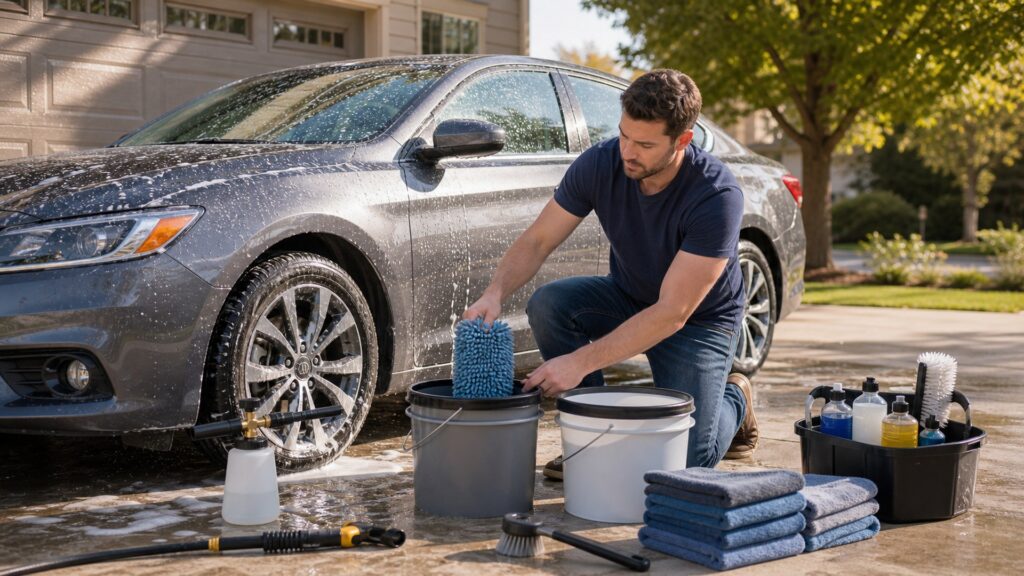
Buying framework
Design a wash around contamination and access
Every wash method has a soil limit. Choose enough removal and lubrication before touching the finish.
Inspect before setup: Check heat, direct sun, wind, loose grit, mud, salt, insects, sap, mineral deposits, wheel dust, damaged paint, and water or runoff constraints.
Prepare distinct tool zones: Separate wheel and lower-body tools from paint, stage clean towel faces, mix products accurately, and keep used media from returning to clean solution.
Remove loose contamination: Use suitable water flow or documented pre-cleaning chemistry to reduce particles before contact, protecting damaged edges, vents, electrical areas, and delicate trim.
Wash in controlled sections: Keep panels cool and wet, work from cleaner areas toward dirtier ones, use light pressure, refresh media frequently, and never allow product to dry.
Dry and inspect promptly: Remove standing water from panels, mirrors, trim, badges, handles, wheels, and seams before minerals spot, then identify residue or contamination needing separate treatment.
Who this is for
Wash routines depend on where and how the vehicle is used
The safest workable method changes with soil, climate, and water availability. Keep the routine proportional.
Garage-kept weekly washers: Light regular soil may support a gentle traditional or rinseless wash with minimal chemistry, plentiful clean media, and quick protection inspection.
Outdoor daily drivers: Bird residue, insects, traffic film, tree contamination, and mineral exposure require prompt spot response and stronger pre-cleaning without letting chemicals dry.
Winter-road drivers: Heavy salt and grit need thorough loose-soil removal, wheel-arch and lower-body attention, warm-enough working conditions, and complete drying around seals and locks.
Water-restricted owners: Rinseless methods or commercial facilities can reduce uncontrolled runoff when soil level and local rules allow; heavy contamination may still require another venue.
What to pay attention to
Wash-product and tool variables that matter weekly
Convenience should not reduce lubrication, cleanliness, or surface control. Match capacity to vehicle size and contamination.
Soil Removal & Contact Safety
Loose-soil removal, chemistry, lubrication, wheel separation, media cleanliness, panel order, temperature, and contact pressure.
Drying & Routine Sustainability
Water quality, spotting, drying tools, runoff, time, storage, laundry, protection compatibility, and readiness for the next wash.
Wash dilution: Confirm concentrate ratio, water volume, soil limit, protection compatibility, dwell, rinse or wipe method, and whether one solution also serves as documented pre-spray or drying aid.
Media design and quantity: Compare fiber or noodle construction, pile, backing, cuff, size, release behavior, and enough clean faces to avoid reusing loaded material across panels.
Pressure and nozzle control: Machine rating is less useful than safe nozzle pattern, distance, angle, flow, hose management, and caution around damaged paint, seals, cameras, and electrical openings.
Wheel-cleaning compatibility: Identify wheel finish, brake type, temperature, cleaner pH and chemistry, dwell, agitation tools, tire use, and restrictions on polished, bare, coated, or damaged surfaces.
Drying capacity: Towel absorbency, softness, edges, blower filtration and noise, electrical safety, water displacement, and access to seams determine whether the vehicle dries before spotting.
Water quality: Hardness and dissolved minerals influence rinse spotting and drying urgency; filtration or deionization can help only when capacity, replacement cost, and output quality are monitored.
Avoid these traps
Weekend wash habits that create correction work
Speed becomes expensive when grit or minerals remain in contact. Simplify the routine without skipping contamination control.
Washing hot paint: Sun and heat accelerate evaporation, shorten dwell, concentrate soap or minerals, and make streaks and water spots more likely.
Using wheel media on paint: Brake dust and coarse road particles can transfer to sensitive finishes; dedicate and visibly identify wheel, tire, lower-body, paint, glass, and drying tools.
Scrubbing isolated grit: Pressure and repeated passes do not replace pre-removal and lubrication; stop when a particle or residue resists the normal wash and treat it separately.
Air-drying the vehicle: Evaporation leaves dissolved minerals behind, especially on dark or warm panels, glass edges, mirrors, badges, and horizontal surfaces.
Ignoring runoff destination: Soap, metals, oil, and road residue may enter storm drains; follow local rules and use a commercial or controlled method when home discharge cannot be managed.
Decision guidance
Choose a routine you can perform consistently
The best setup fits the typical weekend, with a separate plan for exceptional contamination. Do not make a light wash carry a mud-removal job.
If contamination is light: A properly mixed rinseless or gentle hose wash with abundant clean media can work when the surface stays lubricated and dirty solution is isolated.
If mud, grit, or salt is heavy: Use substantial loose-soil removal and an appropriate wash location before contact; increase lower-area and wheel attention without blasting vulnerable surfaces.
If water spots are common: Move into shade, work smaller sections, improve final-rinse water where practical, dry immediately, and treat existing mineral residue separately from ordinary washing.
If protection is installed: Use compatible wash chemistry, avoid unnecessary strong degreasers, inspect behavior after cleaning, and apply maintenance products only according to the protection maker.
If the routine takes too long: Reduce duplicated chemicals and optional stages, improve tool placement and towel quantity, and reserve decontamination, correction, and deep interior work for separate sessions.
Ownership & compatibility
Reset the wash kit after every use
The next safe wash depends on clean, dry tools and known chemical mixtures. Storage is part of the routine.
Launder and inspect towels: Separate heavily contaminated media, use a suitable residue-free wash process, avoid unwanted softeners, dry completely, and retire fibers with embedded grit or damaged edges.
Clean buckets and tools: Rinse dirt traps, sprayers, foam devices, brushes, hoses, nozzles, drying equipment, and wheel tools so residue does not harden or contaminate the next session.
Label every dilution: Record product, ratio, mixing date where relevant, compatible surfaces, and safety warnings; never store chemicals in food or drink containers.
Restock before the next weekend: Replace failed sprayers, worn media, depleted cleaner, protective equipment, and drying capacity while noting any surface issue that needs targeted treatment.
FAQ
Weekend vehicle-wash questions
Use these answers to choose methods, media, drying, and runoff controls.
Is a rinseless wash safe every weekend?
Should wheels be washed before paint?
Does a foam pre-wash eliminate contact washing?
How many wash mitts or towels are enough?
Can a pressure washer damage vehicle paint?
What is the best way to prevent water spots?
Should I add protection after every wash?
Where should home car-wash water go?
How should microfiber wash tools be cleaned?
Bottom line
A safe weekly wash prevents larger detailing work
Remove loose soil, minimize contact, and dry before minerals remain. Repeatability is the main performance measure.
Match the soil: Choose enough pre-cleaning and lubrication.
Protect every contact: Use clean, dedicated media with light pressure.
Reset the kit: Wash tools, label products, and restock.
Reading Shortcuts
Move directly to the decision you need to resolve.
Decision Reminders
Use these checks while narrowing the field.
- Keep panels cool: Prevent drying and spotting.
- Remove loose grit first: Reduce contact risk.
- Separate wheel tools: Brake dust stays isolated.
- Refresh media faces: Do not drag loaded fibers.
- Dry seams and mirrors: Hidden water returns.
- Know the drain path: Manage contaminated runoff.
Glossary Snippets
Terms that appear in listings, labels, and service information.
When to Use a Top 10 Review
Use rankings after requirements and exclusions are clear.
- Scan candidates: Find credible options.
- Compare strengths: See major tradeoffs.
- Build a shortlist: Choose what to inspect.
- Check availability: Confirm current offerings.
Already down to 2–3 options? A Comparison is usually the faster next step.
When to Use a Comparison
Compare directly when only a few candidates remain.
- Align versions: Compare equivalent configurations.
- Trace differences: Locate meaningful distinctions.
- Price the outcome: Include continuing costs.
- Verify uncertainty: Inspect unresolved details.
Still exploring? Start with a Top 10 to build a shortlist first.