
Car Care & Detailing Buying Guide: How to Choose the Right One
Car care products work on different surfaces, contamination, and defects. Road film, mineral deposits, brake dust, tree residue, embedded particles, oxidation, and scratches do not respond to one universal cleaner. Begin with a surface map and a test area, then choose the least aggressive process that produces a measurable improvement.
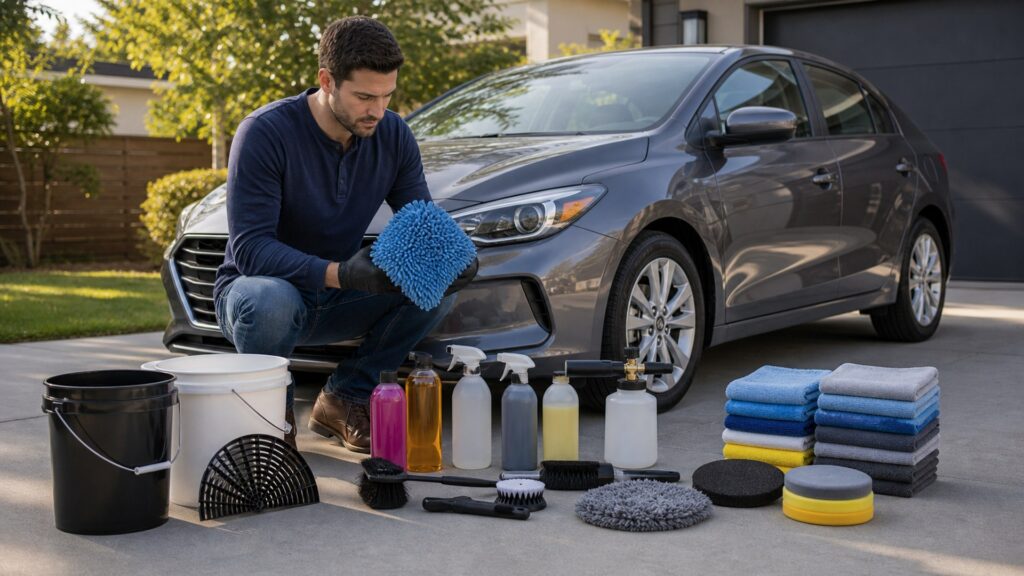
Build the workflow in order: safe washing, targeted decontamination, optional correction, protection, and maintenance. Match chemical dilution, dwell time, agitation, towels, pads, machines, ventilation, weather, and runoff control to product directions and vehicle materials. A smaller, coherent kit usually performs better than a cabinet of overlapping chemicals, especially when every towel and applicator has a defined job.
Buying framework
Design the process before buying products
Each stage should solve a specific condition and prepare the next one. Extra aggressiveness adds risk without guaranteeing a better finish.
Map every material: Identify painted panels, matte or wrapped areas, unpainted trim, glass, wheels, tires, fabric, carpet, coated upholstery, screens, and sensitive controls.
Name the contamination or defect: Separate loose dirt, bonded particles, organic residue, mineral deposits, grease, dye transfer, oxidation, and paint defects because each needs different chemistry or abrasion.
Begin with the mildest method: Use rinsing, suitable cleaner, controlled dwell, lubrication, and gentle agitation before stronger chemicals or abrasives, reassessing after each stage.
Assign tools by surface: Dedicate wash media, wheel tools, interior brushes, glass towels, drying towels, applicators, and polish pads to prevent grit, dye, dressing, or abrasive cross-contamination.
Plan protection and upkeep: Choose wax, sealant, coating, or no added protection according to surface compatibility, preparation, cure conditions, maintenance time, and realistic durability expectations.
Who this is for
Detailing systems should fit the owner
Desired finish, available time, storage, water access, and experience change the sensible kit. Match ambition to repeatable practice.
Maintenance-focused owners: A safe wash, drying system, interior cleaner, glass process, and simple protection deliver more value than correction equipment used rarely or without measurement.
Enthusiast detailers: Decontamination, paint inspection, test spots, machine polishing, pad management, panel preparation, and controlled protection can justify a larger but disciplined system.
Apartment and water-limited users: Rinseless or waterless methods may fit local rules and access when used on appropriate soil levels with adequate solution, clean media, and controlled runoff.
Multi-vehicle households: Different paint, wheels, trim, upholstery, and coatings require labeling, dilution control, dedicated tools, and a compatibility record rather than one assumed universal routine.
What to pay attention to
Product and tool details that change results
Front-label claims rarely describe the whole workflow. Read directions, limitations, and safety information before combining products.
Surface & Defect Match
Paint, trim, glass, wheel finish, fabric, leather-like materials, soil type, defect severity, test spot, and material sensitivity.
Process & Ownership
Dilution, dwell, agitation, towels, machine compatibility, ventilation, runoff, storage, cure conditions, maintenance, and total workflow time.
Dilution and contact time: Confirm ready-to-use versus concentrate, allowable ratios, temperature limits, dwell, drying restrictions, rinse needs, and whether stronger mixing increases risk without authorization.
Surface compatibility: Look for explicit approval or exclusions for matte paint, wraps, polished metal, coated wheels, plastics, screens, leather-like finishes, fabric, glass tint, and existing protection.
Cleaning mechanism: Surfactants, solvents, acids, alkalis, chelating agents, enzymes, and abrasives address different soils and can carry different staining, residue, or material risks.
Microfiber construction: Pile, weave, edge, density, size, absorbency, and laundering tolerance should suit washing, leveling, glass, interior, drying, or polish removal without cross-use.
Polish system variables: Abrasive behavior depends on paint, pad material and condition, machine motion, speed, pressure, working time, residue, temperature, and inspection lighting.
Protection requirements: Preparation, application thickness, leveling window, temperature, humidity, cure time, water avoidance, maintenance chemistry, and compatibility determine whether protection bonds and finishes evenly.
Avoid these traps
Detailing habits that damage surfaces
Most failures come from process mismatch rather than a lack of products. Control dirt, chemistry, abrasion, and time.
Wiping dry contamination: Dust and grit dragged without sufficient rinse or lubrication can mark paint and glossy trim; choose a method appropriate to the soil load.
Letting chemicals dry: Sun, hot panels, wind, and excessive dwell can concentrate cleaners and create streaking, spotting, staining, or difficult residue.
Using one towel everywhere: Wheel particles, interior oils, glass residues, polish, and dressings cross-contaminate surfaces; separate and label media, then retire damaged towels.
Correcting without measurement: Aggressive compounds and pads remove finite material, so inspect paint condition, use a test spot, and stop when the improvement no longer justifies additional removal.
Mixing cleaning chemicals: Combined products can react unpredictably or release hazardous vapors; follow labels and safety data sheets, ventilate, and never improvise mixtures.
Decision guidance
Choose the smallest complete detailing system
Start with safe maintenance and add specialized stages only for diagnosed conditions. Every product needs a surface, purpose, and place in the sequence.
If the vehicle is routinely maintained: Prioritize compatible wash chemistry, clean media, controlled drying, glass and interior tools, and an easy protection product that will actually be renewed.
If bonded contamination remains: Select material-specific chemical or mechanical decontamination, provide lubrication and residue removal, and test whether correction is still necessary afterward.
If paint defects are visible: Inspect in reliable lighting, estimate correction risk, begin with a mild pad and polish test, and protect the improved finish rather than chasing every mark.
If surfaces are unusual: Follow vehicle and film, wrap, wheel, upholstery, or coating manufacturer guidance; avoid universal cleaners or dressings that lack explicit compatibility.
If time and storage are limited: Choose concentrated multifunction products only where directions support each use, minimize duplicated chemicals, and organize a maintenance routine that fits available access.
Ownership & compatibility
Keep the detailing system clean and controlled
Tools and chemicals change with use and storage. Maintenance protects both the vehicle and the operator.
Wash media correctly: Separate contaminated loads, use suitable detergent without unwanted softener residue, inspect fibers and edges, dry fully, and store clean towels in labeled containers.
Manage chemical inventory: Keep original labels and safety information, record dilutions, secure caps, avoid temperature extremes, separate incompatible materials, and discard degraded products lawfully.
Observe protection behavior: Track cleaning ease, water behavior, gloss or appearance, contamination, and maintenance history instead of relying only on advertised durability.
Review runoff and exposure: Follow local water rules, keep wash water from storm drains where required, use ventilation and appropriate protective equipment, and clean spills promptly.
FAQ
Car-care and detailing questions
Use these answers to match products, surfaces, process stages, and maintenance.
Do I need a separate cleaner for every surface?
What does pH tell me about a car cleaner?
When should paint be mechanically decontaminated?
Is machine polishing required before protection?
Can detailing products be mixed together?
How many microfiber towels should I buy?
Are waterless washes safe for dirty vehicles?
How long does paint protection last?
What safety information should I review?
Bottom line
Good detailing is controlled surface care
A coherent process removes contamination without creating new defects. Buy for verified materials and repeatable maintenance.
Diagnose first: Match soil and defect to the method.
Control the process: Manage chemistry, media, abrasion, and environment.
Maintain the system: Clean tools, label products, and reassess protection.
Reading Shortcuts
Move directly to the decision you need to resolve.
Decision Reminders
Use these checks while narrowing the field.
- Test a small area: Compatibility varies.
- Keep panels cool: Do not let products dry.
- Separate towel roles: Prevent cross-contamination.
- Measure before correction: Paint material is finite.
- Read safety data: Ventilation and storage matter.
- Control wash runoff: Follow local requirements.
Glossary Snippets
Terms that appear in listings, labels, and service information.
When to Use a Top 10 Review
Use rankings after requirements and exclusions are clear.
- Scan candidates: Find credible options.
- Compare strengths: See major tradeoffs.
- Build a shortlist: Choose what to inspect.
- Check availability: Confirm current offerings.
Already down to 2–3 options? A Comparison is usually the faster next step.
When to Use a Comparison
Compare directly when only a few candidates remain.
- Align versions: Compare equivalent configurations.
- Trace differences: Locate meaningful distinctions.
- Price the outcome: Include continuing costs.
- Verify uncertainty: Inspect unresolved details.
Still exploring? Start with a Top 10 to build a shortlist first.