
Car Electronics & Driving Tech Buying Guide for Road Trip Technology Needs
Road trips magnify technology weaknesses. Coverage can disappear, navigation can lose its route, a windshield mount can overheat, several devices can exceed one outlet, and an untested cable can fail far from a store. An unfamiliar road is the wrong place to configure accounts, alerts, or a new interface.
Plan by route and consequence. Identify coverage gaps, weather, roaming issues, charging or fueling stops, passenger devices, security, and the longest period without supplies. Give navigation, communication, and essential power first claim on capacity. Test offline information, secure mounts and cables, configure while parked, and pack a backup for each critical function. Convenience technology should make the trip calmer, not create another system the driver must manage.
Buying framework
Build the purchase around the real job
Define the outcome, constraints, and verification steps before comparing products. Let build the purchase around the real job shape the comparison.
Route risk map: Begin by documenting coverage gaps, remote segments, weather, elevation, borders, roaming, closures, charging or fueling intervals, and alternate roads.
Critical-function hierarchy: Make a separate decision about navigation, emergency communication, vehicle charging, medical or accessibility devices, recording, passenger media, and optional convenience.
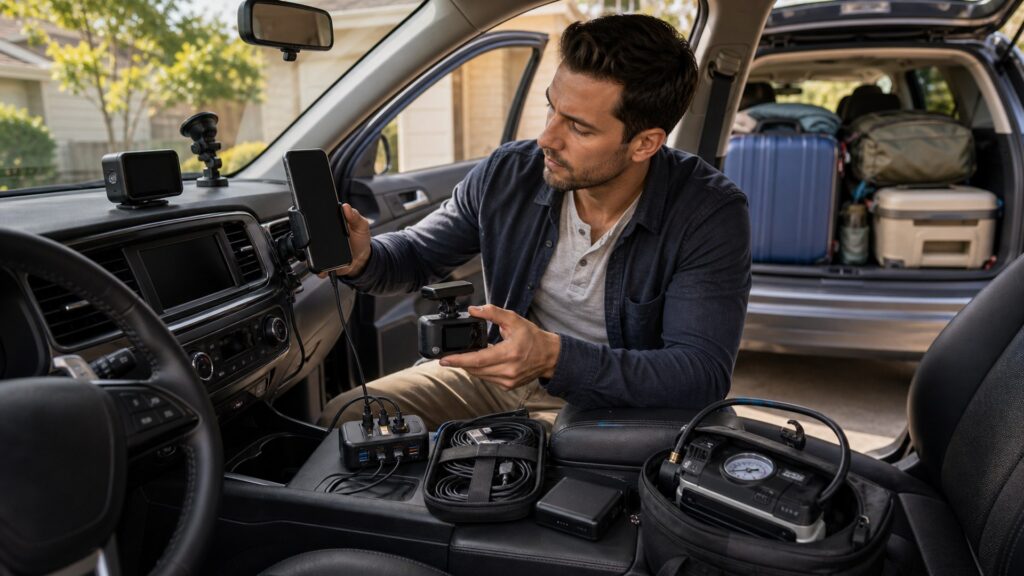
Vehicle power survey: Before shopping, establish outlet locations, circuit ratings, ignition behavior, inverter limits, usb allocation, cable lengths, battery condition, and heat.
Parked setup routine: Use a test to settle maps, destinations, stops, contacts, permissions, updates, playlists, camera storage, hotspot, alerts, profiles, and mount position.
Failure and theft plan: Complete the plan with lost phone, dead cable, overheated device, flat battery, no network, stolen equipment, corrupt storage, and account recovery.
Who this is for
Different users need different priorities
Frequency, environment, skill, vehicle design, and tolerance for downtime change the best choice. Let different users need different priorities shape the comparison.
Interstate family traveler: This use pattern rewards multiuser charging, offline entertainment, hotspot limits, child-safe cables, driver controls, rest-stop security, and simple device labeling.
Remote-area explorer: This owner should prioritize redundant navigation, satellite or other suitable emergency communication, conservative power, weather information, rugged storage, and check-in plan.
EV road-trip driver: For this situation, compare verified fast-charging route, backup stations, account setup, connector availability, battery preconditioning guidance, elevation, temperature, and reserve.
Solo long-distance driver: This project needs low-distraction mount, voice guidance, fatigue-aware stop plan, automatic check-ins, reliable audio, and minimal equipment switching.
What to pay attention to
Specifications that change the result
Published numbers matter only when they connect to fit, performance, safety, and repeatable use. Let specifications that change the result shape the comparison.
Route & Failure Resilience
Offline maps, route sharing, coverage, weather, charging stops, redundancy, emergency contacts, paper references, and recovery.
Cabin Power & Attention
Vehicle outlet capacity, charger allocation, cables, heat, mounts, glare, passenger devices, recording, security, setup, and driver workload.
Offline navigation capability: Read listings for map regions, storage, update date, rerouting without service, saved stops, coordinates, elevation, vehicle restrictions, and route export.
Charger and outlet capacity: Confirm the published details for input voltage, circuit fuse, total and per-port output, usb protocols, simultaneous allocation, inverter waveform, cooling, and ignition state.
Mount retention and sightline: Compare evidence covering attachment surface, vibration, device weight, heat, adjustment, road visibility, airbag and vent clearance, cable routing, and local restrictions.
Network and roaming support: Treat as essential carrier coverage, bands, antenna, hotspot device count, data caps, throttling, international use, account access, and cancellation.
Recording endurance: Look beyond headline claims to memory-card type, capacity, loop duration, heat rating, low-voltage cutoff, file protection, time accuracy, and secure export.
Emergency-device service: Require documentation of coverage model, subscription, activation, battery runtime, message or sos behavior, registration, training, test procedure, and limitations.
Avoid these traps
Shortcuts that create avoidable problems
A plausible product can still fail when preparation, interfaces, or operating limits are ignored. Let shortcuts that create avoidable problems shape the comparison.
Depending on one phone: This fails when buyers overlook loss, damage, heat, battery failure, account lockout, or poor coverage can remove navigation, communication, tickets, and payment together.
Adding charger wattages naively: The hidden problem is advertised port totals may not be available simultaneously and still depend on outlet, circuit, cable, protocol, voltage, and cooling.
Mounting in direct heat and glare: Avoid assuming that sunload can dim or shut down phones and cameras while reflections or placement reduce road visibility.
Updating immediately before departure: This shortcut can cause new software, maps, accounts, or firmware can introduce pairing and routing problems without time to test recovery.
Leaving equipment visible overnight: Correct the plan by checking mounts, cameras, hotspots, bags, and cables can advertise valuables even when the main device is removed.
Decision guidance
Turn the evidence into a shortlist
Use conditional choices instead of treating one configuration as universally best. Let turn the evidence into a shortlist shape the comparison.
Mostly covered highway route: Choose this path only after confirming tested phone navigation with downloaded maps, secure charging, and an independent address or route backup.
Extended coverage gaps: This option fits when offline-capable navigation and a communication plan whose coverage and limitations match the region.
Many passenger devices: Prefer this approach if a measured power and hotspot allocation that reserves capacity for driver navigation and essential communication.
Travel includes severe heat or cold: Escalate the project when temperature-rated equipment, shaded placement, battery planning, cable flexibility, and behavior verified near expected extremes.
Critical route or charging data remains uncertain: Delay purchase until you resolve confirmed stops and alternates, downloaded details, contact numbers, and additional reserve rather than optimistic range or signal assumptions.
Ownership & compatibility
Keep the system dependable after purchase
Maintenance, records, updates, inspection, and storage determine whether the initial result lasts. Let keep the system dependable after purchase shape the comparison.
Predeparture health check: After installation or use, track map age, device updates, account access, cables, mounts, chargers, batteries, storage cards, emergency contacts, and offline tests.
Daily trip reset: Preserve a record of charge levels, route changes, weather, available storage, lens cleanliness, secure cable routing, hotspot use, and next coverage gap.
Data and security hygiene: Routine care should include shared locations, trip history, recordings, public wi-fi, hotel charging, lost-device access, payment accounts, and equipment concealment.
Post-trip review: Recheck the system whenever failed connections, overheating, power shortages, map errors, alert overload, damaged cables, unused subscriptions, and improvements for the next route.
FAQ
Road trip technology questions
Resolve navigation, power, mounting, connectivity, recording, emergency, and backup decisions before departure.
How much offline navigation should I download?
How many watts does a road-trip charger need?
Can a power inverter run any appliance?
Where should a phone mount be placed?
Do I need a separate GPS device?
How can a dash camera survive a long trip?
Is a mobile hotspot worth carrying?
When is satellite communication useful?
What technology should be tested before leaving?
Bottom line
Make the final choice defensible
The strongest purchase connects the requirement, evidence, and verification plan without adding unsupported complexity. Let make the final choice defensible shape the comparison.
Resilient essentials: Anchor the purchase to navigation, communication, and power surviving the most likely single failure.
Calm cabin operation: Protect the result through mounts, cables, alerts, profiles, and passenger loads settled before movement.
Route-specific backup: Leave room for offline information, alternates, contacts, and reserve matched to actual service gaps.
Reading Shortcuts
Move directly to the decision you need to resolve.
Decision Reminders
Use these checks while narrowing the field.
- Identify the exact application: Names alone do not prove fit.
- Read primary instructions: Limits and steps matter.
- Test before full commitment: Small trials expose mismatch.
- Budget the complete system: Accessories and labor count.
- Protect safety functions: Convenience never overrides control.
- Keep records: Future diagnosis needs evidence.
Glossary Snippets
Terms that appear in listings, labels, and service information.
When to Use a Top 10 Review
Use rankings after requirements and exclusions are clear.
- Scan candidates: Find credible options.
- Compare strengths: See major tradeoffs.
- Build a shortlist: Choose what to inspect.
- Check availability: Confirm current offerings.
Already down to 2–3 options? A Comparison is usually the faster next step.
When to Use a Comparison
Compare directly when only a few candidates remain.
- Align versions: Compare equivalent configurations.
- Trace differences: Locate meaningful distinctions.
- Price the outcome: Include continuing costs.
- Verify uncertainty: Inspect unresolved details.
Still exploring? Start with a Top 10 to build a shortlist first.