
Car Interior Accessories Buying Guide for All-Weather Interior Use
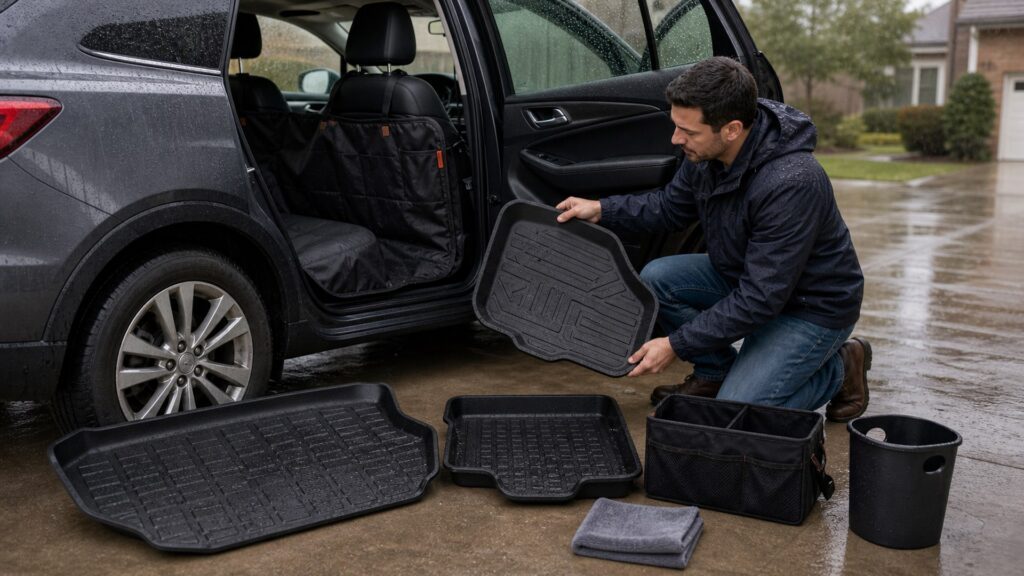
All-weather cabin protection must manage contaminants through their complete path: snow or rain enters on shoes and clothing, melts or spreads, carries salt and grit into seams, and then needs to leave the vehicle without spilling or remaining trapped. Cold can stiffen liners and curl edges; parked heat can soften backing, release odor, or weaken attachments.
This guide compares floor, seat, cargo, glare, and moisture-control accessories by season, exact fit, retention, pedal and restraint clearance, liquid capacity, controlled removal, material temperature range, cleaning, drying, and hidden-surface inspection. The goal is a cabin that returns to dry verified condition rather than one that merely hides weather under a protective layer.
Buying framework
A four-stage test for all-weather cabin protection
Make each stage produce seasonal evidence that constrains the next one.
Quantify exposure cycle: Quantify exposure cycle with a stated pass condition. Use retention and clearance to reject seasonal choices whose performance cannot sustain the measured workload.
Confirm retention and clearance: Establish the supported boundary for retention and clearance. Name the approver, source, and corrective action before seasonal uncertainty reaches liquid exit.
Map liquid exit: Lay out liquid exit at the actual vehicle or site. Include seasonal movement, access, exposure, and the fault route leading into material climate range.
Test material climate range: Run a realistic trial of material climate range. Confirm hidden-surface inspection still works when the preferred seasonal arrangement, control, or service is unavailable.
Who this is for
Match the plan to the user
Workload, authority, parking, and recovery needs separate these buyers.
Drivers in wet or snowy regions: Prioritize deep containment, secure anchors, dependable pedal clearance, and a surface that can be emptied without spilling collected water back into the footwell.
Beach, trail, and worksite users: Choose removable pieces that trap sand, grit, and mud yet remain practical to shake out, rinse, dry, and reinstall after frequent dirty trips.
Families carrying children or pets: Favor broad coverage at seat edges and cargo transitions, materials that tolerate repeated cleaning, and attachment points that do not interfere with restraints.
Owners protecting leased or resale vehicles: Look for reversible coverage that avoids dye transfer, trapped moisture, trim abrasion, adhesive residue, or permanent changes to the original cabin.
What to pay attention to
Specifications that change the installed result
Read each characteristic inside the complete seasonal system.
Exposure cycle: Rain, snow, ice, road salt, mud, sand, humidity, heat, and freeze-thaw timing
Retention and clearance: Factory anchors, flat edges, pedal sweep, seat tracks, buckles, airbags, and door movement
Liquid exit: Channel volume, overflow direction, liner lifting, spill control, washing location, and full drying
Material climate range: Cold flexibility, heat stability, UV resistance, odor, friction, dye, and chemical compatibility
Hidden-surface inspection: Carpet, upholstery, anchors, seams, wiring, corrosion, mold, grit, and pressure marks
Avoid these traps
Planning errors that create expensive corrections
These seasonal failures usually begin before equipment reaches the site.
Stacking seasonal mats: Multiple layers defeat intended retention and alter pedal clearance. Put this stacking failure in the seasonal requirements and close it before ordering.
Ignoring liquid during removal: Tall edges can spill concentrated saltwater across carpet and wiring. Expose the ignoring conflict through a realistic seasonal trial under normal use.
Leaving impermeable layers unchecked: Condensation and edge leakage can remain hidden beneath a dry-looking surface. Assign a seasonal reviewer to the leaving gap before the system reaches users.
Storing products while damp: Folded wet liners and covers develop odor, mold, deformation, and damaged backing. Define seasonal recovery from the storing error; reject unsupported improvisation.
Decision guidance
Choose the least complicated supported route
The supported seasonal branch meets the measured requirement and remains recoverable.
Use vehicle-specific liners: Exact contours and factory anchors matter in the driver footwell. This remains the lean seasonal choice while evidence stays inside every verified seasonal limit.
Use removable absorbent inserts: Small recurring moisture can be lifted and dried without replacing the retained base. Price the complete seasonal path, including who operates it, provides seasonal support, and restores the site.
Use fitted seat or cargo protection: Verified seams, sensors, restraints, controls, folds, and attachment support the exposure. Let a measured seasonal constraint—not feature appeal—justify the added seasonal capability.
Remove seasonal equipment: The climate or use changes and the product adds heat, odor, bulk, or trapped moisture. Commission the seasonal option; reject it without proven seasonal behavior and a usable fallback.
Ownership & compatibility
Keep performance verifiable after installation
Inspection, records, and exit planning protect the original decision.
Remove contamination deliberately: Vacuum loose grit before lifting liners, carry liquid-filled pieces level, and clean underneath before hidden moisture or abrasive particles mark the original carpet.
Dry every layer completely: Follow the material instructions, clear channels and anchors, and reinstall only when the liner and the covered footwell are dry and odor-free.
Recheck fit after service: Confirm retention, edge shape, seat travel, and pedal clearance whenever a liner is removed, the cabin is detailed, or temperatures change substantially.
FAQ
Questions buyers ask about all-weather cabin protection
Short answers for unresolved evidence and approval questions.
How should buyers evaluate exposure cycle?
How should buyers evaluate retention and clearance?
How should buyers evaluate liquid exit?
How should buyers evaluate material climate range?
How should buyers evaluate hidden-surface inspection?
How should buyers evaluate stacking seasonal mats?
How should buyers evaluate ignoring liquid during removal?
How should buyers evaluate leaving impermeable layers unchecked?
How should buyers evaluate storing products while damp?
Bottom line
A defensible purchase in three checks
Demand, seasonal fit, and lifecycle responsibility must all remain clear.
Define the need: Base the purchase on measured seasonal demand and a named pass condition.
Prove the fit: Verify compatibility, seasonal access, and failure behavior before acceptance.
Own the outcome: Keep inspections, seasonal support, and replacement planning active.
Reading Shortcuts
Jump to the evidence you need.
Decision Reminders
Keep these checks visible.
- Exposure cycle: Quantify the evidence.
- Retention and clearance: Confirm the evidence.
- Liquid exit: Map the evidence.
- Material climate range: Test the evidence.
- Hidden-surface inspection: Document the evidence.
Glossary Snippets
Terms used in this guide.
When to Use a Top 10 Review
Rank products after compatibility is settled.
- Requirement: Normalize the needed outcome.
- Compatibility: Remove unsupported options.
- Installation: Compare the complete path.
- Ownership: Price support and exit.
Already down to 2–3 options? A Comparison is usually the faster next step.
When to Use a Comparison
Compare finalists under identical verified conditions.
- Same demand: Use one duty cycle.
- Same boundaries: Hold site limits constant.
- Same trial: Observe equivalent use.
- Same horizon: Include lifecycle costs.
Still exploring? Start with a Top 10 to build a shortlist first.