
Car Interior Accessories Buying Guide for Family Vehicle Organization
Family vehicle organization is a safety and workflow problem, not a contest to add pockets. Child restraints require clear belt, buckle, lower-anchor, and top-tether paths. Hard bottles, tablets, toys, tools, and emergency equipment need control during sudden braking. Snacks and wet gear need removable containment, while doors, seat-fold mechanisms, vents, airbags, sight lines, and exits must continue to work for adults and children.
This guide divides the cabin and cargo area into loading zones based on access and consequence. It compares seatback organizers, console storage, covered bins, trash and spill systems, nets, and stroller or emergency-gear placement through restraint clearance, retention, cleaning, caregiver handoff, and changing family needs. The result should be simpler to verify than an unstructured pile.
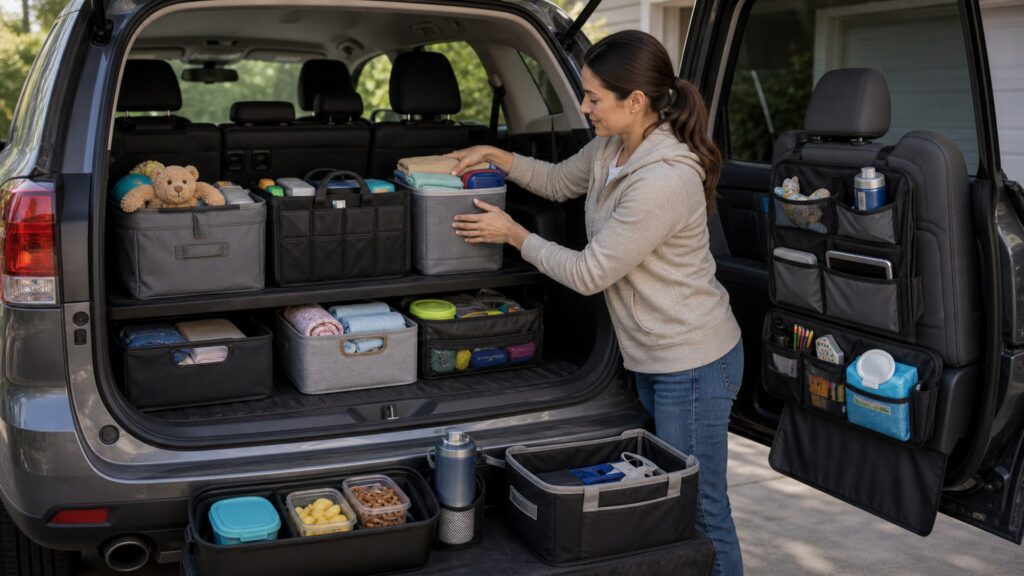
Buying framework
Build zones around the trip sequence
Plan what is loaded, who retrieves it, how it is secured, and how the vehicle is reset from curbside loading through cleanup.
Inventory the real trip: List occupants, child restraints, stroller, bags, food, drinks, devices, medicine, clothing, sports or pet gear, emergency equipment, and what enters or leaves at each stop.
Assign access zones: Keep driver items reachable only while parked or through safe controls; place child items within supervised reach; reserve low secured cargo space for dense gear; keep emergency items accessible after loading.
Protect restraint and exit paths: Keep buckles, belt routes, lower anchors, top tethers, seat tracks, fold releases, doors, airbags, vents, and evacuation movement visible and unobstructed.
Design a reset routine: At trip end remove trash and perishables, dry wet items, recharge devices, return supplies, inspect restraints and attachments, and make one adult responsible for the final cabin check.
Who this is for
Organization changes with family stage and trip type
Infant loading, school runs, sports carpools, and long trips create different access, supervision, cleanup, and cargo-control demands.
Infant and toddler households: Prioritize correct child-restraint installation, uncluttered loading, caregiver reach while parked, diaper and clothing containment, spill removal, and hard-item placement away from occupants.
School and activity carpools: Use labeled zones for bags, footwear, bottles, devices, consent items, and sports equipment while preserving every passenger’s buckle, footwell, door, and exit route.
Long-trip families: Separate driver, passenger, snack, entertainment, sleep, medicine, cleanup, and emergency kits. Control cables and hard devices, then schedule parked resets rather than reorganizing while moving.
Mixed-use vehicles: Choose modular containers that can leave as a unit, restore cargo capacity quickly, preserve tie-downs and folding seats, and make family equipment distinguishable from work or pet gear.
What to pay attention to
Organization specifications that protect occupants
Capacity is useful only when attachment, item mass, restraint clearance, cleaning, and emergency access remain credible under real loading.
Occupants, Restraints & Access
Compare who reaches each zone, child-seat clearance, hard-item exposure, driver distraction, doors, vents, and emergency movement.
Containment, Cleaning & Reset
Compare attachment, load direction, liquid control, washable parts, drying, labeling, modular removal, supply checks, and caregiver handoff.
Location and occupant reach: Map driver distraction, child reach and choking concerns, airbag zones, head and leg space, doors, vents, controls, seat movement, visibility, motion sickness, and retrieval only while parked.
Containment and load direction: Compare lids, zippers, pocket stretch, net tension, bin walls, anti-slip bases, anchor design, rated loads, sharp edges, rigid items, liquid orientation, and behavior under braking or turning.
Child-restraint compatibility: Verify belt and buckle access, lower-anchor and top-tether routes, support-leg areas, seatback contact rules, recline indicators, harness adjustment, carrier removal, and manufacturer prohibitions.
Spill and hygiene workflow: Assess waterproof versus absorbent layers, removable liners, seam leakage, food-safe use, allergen separation, machine washing, drying, odor, mold risk, disinfectant compatibility, and dirty-item isolation.
Cargo and emergency access: Preserve tie-downs, rear visibility, hatch operation, folding seats, spare or tool access, first aid and roadside equipment, stroller loading path, weight distribution, and an unload order that avoids roadside exposure.
Avoid these traps
Family organization that adds clutter or risk
A tidy-looking cabin can still conceal overloaded pockets, loose hard items, inaccessible buckles, wet materials, and routines no one consistently resets.
Hanging heavy items on seatbacks: Organizer seams and straps may not restrain dense bottles, tablets, or tools in a severe stop. Keep heavy objects low and secured in appropriate cargo containment.
Routing straps through restraint hardware: Do not improvise with lower anchors, top tethers, belts, buckles, head restraints, or seat structures unless both vehicle and product instructions explicitly allow the use.
Giving children unrestricted hard items: Convenient reach can increase projectile, choking, spill, entanglement, and distraction risk. Match contents and access to age, supervision, trip state, and secure storage.
Letting cleanup kits become contamination kits: Wet wipes, food, trash, damp clothes, and leaking cleaners degrade in hot cabins and spread odor or residue. Separate, remove, dry, and replenish them deliberately.
Decision guidance
Use fewer zones with clearer ownership
A family system should let an adult see restraints, locate critical supplies, secure dense items, and reset the vehicle without emptying every compartment.
Choose seatback storage if: It remains within rated load, keeps rigid items controlled and away from the occupant, preserves airbags and seat functions, and does not invite unsafe child access.
Choose removable bins if: They are stable or positively secured, labeled by task, washable, low in the cargo area, compatible with tie-downs, and easy to carry inside for restocking.
Choose a cargo net or barrier if: The exact vehicle and load suit its attachment and rating, rear-seat and airbag functions remain intact, and small objects cannot bypass the containment.
Reject the system if: It obscures restraint checks, places hard items near heads, crosses deployment or exit paths, blocks driver vision, leaks, cannot be cleaned, or depends on inconsistent improvised attachment.
Ownership & compatibility
Reset is part of the product
Family equipment changes daily; the organization remains safe only when one short routine restores containment, cleanliness, and restraint visibility.
Use a departure check: Confirm child-restraint installation, buckles and tethers, closed containers, secured devices, clear floors and doors, accessible emergency gear, and driver sight lines before moving.
Perform a weekly inventory: Remove trash, food, medication requiring controlled storage, damaged toys, depleted supplies, wet textiles, redundant items, and equipment children have outgrown.
Reconfigure as the family changes: Repeat measurements and restraint checks after changing car seats, seating positions, passenger count, stroller, school or sports gear, pets, or the child’s reach and mobility.
FAQ
Family vehicle organization FAQ
Answers about seatback organizers, child restraints, hard objects, snack storage, trash, cables, stroller loading, emergency gear, cleaning, and family-stage changes.
Are seatback organizers safe around children?
Can organizer straps use child-seat anchors?
Where should tablets and metal bottles be stored?
How should family snacks be organized?
What makes a vehicle trash container practical?
How should charging cables be routed around children?
Where should a stroller go in the cargo area?
Which emergency items should remain accessible?
When should the family organization system be redesigned?
Bottom line
Family organization should make safety visible
Create clear zones, preserve restraints and exits, secure hard items, isolate spills, keep emergency access, and give the reset routine an owner.
Zone the trip: Assign contents by user, access time, mass, and consequence.
Protect occupants: Keep restraints, airbags, exits, and head space clear.
Reset deliberately: Remove waste, dry materials, restock, and verify attachments.
Reading Shortcuts
Move from family vehicle organization fundamentals to specifications, decision paths, or recurring questions.
Decision Reminders
Keep these family vehicle organization checks visible before committing.
- Inventory: List occupants, restraints, gear, food, and stops.
- Zone: Assign driver, child, cargo, cleanup, and emergency areas.
- Restrain: Control hard and heavy objects.
- Protect: Preserve seats, belts, anchors, airbags, and exits.
- Clean: Separate spills, waste, wet items, and supplies.
- Reset: Give departure and weekly checks an owner.
Glossary Snippets
Terms that clarify family vehicle organization decisions.
When to Use a Top 10 Review
Use rankings after the requirements and compatibility gates are settled.
- Family stage: Filter by occupants and restraints.
- Safety screen: Rank access and containment.
- Cleanup view: Compare liners and washability.
- Reset score: Include caregiver handoff.
Already down to 2–3 options? A Comparison is usually the faster next step.
When to Use a Comparison
Use direct family vehicle organization comparisons when finalists differ in specifications that alter installation, use, or ownership.
- Same occupants: Normalize ages and restraints.
- Same trip: Use identical stops and gear.
- Same loads: Compare real item mass.
- Same reset: Include cleanup and restocking.
Still exploring? Start with a Top 10 to build a shortlist first.