
Car Interior Accessories Buying Guide for Seat and Floor Protection
Seat and floor protection sits directly beside critical safety systems. Driver mats must remain on their intended retention points and clear every pedal through full travel. Seat products may approach side-airbag seams, occupant-classification sensors, buckles, belts, lower anchors, heating and ventilation, controls, and fold mechanisms. Even a perfectly contained spill can become a moisture or abrasion problem when it stays hidden underneath.
This guide compares vehicle-specific liners, carpet mats, seat covers, temporary protectors, kick mats, and removable absorbent layers through exact fit, loaded behavior, retention, restraint clearance, liquid management, material compatibility, cleaning, and under-layer inspection. The goal is protection that can be proven safe and maintained—not simply the greatest thickness or tallest edge.
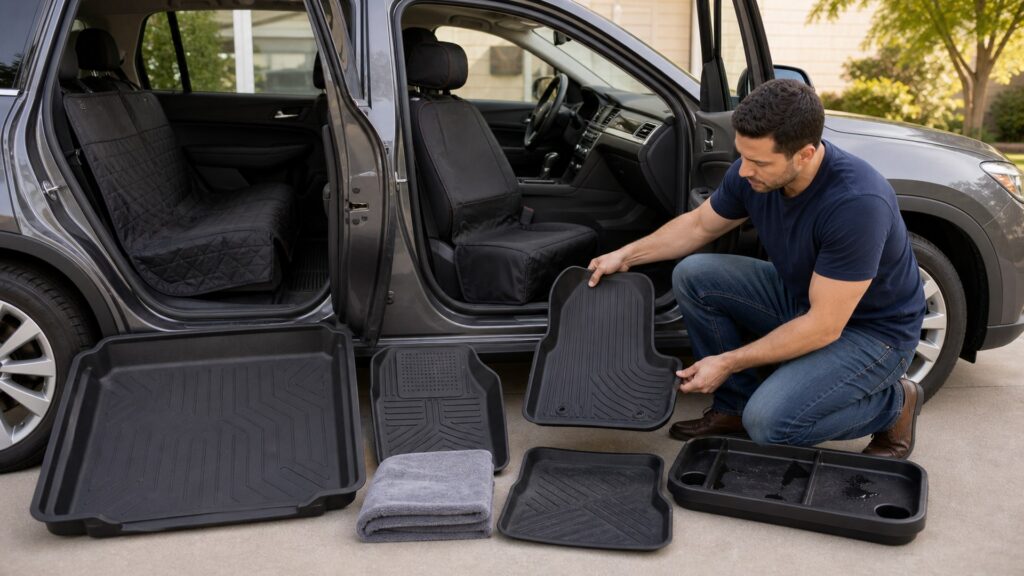
Buying framework
Protect the vehicle without covering its functions
Identify the exposure, map safety hardware, select a retained layer, and build removal and drying into normal care.
Characterize the exposure: Separate dry dust, abrasive grit, mud, snow, salt, drinks, food, pet moisture, child-seat pressure, dye, UV, and repeated shoe or cargo contact. Estimate volume and frequency.
Map the exact protected area: Record floor posts, contours, pedals, footrest, seat rails, under-seat wiring, buckles, anchors, airbag seams, sensors, controls, ventilation, heating, folds, and trim boundaries.
Test loaded retention: Install one layer only, engage all intended anchors, compress covers and protectors with the real occupant or restraint, cycle seats and pedals, then check migration, curling, bunching, and warnings.
Plan the soil exit path: Define how liquid and grit are removed without spilling, where the product is washed, how both sides and the vehicle dry, and when hidden surfaces and attachments are inspected.
Who this is for
Match protection to the contaminant and seat system
Snow, sand, family spills, pets, workwear, and child restraints create different containment, friction, breathability, and cleaning requirements.
Wet-weather drivers: Prioritize exact floor contour, raised containment where it does not interfere, stable anchors, manageable removal, salt cleanup, drainage control, and complete drying beneath liners.
Families with child restraints: Preserve manufacturer-approved installation, buckle and anchor access, support-leg area, top-tether path, seat sensors, and vehicle or restraint rules on protective mats underneath.
Pet and outdoor users: Compare claw and abrasion resistance, traction, hair release, liquid barriers, breathability, washability, attachment, door and belt clearance, and hidden moisture after wet travel.
Lease and resale-focused owners: Favor reversible exact-fit products with low dye and adhesive risk, documented cleaning, regular under-layer photographs, original-part retention, and no unapproved permanent alterations.
What to pay attention to
Protection specifications with real consequences
Judge the complete installed layer under feet, occupants, restraints, temperature, liquid, and repeated removal—not an uninstalled material sample.
Fit, Retention & Safety Hardware
Compare floor anchors, pedal sweep, seat seams, sensors, restraints, controls, loaded thickness, migration, and full-range movement.
Contaminants, Materials & Hidden Surfaces
Compare grit, liquids, salt, friction, dye, breathability, removal, washing, drying, underside inspection, and restoration.
Driver-floor geometry: Verify exact footwell contour, factory retention type and count, flat edges, heel position, footrest, full accelerator, brake and clutch travel, seat movement, and no mat stacking.
Seat-system compatibility: Confirm seat construction, integrated belts, side airbags and seams, occupant sensors, head restraints, buckles, anchors, controls, armrests, folding, heating, ventilation, and manual restrictions.
Material and friction: Compare stiffness across temperature, coefficient of grip, backing compatibility, abrasion, compression set, edge memory, tears, UV stability, odor, dye transfer, plasticizer migration, and surface-coating effects.
Containment and removal: Assess raised-edge location, channel capacity, seam leakage, absorbency, overflow path, trapped grit, lifting without spilling, weight when wet, removable inserts, and access to drains or carpet.
Cleaning and inspection: Review approved cleaners, pressure-wash or machine-wash limits, drying time, underside access, anchor wear, mold and corrosion risk, replacement pieces, warranty exclusions, and inspection interval.
Avoid these traps
Protection products that create hidden problems
The common failures are extra layers, unverified seat compatibility, overfilled channels, and months of moisture or grit concealed beneath a clean-looking surface.
Stacking a new mat over an old one: Multiple layers defeat intended retention, change height and friction, and can enter pedal travel. Remove the prior mat and install only the correct retained product.
Treating airbag wording as universal approval: Seat designs and deployment seams differ. Match the exact vehicle and seat, read exclusions, follow the owner manual, and reject straps or panels crossing protected zones.
Lifting a full liner carelessly: Tall edges do not help if meltwater, mud, or chemicals spill during removal. Reduce volume safely and practice a controlled extraction path.
Cleaning only the visible surface: Grit abrades carpet and upholstery, while moisture, salt, dye, and residue remain underneath. Remove protection on schedule and inspect, clean, and dry both surfaces.
Decision guidance
Select the minimum layer that controls the exposure
Exact fit, dependable retention, compatible material, and easy under-layer care matter more than maximum thickness or aggressive styling.
Choose vehicle-specific floor protection if: The product matches the exact footwell and factory anchors, lies flat through temperature changes, preserves full pedal and seat travel, and can be removed without spilling.
Choose a fitted seat cover if: The exact seat application, airbag seams, sensors, belts, buckles, anchors, controls, heating, ventilation, folding, loaded fit, and removal method are documented.
Use temporary protection if: It is needed for a defined parked or limited task, can be positively controlled, does not affect occupants or controls, and will be removed, cleaned, and dried promptly.
Reject the product if: It stacks, shifts, curls, obscures hardware, changes restraint geometry, triggers warnings, blocks airflow or controls, traps damaging moisture, transfers color, or lacks exact application evidence.
Ownership & compatibility
Inspect what the protector hides
Protection is successful only if the vehicle surface, anchors, seams, and safety functions remain visible enough to verify over time.
Set an under-layer interval: Remove mats and covers based on weather, spills, passengers, pets, and mileage; vacuum grit; inspect anchors, carpet, upholstery, wiring, seams, moisture, odor, dye, and pressure marks.
Dry every layer completely: Clean with compatible methods, remove residue, dry product and vehicle separately, clear channels and fasteners, and reinstall only after confirming correct orientation and retention.
Replace at the first functional defect: Retire curling edges, hardened backing, stretched straps, torn seams, broken anchors, delamination, deformation, persistent odor, staining, or any fit that no longer preserves safety clearance.
FAQ
Seat and floor protection FAQ
Answers about mat stacking, floor anchors, pedal clearance, raised edges, seat airbags, occupant sensors, child restraints, waterproof layers, cleaning, and replacement.
Can I place a rubber mat over the factory carpet mat?
Why do factory floor-mat anchors matter?
How should pedal clearance be tested?
Are taller floor-liner edges always better?
Can seat covers interfere with side airbags?
Can a seat protector affect occupant sensors?
Should a protector go under a child restraint?
Can waterproof protection trap moisture?
When should mats or seat covers be replaced?
Bottom line
Protection must remain safer than the soil
Match the exact vehicle, preserve every safety interface, control contaminants, and inspect beneath the layer before hidden damage develops.
Fit exactly: Verify contours, anchors, seams, hardware, and movement.
Retain securely: Test one layer under real feet, occupants, and temperature.
Inspect underneath: Remove grit and moisture, dry fully, and replace worn parts.
Reading Shortcuts
Move from protective mats and covers fundamentals to specifications, decision paths, or recurring questions.
Decision Reminders
Keep these protective mats and covers checks visible before committing.
- Exposure: Identify grit, liquid, salt, wear, pets, or restraints.
- Fit: Match footwell, seat, anchors, seams, and controls.
- Safety: Protect pedals, airbags, sensors, belts, and movement.
- Contain: Evaluate edges, channels, leakage, and removal.
- Material: Compare friction, heat, dye, odor, and moisture.
- Inspect: Clean and dry both visible and hidden surfaces.
Glossary Snippets
Terms that clarify protective mats and covers decisions.
When to Use a Top 10 Review
Use rankings after the requirements and compatibility gates are settled.
- Fitment field: Filter by exact floor and seat.
- Safety screen: Rank pedal and restraint clearance.
- Soil view: Compare containment and removal.
- Lifecycle: Include hidden-surface inspection.
Already down to 2–3 options? A Comparison is usually the faster next step.
When to Use a Comparison
Use direct protective mats and covers comparisons when finalists differ in specifications that alter installation, use, or ownership.
- Same vehicle: Normalize anchors and seat systems.
- Same exposure: Use identical grit or liquid.
- Same load: Test feet, occupant, or restraint.
- Same cleaning: Include removal and drying.
Still exploring? Start with a Top 10 to build a shortlist first.