
Car Interior Accessories Buying Guide: How to Choose the Right One
Car interior accessories work in a crowded safety space. Seats slide and fold, belts and child restraints carry loads, airbags deploy through defined zones, pedals need unobstructed travel, and drivers need clear sight lines and controls. A mat, cover, organizer, cushion, shade, mount, or storage bin can be useful only if it fits that moving system rather than merely fitting inside the cabin.
This guide starts with the task and the exact vehicle. It explains measurement, retention, restraint and airbag clearance, driver visibility, material behavior, cleaning, installation, return rights, and long-term inspection across common cabin-accessory categories. The aim is a durable improvement that remains secure, usable, and reversible through different occupants, seasons, and seating positions.
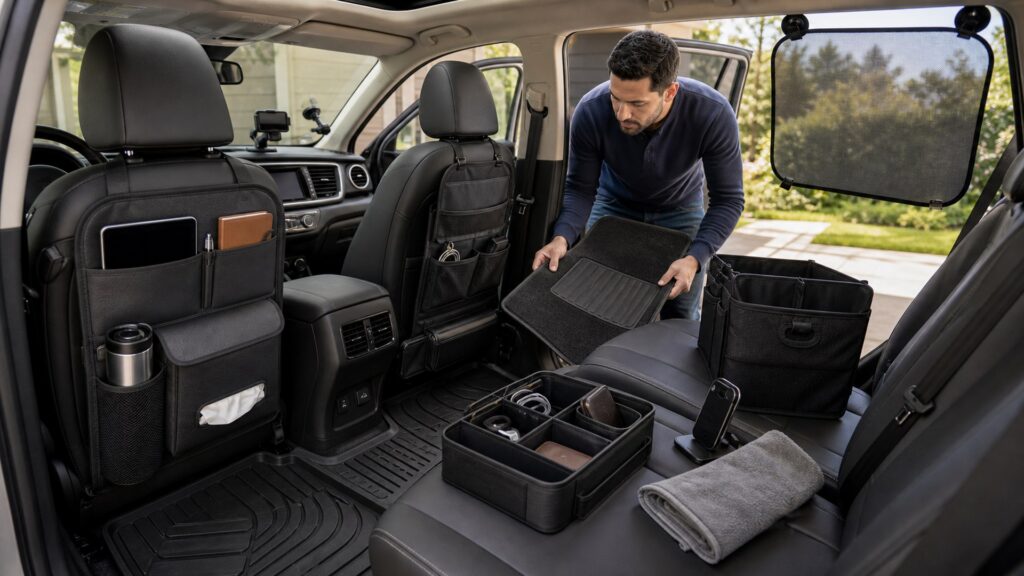
Buying framework
Start with the cabin function, then protect every boundary
A defensible purchase solves a repeated problem without entering the operating space of the vehicle or its occupants.
Name the repeated problem: Describe the spill, wear point, glare, loose-item route, device position, comfort issue, or storage task. Observe frequency and consequence before choosing a product.
Measure the moving fit envelope: Record seats through their travel, recline and fold paths, head restraints, buckles, anchors, rails, pedals, doors, consoles, vents, controls, and the driver’s view.
Mark prohibited zones: Use the owner manual to locate airbags, seat-mounted deployment seams, occupant sensors, belts, child-restraint anchors, pedal space, exits, defroster paths, and warning labels.
Plan installation and removal: Choose retention that resists normal forces without drilling or damaging hidden systems. Trial-fit parked, test every affected function, and keep parts and instructions for restoration.
Who this is for
The right accessory depends on occupant and duty cycle
Daily commuters, families, pets, work vehicles, and occasional travelers create different loads, soils, access needs, and reset routines.
Daily commuters: Prioritize low-friction routines: secure phone and small-item placement, glare control, breathable contact surfaces, fast cleaning, and no interference with driving controls.
Families and caregivers: Protect restraint access, child-seat installation, door openings, spill containment, small-item security, and quick cleaning. Recheck accessories whenever seating changes.
Pet and outdoor users: Compare claws, hair, mud, water, abrasion, traction, barriers, ventilation, attachment strength, and washability without attaching to a restraint point unless expressly allowed.
Work and shared vehicles: Favor standardized placement, inventory, durable surfaces, easy disinfection, tamper-resistant retention, driver handoff, and inexpensive replaceable wear components.
What to pay attention to
Specifications that determine cabin compatibility
Dimensions are the beginning; safe clearance, attachment, material response, and real cleaning determine whether an accessory remains useful.
Cabin Geometry & Safety Systems
Map seats, restraints, airbags, pedals, controls, sight lines, doors, vents, and every moving boundary.
Material, Retention & Lifecycle
Compare attachment, friction, wear, heat, moisture, odor, cleaning, inspection, replacement, and restoration.
Vehicle and trim fitment: Verify model year, body style, seat design, powered or ventilated features, console, floor anchors, head restraints, cargo layout, and left- or right-hand drive where relevant.
Safety-system clearance: Confirm airbag seams and zones, belt paths and buckles, occupant sensors, child anchors, head-restraint movement, pedals, steering, switches, visibility, and emergency egress.
Retention and movement: Assess clips, anchors, straps, friction backing, hook compatibility, tension, sharp edges, load direction, vibration, seat travel, repeated entry, and whether loose parts can become projectiles.
Material performance: Compare temperature, flammability claims, abrasion, compression, breathability, moisture absorption, waterproof barriers, trapped condensation, dye transfer, odor, UV exposure, and chemical compatibility.
Cleaning and lifecycle: Review removable parts, machine-wash limits, drying time, seams, crevices, replacement pieces, warranty exclusions, repairability, recycling, storage, and restoration marks after removal.
Avoid these traps
Accessory choices that create new cabin hazards
Most failures come from treating the interior as static space or accepting a universal-fit claim without a complete functional test.
Shopping by vehicle class alone: Two vehicles in the same class can have different seats, airbags, anchors, consoles, footwells, and cargo trim. Verify year, trim, measurements, and exclusions.
Covering labels or restraint hardware: Fabric, pockets, cushions, and straps can hide buckles, anchors, warnings, or deployment seams. Required hardware must remain visible, reachable, and correctly routed.
Using unsecured containers: A bin that stays put in a parking lot can move during braking or a crash. Use designed retention and keep dense items low and secured.
Ignoring removal evidence: Dye transfer, trapped grit, moisture, adhesive residue, compressed foam, and scratched trim may appear months later. Inspect underneath on a schedule and before return windows close.
Decision guidance
Choose the least intrusive product that solves the task
Prefer exact fit, positive retention, clear safety boundaries, maintainable materials, and a simple return path over extra pockets or thickness.
Choose vehicle-specific fit if: The product approaches pedals, seat seams, anchors, consoles, cargo contours, or moving components where small dimensional errors matter.
Choose a simpler universal accessory if: It occupies a noncritical area, has measured clearance, remains positively retained, and can be tested through every normal vehicle and occupant movement.
Use professional guidance if: The installation affects seats, airbags, occupant sensors, restraints, electrical systems, structural trim, permanent fasteners, or an unclear safety boundary.
Reject the accessory if: It hides warnings, changes belt geometry, interferes with pedals or controls, blocks visibility or exits, cannot be retained, traps damaging moisture, or has unverifiable fit claims.
Ownership & compatibility
Treat fit as a condition that can change
Seat positions, passengers, child restraints, loads, temperature, cleaning, and material wear can turn an acceptable installation into interference.
Inspect after the first week: Look for shifting, strap stretch, pressure marks, blocked hardware, trapped soil, odor, color transfer, loose pieces, new noises, and changed seat or control operation.
Reset for occupant changes: Recheck fit after moving or folding seats, installing child restraints, carrying pets or cargo, lending the vehicle, or changing driver position.
Retire damaged accessories: Replace cracked, curled, stretched, torn, delaminated, heat-deformed, or non-retaining products before pieces enter pedals, controls, restraint paths, or passenger space.
FAQ
Car interior accessories FAQ
Answers about universal fit, airbags, seat sensors, floor mats, organizers, materials, odors, cleaning, installation, and return checks.
Do universal car accessories really fit every vehicle?
Can a seat cover interfere with airbags?
Do cushions affect occupant sensors or belt fit?
What makes a driver floor mat safe?
How should cabin organizers be secured?
Which interior materials handle hot climates well?
How can I avoid chemical odor from an accessory?
How often should interior accessories be cleaned?
What should I test before the return window ends?
Bottom line
A cabin upgrade must respect the whole vehicle
Define the job, measure moving space, protect safety systems, validate retention and materials, then inspect the accessory as conditions change.
Measure movement: Test seats, occupants, controls, restraints, doors, and cargo.
Protect safety space: Keep airbags, belts, pedals, sight lines, and exits clear.
Inspect ownership: Monitor retention, wear, moisture, cleaning, and restoration.
Reading Shortcuts
Move from car interior accessories fundamentals to specifications, decision paths, or recurring questions.
Decision Reminders
Keep these car interior accessories checks visible before committing.
- Task: Name the repeated cabin problem.
- Measure: Map moving seats, controls, and openings.
- Protect: Mark restraints, airbags, pedals, and sight lines.
- Retain: Verify attachment under normal forces.
- Material: Compare heat, wear, moisture, and cleaning.
- Restore: Plan inspection, replacement, and removal.
Glossary Snippets
Terms that clarify car interior accessories decisions.
When to Use a Top 10 Review
Use rankings after the requirements and compatibility gates are settled.
- Fitment field: Filter by exact vehicle and trim.
- Safety review: Compare prohibited-zone clearance.
- Material view: Rank wear and cleaning behavior.
- Lifecycle: Include removal and replacement.
Already down to 2–3 options? A Comparison is usually the faster next step.
When to Use a Comparison
Use direct car interior accessories comparisons when finalists differ in specifications that alter installation, use, or ownership.
- Same vehicle: Normalize seat and trim geometry.
- Same occupants: Use actual seating positions.
- Same task: Compare one repeated problem.
- Same cycle: Include cleaning through removal.
Still exploring? Start with a Top 10 to build a shortlist first.