
Car Phone Mounts Buying Guide for All-Weather Interior Use
The relevant environment is the mount's microclimate. Glass, dash, and vent locations expose hardware and phones to different sunlight, surface temperature, airflow, condensation, and seasonal cycling.
Before choosing hardware, document direct sunlight in the actual vehicle and consult the relevant manuals. This guide connects winter suction and adhesive cure to reversible checks made before installation.
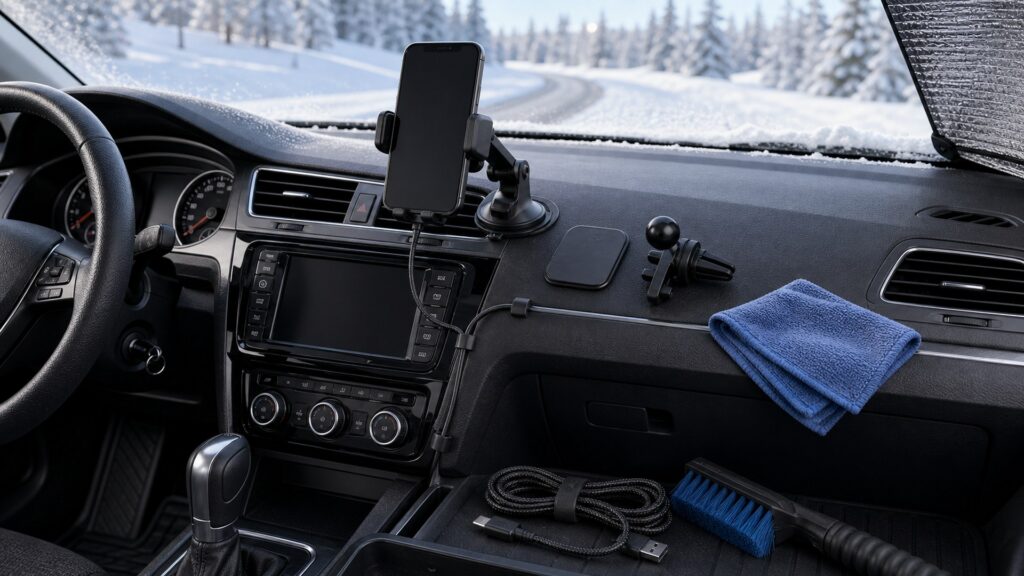
Buying framework
Build the decision around seasonal cabin exposure
The order matters: establish the outdoor-parked car weathered interface and use constraints before comparing convenience features. These four checks prevent a superficially compatible weather-exposed holder system from becoming a daily nuisance.
Direct-Sun Exposure: Map direct-sun exposure before shopping, then reject locations that compromise vent heating airflow. This sets the first priority for the intended seasonal routine.
Summer Dashboard Temperature: Treat summer dashboard temperature as a physical constraint; reconfirm it with air-conditioning condensation in the typical sun-aware position. The result narrows which interfaces deserve comparison.
Winter Suction Flexibility: Compare attachment styles only after documenting winter suction flexibility and the limits created by thermal charging limits. That evidence prevents a convenience feature from masking poor climate-ready fit.
Adhesive Cure Conditions: Use a parked mock-up to judge adhesive cure conditions, paying particular attention to UV-aged plastics during adjustment. Keep only positions that remain workable without improvisation.
Who this is for
Match the material system to the actual user
Different owners expose the product to different combinations of direct sunlight, heated vent flow, and UV-aged joints. Weight the profile that best matches the recurring risk.
Hot-climate parker: This owner should establish direct sunlight first, then check whether adhesive cure changes the result. Reproduce the occupied cabin and regular equipment so the trial reflects seasonal exposure rather than a store display.
Cold-weather commuter: For this routine, document winter suction with all regular components present. Compare alternatives only after heated vent flow has been observed through its full movement or contact range.
Four-season road user: Give this user a separate trial centered on adhesive cure. The better candidate preserves charging temperature without additional pressure, a blocked control, or a special handling sequence.
Outdoor-work vehicle owner: This profile benefits from a reversible setup that makes heated vent flow easy to inspect. Recheck UV-aged joints after normal adjustment and retain the option with the fewest assumptions.
What to pay attention to
Specifications that become real interior microclimate consequences
Translate dimensions, materials, and compatibility claims into visible outcomes for seasonal exposure. Record the first point where winter suction changes access, movement, surface contact, or intended function.
outdoor-parked car weathered interface
Judge attachment and airflow gap against the interior microclimate conditions that shape seasonal cabin exposure.
operating Use
Observe the weather-exposed holder system with the real temperature-limited handset and cable in place, not as an empty display.
direct sunlight: Compare shaded and sun-facing positions because radiant heat can differ sharply within the same cabin.
winter suction: Use suction hardware only on approved surfaces and follow the maker's cold-weather installation and reattachment directions.
adhesive cure: Respect the stated preparation, application, cure, and temperature limits for every bonded pad or dashboard disc.
heated vent flow: Avoid directing sustained heated air at the phone when navigation and charging are already adding heat.
charging temperature: Treat charging pauses and temperature warnings as reasons to cool or relocate the setup, not nuisances to bypass.
Avoid these traps
Shortcuts that create hidden conflicts
Most disappointments begin with an assumption made before seasonal setup. Correct the buying logic while the weather-exposed holder system can still be returned or repositioned.
Treating cabin temperature as uniform: A sunlit windshield zone, shaded console, and active vent can differ substantially. Evaluate the exact mounting point and the phone's combined navigation and charging load rather than relying on the dashboard temperature display.
Bonding outside the application range: Cold trim, overheated surfaces, moisture, dressings, or shortened cure time can undermine an adhesive installation. Follow the specified cleaner, temperature window, pressure, and waiting period for the supplied pad.
Forcing stiff winter hardware: Plastic and elastomer behavior can change in cold conditions. Do not wrench a reluctant joint, jaw, or suction lever; unload it, inspect for damage, and follow the maker's instructions before attempting adjustment.
Ignoring gradual solar aging: A mount can remain attached while its arm, pad, or cable becomes brittle. Seasonal inspection should include discoloration, cracks, lost elasticity, joint creep, and changes at every sun-exposed contact point.
Decision guidance
Turn constraints into a clear choice
Use the interior microclimate's limiting condition to narrow the material system. The objective is to select the lower-exposure zone and attachment chemistry for the interior microclimate's temperature cycle.
For long periods in direct sun: Favor the coolest workable cabin zone that preserves the driver's view and controls. A shade, shorter exposure, or removable mount may be more reliable than expecting adhesive, plastic, and a charging phone to tolerate maximum heat.
For repeated freezing starts: Use an attachment whose instructions cover the surface and temperature involved. Do not force a stiff joint or rely on a suction seal that has lifted; warm and reinstall components only as the maker directs.
For vent-mounted charging: Separate airflow convenience from phone temperature. Redirecting heated air, reducing charging load, or selecting a non-vent position may be necessary when navigation, wireless power, and cabin heat overlap.
For year-round outdoor work: Choose replaceable pads and joints, reversible installation, and an inspection routine. Seasonal reliability matters more than an extra arm position if UV exposure or temperature cycling steadily changes holding force.
Ownership & compatibility
Keep the weathered interface clean, stable, and reversible
Weather-related wear appears gradually in seals, pads, plastics, springs, and bonded interfaces. Inspect at seasonal changes and whenever the phone begins vibrating, charging intermittently, or returning to a different angle.
Inspect after temperature swings: With the cabin parked and moderate, check suction edges, adhesive pads, vent engagement, and joint play. Reinstall only according to the accessory maker's preparation and temperature limits.
Keep contact areas clean: Dust and skin oils weaken some interfaces, while aggressive cleaners can damage trim or elastomers. Use methods approved for both the vehicle surface and the mount material.
Respond to phone heat: If the device dims, pauses charging, or displays a temperature warning, reduce the thermal load and follow its maker's guidance. Do not cover the warning by tightening or relocating hardware while driving.
FAQ
Questions about seasonal exposure
These answers address climate-ready fit and use details that are easiest to reconfirm before permanent seasonal setup.
Which mount location is coolest in summer?
Does winter cold weaken a suction mount?
When should an adhesive pad be installed?
Can a mount stay on a heated vent?
Why does wireless charging stop in hot weather?
What should I inspect after a very cold night?
How does ultraviolet exposure affect a mount?
Is a windshield mount better than a vent mount for weather?
How should two all-weather finalists be compared?
Bottom line
specify for the interior microclimate you actually use
A sound seasonal exposure choice passes the vehicle-specific boundaries without sacrificing a safety-related opening, control, surface, or function.
Start with the interior microclimate: Confirm direct-sun exposure and summer dashboard before choosing features that cannot rescue a poor lower-exposure zone.
Test the operating setup: Use the real temperature-limited handset, case, charging lead, seat sun-aware position, and screen orientations to expose conflicts before permanent seasonal setup.
Prefer repeatable use: The sound choice for seasonal cabin exposure preserves the key interior microclimate function without a fragile workaround.
Reading Shortcuts
Jump to the decision layer that matters most for seasonal cabin exposure.
Seasonal Exposure Checks
Complete these observations in the parked vehicle with the normal load present.
- Direct Sunlight: Write down the available range.
- Winter Suction: Observe movement under load.
- Adhesive Cure: Keep the affected path unobstructed.
- Heated Vent Flow: Repeat after a representative cycle.
- Charging Temperature: Include every connected component.
- Uv-Aged Joints: Retain a reversible exit plan.
Glossary Snippets
Terms that define the physical boundaries behind seasonal exposure.
When to Use a Top 10 Review
Use a ranked shortlist after the vehicle limits for direct sunlight and UV-aged joints are documented.
- Direct Sunlight: The limiting condition is documented.
- Winter Suction: The loaded behavior has been observed.
- Adhesive Cure: The relevant movement path remains usable.
- Heated Vent Flow: The recurring ownership demand is understood.
Already down to 2–3 options? A Comparison is usually the faster next step.
When to Use a Comparison
Compare finalists against the same seasonal exposure setup, manuals, movements, and contact surfaces.
- Adhesive Cure: Both candidates preserve this boundary.
- Heated Vent Flow: Both survive the representative routine.
- Charging Temperature: Both include the complete everyday setup.
- Uv-Aged Joints: The remaining difference changes a real outcome.
Still exploring? Start with a Top 10 to build a shortlist first.