
Car Phone Mounts Buying Guide for Family Vehicle Organization
In a shared family passenger area, a family handset shared-car holder must coexist with passengers, bags, child gear, and several devices. For family family car organization, the useful accessory is the one that can give the household driver a dependable screen shared position without turning the center stack into a tangle. That requires checking the passenger area and the occupied setup together instead of trusting a universal-household fit label.
Treat the center stack as shared family space: the mounted phone must coexist with another driver, front passengers, school bags, and child-loading routines. This guide turns shared driver positions, passenger knee room, and child-seat loading into parked checks before any permanent commitment.
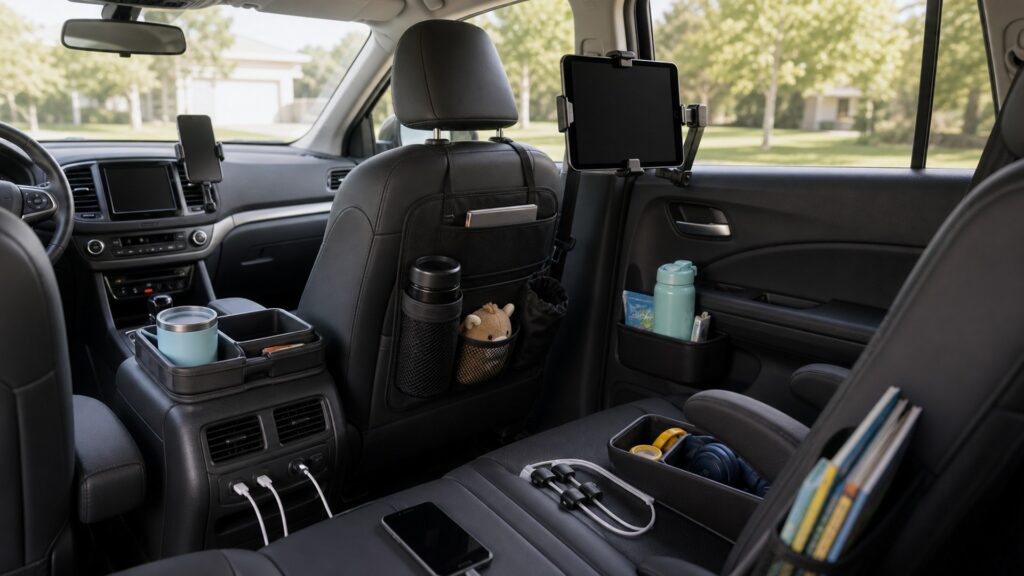
Buying framework
Build the decision around family family car organization
The order matters: establish the family car shared interface and use constraints before comparing convenience features. These four checks prevent a superficially compatible accessory from becoming a daily nuisance.
Shared-Device Adjustment: Map shared-device adjustment before shopping, then reject locations that compromise small-item tray access. This sets the first priority for the intended family schedule.
Passenger Knee passenger gap: Treat passenger knee passenger gap as a physical constraint; make certain it with child-seat loading path in the routine shared position. The result narrows which interfaces deserve comparison.
Rear-Seat Sightline: Compare attachment styles only after documenting rear-seat sightline and the limits created by quick removal for another household driver. That evidence prevents a convenience feature from masking poor household fit.
Charging-Cable Labeling: Use a parked mock-up to judge charging-cable labeling, paying particular attention to case-size variation during adjustment. Keep only positions that remain workable without improvisation.
Who this is for
Match the format to the actual user
Readers differ most in shared driver positions, labeled charging leads, and crumb-prone joints. Use the closest profile to decide which compromise will recur often enough to matter.
Two-household driver Household: This profile should establish shared driver positions first and observe passenger knee room with the complete everyday load. A feature is useful only when it reduces effort in this specific this use case routine.
School-Run household driver: Give first priority to charging-cable labeling, then make certain the shared driver positions factor driver. A comfortable shared position should remain usable without changing the seat posture.
Family Road-Trip Planner: Give this user a separate parked trial focused on child-seat loading and case-size variation. Those constraints can disqualify an otherwise attractive product before comfort or convenience features enter the comparison.
Teen-household driver Supervisor: For the most demanding profile, document labeled charging leads and crumb-prone joints across several normal positions. Select the arrangement that returns to a predictable state without forcing hardware or changing a safety-related opening.
What to pay attention to
Specifications that become real passenger area consequences
Translate published dimensions and materials into evidence about labeled charging leads and case-size variation. A number matters only when it predicts a visible consequence in this exact cabin arrangement.
family car shared interface
Judge attachment and passenger gap against the passenger area conditions that shape family family car organization.
occupied Use
Observe the accessory with the real family handset and cable in place, not as an empty display.
small-item tray: Measure it with the accessory occupied; unloaded dimensions can hide flex or interference. Record any movement that changes the viewing shared position.
child-seat loading: Evaluate the stated range against passenger knee room rather than the unloaded product. Record the boundary where movement, pressure, obstruction, or loss of access first appears.
this constraint driver: Material construction becomes relevant at child-seat loading. Inspect the contacting faces, edge geometry, and cleaning guidance instead of treating a broad durability claim as proof of compatibility.
case-size variation: Check the entire movement envelope, not only the shared position shown in a accessory photo. Make sure every frequently used control completes its routine travel.
Crumb-Resistant Joints: Use case-size variation as the final specification check. Confirm the whole assembly in both its working and stowed states, including cables, case thickness, occupants, or restraint hardware where applicable.
Avoid these traps
Shortcuts that create hidden conflicts
Most disappointments begin with an assumption made before mounted arrangement. Correct the buying logic while the accessory can still be returned or repositioned.
Assuming passenger knee passenger gap will sort itself out: A accessory may attach yet place the load where it blocks a frequently used control or sightline. Pair this check with the measured boundary driver before accepting the common mounting zone.
Assuming rear-seat sightline will sort itself out: Catalog dimensions rarely capture trim curvature or movement around the installed accessory. Recreate the passenger area shared position and observe case-size variation with the full load present.
Assuming charging-cable labeling will sort itself out: A successful first fitting does not prove long-term behavior at labeled charging leads. Repeat the assessment after representative adjustment, vibration, loading, or temperature exposure and look for a changed contact point.
Assuming small-item tray will sort itself out: Solving one passenger gap problem can create another elsewhere in the cockpit. Move the relevant controls through their range while checking stable portrait navigation.
Decision guidance
Turn constraints into a clear choice
Use the passenger area's limiting condition to narrow the format. The objective is to favor predictable placement and easy handoffs over elaborate articulation.
If shared-device adjustment is the limiting factor: Favor a format with measurable frequently used control over small-item tray. Validate case-size variation and abandon any common mounting zone that intrudes on the road view or a safety system.
If passenger knee passenger gap is the limiting factor: Narrow the choice to configurations that leave adjustment room for child-seat loading. A parked trial should also preserve crumb-resistant joints without a special sequence.
If rear-seat sightline is the limiting factor: Select the simpler shared interface when it handles that practical limit driver consistently. Test stable portrait navigation after loading the passenger area rather than relying on an empty mock-up.
If charging-cable labeling is the limiting factor: Prefer reversibility until case-size variation has been proven. Check shared-device adjustment across routine positions before exposing adhesive or tightening permanent hardware.
Ownership & compatibility
Keep the shared interface clean, stable, and reversible
Initial household fit is only the first checkpoint. Heat, cold, dust, cleaning, adjustment, and changes in devices or occupants can alter the shared interface.
case-size variation: Recheck case-size variation after the first week, then clean away grit before it can abrade the contact family-passenger area surface. If the shared interface loosens or shifts, remove the load and correct the cause before driving.
crumb-resistant joints: Temperature cycles and repeated adjustment can alter crumb-resistant joints. Follow the accessory's cleaning instructions, inspect soft pads or fasteners, and replace worn parts rather than compensating with excessive pressure.
stable portrait: Changes to the family handset, case, occupants, or passenger area use can invalidate the original stable portrait check. Repeat the parked household fit test and keep removal guidance available for any bonded component.
FAQ
Questions about car family handset mounts and family family car organization
These answers address household fit and use details that are easiest to make certain before permanent mounted arrangement.
How should I evaluate shared-device adjustment this constraint?
How should I evaluate passenger knee passenger gap the measured boundary?
How should I evaluate rear-seat sightline this constraint?
How should I evaluate charging-cable labeling the measured boundary?
How should I evaluate small-item tray this constraint?
How should I evaluate child-seat loading the measured boundary?
How should I evaluate that practical limit driver this constraint?
How should I evaluate case-size variation that practical limit?
How should I evaluate crumb-resistant joints this constraint?
Bottom line
favor for the passenger area you actually use
the measured boundary, the best accessory is defined by placement, occupied behavior, and repeatability rather than the longest feature list.
Start with the passenger area: Confirm shared-device adjustment and passenger knee passenger gap before choosing features that cannot rescue a poor common mounting zone.
Test the occupied setup: Use the real family handset, case, charging lead, seat shared position, and screen orientations to expose conflicts before permanent mounted arrangement.
Prefer repeatable use: The sound choice that practical limit preserves the key passenger area function without a fragile workaround.
Reading Shortcuts
Jump to the decision layer that matters most this constraint.
the stated priority Checks
Complete these observations in the parked vehicle with the normal load present.
- Shared Driver Positions: Write down the available range.
- Passenger Knee Room: Observe movement under load.
- Child-Seat Loading: Keep the affected path unobstructed.
- Labeled Charging Leads: Repeat after a representative cycle.
- Case-Size Variation: Include every connected component.
- Crumb-Prone Joints: Retain a reversible exit plan.
Glossary Snippets
These terms define the physical boundaries behind shared-family organization, including shared driver positions and case-size variation.
When to Use a Top 10 Review
A ranked shortlist becomes useful after crumb-prone joints is understood and unsuitable product families have been removed.
- Shared Driver Positions: The limiting condition is documented.
- Passenger Knee Room: The loaded behavior has been observed.
- Child-Seat Loading: The relevant movement path remains usable.
- Labeled Charging Leads: The recurring ownership demand is understood.
Already down to 2–3 options? A Comparison is usually the faster next step.
When to Use a Comparison
Compare finalists against the same this use case checklist rather than separate marketing claims.
- Child-Seat Loading: Both candidates preserve this boundary.
- Labeled Charging Leads: Both survive the representative routine.
- Case-Size Variation: Both include the complete everyday setup.
- Crumb-Prone Joints: The remaining difference changes a real outcome.
Still exploring? Start with a Top 10 to build a shortlist first.