
Car Wash Equipment Buying Guide for Paint and Finish Care
Paint-safe equipment minimizes abrasive contact from the first rinse through the final dry; it cannot compensate for dirty media, hot panels, incompatible chemistry, or excessive pressure.
Reduce wash-induced marring by matching pre-rinse capability, lubricious chemistry, clean wash media, dirt isolation, pressure control, dedicated wheel tools, gentle drying, lighting, and decontamination boundaries to the finish. Keep the paint-safe washing recommendation conditional until pre-rinse effectiveness, chemical lubrication, and inspection lighting agree with the final check.
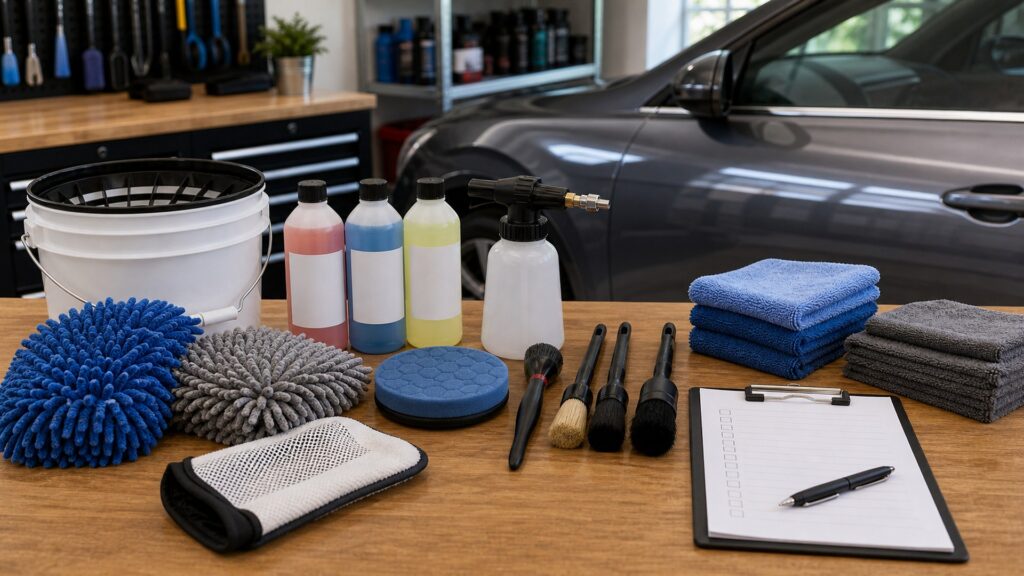
Buying framework
Build the paint-safe wash equipment decision
Paint-safe washing begins with finish condition, is constrained by dirt isolation, and finishes through inspection lighting.
Capture the starting condition: For paint-safe washing, document finish condition. Photograph pre-rinse effectiveness, identify the vehicle or surface, and preserve paint-safe washing evidence from prior work.
Separate cause from symptom: Test pre-rinse effectiveness against chemical lubrication. The paint-safe washing diagnosis must explain the paint-safe washing system, not merely the easiest visible defect.
Map paint-safe washing material and equipment limits: Make wash-media cleanliness agree with dirt isolation. Apply the exact paint-safe washing instructions for paint-safe washing vehicle, surface, chemical, component, and tool.
Price the completed workflow: Combine chemical lubrication with access and cleanup. Add pressure and contact control, paint-safe washing materials, paint-safe washing setup, verification, downtime, and labor.
Define the finish line: Set stop conditions for drying friction. Preserve inspection lighting as the paint-safe washing paint-safe washing release or storage record.
Who this is for
Situations that reshape paint-safe wash equipment
Vehicle condition, surface, work area, prior service, and failure consequence change which paint-safe washing evidence matters most.
Soft or dark clear coat: Maximize pre-rinse, use multiple clean plush media, inspect frequently, separate lower panels, minimize passes, and dry with high-capacity clean towels under good lighting.
Ceramic-coated vehicle: Follow coating-maintainer guidance, choose compatible shampoo and drying aids, avoid aggressive contamination removal during routine washing, and diagnose declining behavior before polishing.
Matte paint or wrap: Use products and tools explicitly suitable for the surface, avoid gloss-enhancing or abrasive steps, control edges and pressure, and test unfamiliar chemistry discreetly.
Vehicle with bonded contamination: Routine wash equipment should remove loose soil. Tar, sap, mineral deposits, fallout, and overspray need identified chemistry or professional correction, not harder mitt pressure.
Winter salt and road film: Prioritize underbody and crevice rinse where appropriate, generous pre-cleaning, cool panels, wheel segregation, and complete rinse while respecting electrical, brake, and runoff constraints.
What to pay attention to
Specifications governing paint-safe wash equipment
Read finish condition, dirt isolation, and drying friction as connected gates; passing one paint-safe washing gate does not waive another.
Condition and compatibility
Finish condition, Pre-rinse effectiveness, Wash-media cleanliness, Dirt isolation.
Process and verification
Chemical lubrication, Pressure and contact control, Drying friction, Inspection lighting.
Finish condition: Inspect swirls, scratches, chips, oxidation, repaint, coating, film, matte areas, trim, sharp edges, and existing contamination. Set realistic wash and correction boundaries before choosing tools.
Pre-rinse effectiveness: A useful pre-rinse delivers enough flow and controlled fan pressure to remove loose grit from top, lower panels, gaps, wheels, and wheel wells without forcing water into vulnerable interfaces.
Wash-media cleanliness: Use clean plush mitts or pads with intact seams and no hard debris; dedicate pieces by panel zone and replace contaminated media. Softness at purchase does not guarantee cleanliness in use.
Dirt isolation: Buckets, separators, multiple media, rinse methods, and panel sequencing should keep released soil away from the next paint contact. The objective is contamination control, not ritual.
Chemical lubrication: Select lubricious vehicle wash at correct dilution and use foam or pump applicators as controlled delivery tools. Foam thickness alone says little about encapsulation, cleaning, rinse, or compatibility.
Pressure and contact control: Maintain nozzle distance and fan pattern, avoid rotating or pinpoint jets, reduce contact force, use straight controlled passes, and protect chips, edges, badges, cameras, seals, and repainted areas.
Drying friction: Choose high-capacity clean microfiber, safe air, or a compatible combination that reduces repeated wiping. Blot or glide as appropriate; retire towels carrying grit or hardened edges.
Avoid these traps
Errors that undermine paint-safe wash equipment
These paint-safe washing shortcuts confuse paint-safe washing appearance, pressure, price, or a single symptom with a complete paint-safe washing result.
Scrubbing before loose grit is removed: Abrasive soil trapped between media and paint creates marring. Improve pre-rinse and lubrication before adding pressure or passes.
Using foam as a safety guarantee: Foam can dwell unevenly, dry, or slide away. Product dilution, panel temperature, actual cleaning, rinse, and contact method remain controlling.
Reusing dropped media: A mitt or towel that touches the ground should leave the paint workflow until thoroughly cleaned and inspected. Visible shaking is not decontamination.
Mixing wheel and paint towels: Metallic brake dust and harsh residues can transfer after washing. Color-code, store, launder, inspect, and retire wheel media separately.
Drying with low-capacity towels: Saturated or contaminated towels require repeated friction and may redeposit soil. Size drying capacity for the vehicle and inspect every contact surface.
Decision guidance
Choose by the unresolved condition
Branch on the remaining paint-safe washing uncertainty, then close the paint-safe washing question with paint-safe washing materials, controlled procedure, and retained verification.
If the finish is already marred: Use paint-safe washing to avoid adding defects, then assess correction separately. Wash equipment should not promise to polish scratches away.
If no-touch washing leaves film: Improve pre-cleaning and chemistry within safe limits, then use controlled lubricated contact rather than escalating to a harsh jet.
If water spotting is common: Manage panel temperature, section size, rinse quality, dwell, and drying speed; consider compatible filtered water or drying aid under manufacturer guidance.
If the vehicle has mixed surfaces: Create separate chemistry and media rules for gloss paint, matte film, glass, trim, wheels, and coated areas; the most aggressive surface should not set the whole workflow.
If time is short: Wash fewer areas correctly or defer the job. Rushing contact and drying on hot dirty paint is worse than a planned safe wash later.
Ownership & compatibility
Preserve a usable work record
A paint-safe washing file should identify the choice, procedure, result, and later paint-safe washing follow-up without reconstructing the record.
Save identity and condition: File finish condition with paint-safe washing photographs, date, invoice, and equipment identity. Store pre-rinse effectiveness in the same paint-safe washing record.
Record materials and procedure: Connect wash-media cleanliness to dirt isolation. Note every paint-safe washing paint-safe washing chemical, dilution, tool, environment, instruction revision, and stop condition.
Keep setup and verification outputs: Attach proof of drying friction. Preserve paint-safe washing paint-safe washing calibration, cure, moisture, finish, scan, inspection, or operational output where paint-safe washing work requires it.
Track later performance: Link later paint-safe washing damage, warnings, residue, odor, moisture, or claims to inspection lighting. Keep each paint-safe washing paint-safe washing follow-up with the original work file.
FAQ
Car Wash Equipment paint-safe wash equipment FAQ
Answers about finish condition, paint-safe washing equipment boundaries, procedure, evidence, and follow-up.
How should swirl prevention be evaluated?
Why does pre-rinse role matter?
What evidence supports mitt materials?
When should grit separators change the plan?
Can foam cannons be handled routinely?
What mistake is common with pressure limits?
How is matte finishes verified?
What should be recorded about drying technique?
When does towel laundering need specialist help?
Bottom line
Complete paint-safe wash equipment without a missing link
The paint-safe washing identity, interfaces, paint-safe washing procedure and measured outcome must support one conclusion.
Identify: Begin paint-safe washing work with finish condition and pre-rinse effectiveness.
Match: For paint-safe washing, cross-check wash-media cleanliness against dirt isolation.
Control: During paint-safe washing work, manage chemical lubrication and document pressure and contact control.
Verify: Close the paint-safe washing record with drying friction and inspection lighting.
Reading Shortcuts
Confirm application and condition first.
Decision Reminders
Checks to complete before committing.
- Confirm the exact application: Cross-check vehicle, engine, housing, and original part.
- Preserve removed-part clues: Contamination and damage can identify another fault.
- Keep the work clean: Keep downstream openings protected.
- Follow the procedure: Respect pressure, fluids, torque, priming, and resets.
- Inspect interfaces: Seals, caps, connectors, threads, and fittings must agree.
- Verify before release: Check leaks, warnings, starting, idle, and road behavior.
Glossary Snippets
Terms used in this decision.
When to Use a Top 10 Review
Use rankings after application and service scope are documented.
- Application confirmed: Filter with exact engine and interface evidence.
- Duty identified: Compare parts for the real interval and environment.
- Evidence published: Rank construction, testing, traceability, and support.
- Job scope complete: Include seals, fluids, tools, and verification.
Already down to 2–3 options? A Comparison is usually faster.
When to Use a Comparison
Compare finalists for the same verified application.
- Interfaces: Match dimensions, seals, valves, fittings, and connectors.
- Performance evidence: Compare documented efficiency, capacity, and service claims.
- Included content: List every seal, cap, sensor, boot, and fitting.
- Installed outcome: Price fluids, labor, priming, disposal, and downtime.
Still building a shortlist? Start with a Top 10.