
Cardio Equipment Buying Guide for Home Gyms
Cardio equipment in a home gym has to share space with the people, pathways, and other equipment around it. A treadmill, bike, rower, elliptical, or stepper creates a different room requirement.
Measure the active footprint, floor, ceiling, power, noise, storage, delivery path, and service access before comparing features. The best machine is the one the household can use and reset without friction.
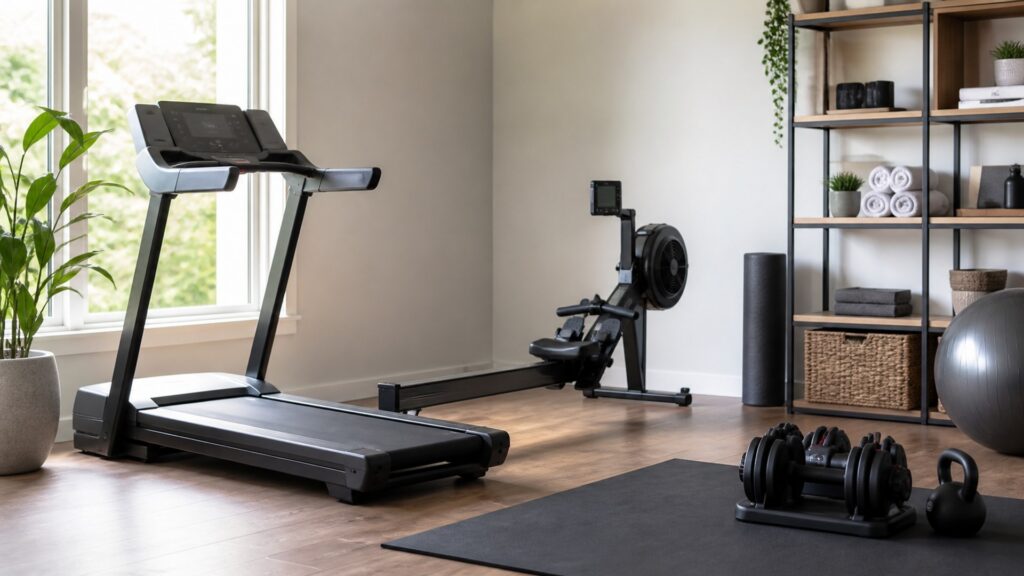
Buying framework
Fit the cardio machine to the home
Home-cardio buying starts with the room and ends with a machine people can start, use, and store without disrupting the household.
Measure active clearance: Include entry, dismount, arm movement, rear clearance, ceiling height, and the space needed to move around the machine.
Match the floor and neighbors: Impact, vibration, motors, fans, and foot contact interact with floors and shared walls. Choose the machine and protective surface together.
Check power and airflow: Powered cardio machines need the right outlet, cord path, and breathing room. Do not crowd a motor or block a room vent.
Choose a routine before a feature list: A machine should serve the movement and duration the household will actually use. A long menu cannot compensate for poor room fit.
Plan the reset: Shared homes need storage, quick controls, towel and bottle placement, and enough pathway to return the room to its other purpose.
Who this is for
Match the machine to the home gym
The same cardio type can work in one room and fail in another. Start with the room's constraint.
Spare-bedroom gym: Favor compact active clearance, manageable noise, and a storage mode that preserves the room's other function. Check floor protection before adding a machine.
Garage gym: Measure ceiling, temperature, moisture, floor condition, power, and delivery access. A large treadmill or rower still needs a clear service and storage plan.
Apartment workout space: Noise, vibration, and dismount space are first-order criteria. Seated cycling or quieter compact equipment may be easier to use than impact-heavy formats.
Shared household gym: Choose clear adjustments, broad fit, visible controls, and storage that can be reset quickly. Leave room for different users to enter and exit.
Cardio-plus-strength room: Reserve the active zone and storage for both the machine and weights. A cardio purchase should not eliminate the clearance needed for the rest of the program.
What to pay attention to
Read cardio specifications as room requirements
Home-gym specifications describe what the machine asks of the room. Translate each one into movement, noise, power, and reset consequences.
Home Space & Infrastructure
Judge active footprint, floor, ceiling, power, noise, airflow, and delivery access.
Training Fit & Household Flow
Judge movement, controls, shared adjustment, storage, and how quickly the room resets.
Active dimensions: A machine's working zone includes the user, the handles or deck, entry, dismount, and any folding or moving parts. Draw it on the floor before delivery.
Ceiling and overhead clearance: Treadmill users, pull-up areas near cardio, and tall steppers need room above the user. Measure the lowest obstruction.
Floor and vibration behavior: Base design, feet, rollers, and impact interact with the floor and neighboring rooms. Plan protection and noise control before installation.
Power and cord routing: Check outlet location, cord length, access, and trip protection. Powered equipment should not force a cord across a walking path.
Control and shared fit: Speed, incline, resistance, seat, stride, and handle settings should change clearly for different users without a full reconfiguration.
Service access: Leave room to inspect belts, rails, pedals, motors, and cables. A corner that looks efficient can make routine care impossible.
Avoid these traps
Home-cardio planning mistakes
A home cardio machine has to coexist with the room. Most failures come from treating the machine as a standalone object.
Measuring the folded machine only: The deck, pedals, handles, and user need room while exercising. A foldable product can still be too large for the active zone.
Leaving flooring until later: Impact, rollers, and vibration can mark floors or transmit noise immediately. Decide what the surface needs before the machine arrives.
Ignoring delivery and service: Large equipment needs turns, door clearance, assembly room, and future access. A product that fits the final wall may not fit the route there.
Buying by screen features: Streaming and programs do not solve a poor movement fit, loud motor, or crowded dismount. Judge the room and session first.
Forgetting shared schedules: Noise, heat, and quick reset matter when more than one person uses the room. Consider when the machine will actually be available.
Decision guidance
Choose the home-cardio format
Use the room and the primary movement together; either one can disqualify an otherwise attractive machine.
If walking or running is the anchor and the room has clearance, choose a treadmill: Check deck, handrails, ceiling, rear clearance, noise, power, and folding behavior. Make sure the storage position does not block a door or route.
If quiet seated cardio matters, choose an exercise bike: Compare upright or recumbent fit, saddle adjustment, resistance, power needs, noise, and the space to mount and dismount.
If you want full-body work and can store the length, choose a rower: Measure the rail, stroke space, rear clearance, fold or stand-up storage, and the pathway to put it away.
If you prefer guided low-impact movement, choose an elliptical: Check stride, step-on height, handle path, ceiling clearance, base width, and noise. A larger active zone may be needed than the image suggests.
If the room must serve strength work too, choose the cleanest multi-use footprint: A compact bike or foldable format may leave more open floor than a large machine. Compare what the cardio product displaces from the rest of the gym.
Ownership & compatibility
Maintain the home around the machine
Home-cardio care includes the equipment, the floor, the power path, and the air around it.
Clean sweat and floor contact: Wipe touch points and vacuum around the base. Follow care instructions for decks, belts, pedals, rails, and displays.
Keep service access: Do not pack storage against motors, belts, rollers, or power connections. Leave the path needed for inspection and repair.
Check cords and airflow: Inspect plugs, cords, outlets, and vents. Keep cables out of traffic and avoid blocking the machine's cooling path.
Watch noise and vibration: A new rattle, scrape, or movement through the floor is a reason to stop and investigate before continuing normal use.
FAQ
Cardio equipment for home gyms FAQ
Answers about space, power, noise, and machine selection at home.
What cardio equipment is best for a home gym?
How much space does a home cardio machine need?
Can I put cardio equipment on any floor?
Do home cardio machines need a dedicated outlet?
Which cardio machine is quietest for an apartment?
Should I buy a foldable treadmill for a small home gym?
How do I protect a home gym floor under cardio equipment?
Can a home cardio machine share a room with weights?
How often should I inspect a home cardio machine?
Bottom line
Buy the machine the room can live with
Home cardio succeeds when the machine supports the routine without taking over the space or household schedule.
Measure use: Plan active clearance, entry, dismount, ceiling, and storage.
Protect the home: Check floor, noise, power, airflow, and pathways.
Keep it serviceable: Leave access to cords, motors, rails, and moving parts.
Reading Shortcuts
Start with the room constraint, then use the specs to compare movement, power, noise, and service access.
Decision Reminders
A home cardio machine is part of the room's infrastructure.
- Footprint: Measure active and storage positions.
- Floor: Plan impact, rollers, and vibration.
- Power: Check cords and outlets.
- Noise: Consider walls and schedules.
- Shared use: Check reset time and access.
- Service: Leave inspection clearance.
Glossary Snippets
These terms turn cardio dimensions into room decisions.
When a Top 10 Helps
Use a Top 10 after you know which cardio family and room footprint fit.
- Room fit: Browse products within a workable space.
- Installation: Compare setup and storage behavior.
Use a Top 10 after you have defined the product family and the priorities your routine actually needs.
When a Comparison Helps
Use a comparison after products meet your room and power requirements.
- Noise: Compare sound and vibration factors.
- Flow: Compare entry, controls, and reset.
Use a comparison after you have a shortlist and need direct product-to-product tradeoffs.