
Conditioner Buying Guide for Dry Hair
Dry hair needs enough lubrication and film formation to reduce roughness, tangling, and moisture loss without becoming limp or coated. First identify whether dryness affects ends, the whole length, or hair damaged by heat and chemicals.
Trial conditioner within an unchanged wash routine and follow the hair through complete drying. Wet slip matters, but the real decision includes softness, flexibility, shine, volume, breakage, residue, and how the ends feel before the next wash.
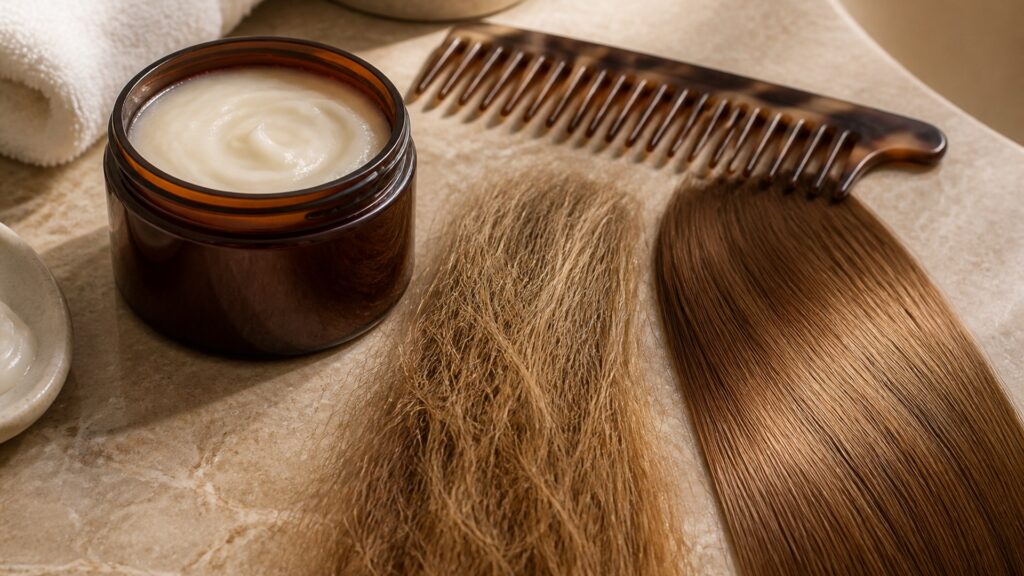
Buying framework
Define the dry hair job before comparing conditioners
Separate naturally coarse texture from sudden dryness because a recent change may point to damage, buildup, weather, or health factors.
Recreate the setting: Concentrate product on older lengths and ends, where cuticle wear and repeated heat usually create the greatest conditioning need.
Write a pass condition: Fatty alcohols and cationic agents support slip, while oils and silicones can reduce friction and slow moisture loss.
Set the rejection line: Protein can help some damaged hair feel stronger, yet frequent use may feel rigid when the formula does not suit the strand.
Use profiles
Match the conditioner to the person and frequency
Distribute conditioner in sections with fingers first, adding water for spread instead of repeatedly increasing the product amount.
The low-maintenance buyer: Time the rinse and notice whether softness remains after excess product leaves rather than depending on a deliberately persistent coating.
The careful experimenter: Evaluate ends once fully dry; a glossy wet strand can still finish stiff, fluffy, tangled, or heavy after evaporation.
The targeted upgrader: Use richer masks according to observed need, not automatically at every wash, and track whether improvement survives the following shampoo.
Specifications
Read conditioner specifications through real use
Clarify only when compatible with the hair and routine because aggressive cleansing can trade buildup relief for renewed roughness.
Evidence from the first trial
Reduce excessive hot-water exposure, rough towel friction, and unprotected heat styling so conditioner is not asked to offset preventable damage.
Evidence after repetition
Packaging should deliver enough product for thick sections without admitting shower water or becoming impossible to empty cleanly.
Working behavior: Seek professional advice for abrupt texture changes, scalp symptoms, or breakage that continues despite gentler handling and appropriate conditioning.
Contact and comfort: Separate naturally coarse texture from sudden dryness because a recent change may point to damage, buildup, weather, or health factors.
Package and control: Concentrate product on older lengths and ends, where cuticle wear and repeated heat usually create the greatest conditioning need.
Common mistakes
Avoid shortcuts that distort the dry hair decision
Fatty alcohols and cationic agents support slip, while oils and silicones can reduce friction and slow moisture loss.
Rewarding the loudest claim: Protein can help some damaged hair feel stronger, yet frequent use may feel rigid when the formula does not suit the strand.
Testing under ideal conditions: Distribute conditioner in sections with fingers first, adding water for spread instead of repeatedly increasing the product amount.
Ignoring the boundary: Time the rinse and notice whether softness remains after excess product leaves rather than depending on a deliberately persistent coating.
Decision guidance
Decide when basic, premium, or no purchase makes sense
Evaluate ends once fully dry; a glossy wet strand can still finish stiff, fluffy, tangled, or heavy after evaporation.
Choose a basic option: Use richer masks according to observed need, not automatically at every wash, and track whether improvement survives the following shampoo.
Upgrade for evidence: Clarify only when compatible with the hair and routine because aggressive cleansing can trade buildup relief for renewed roughness.
Wait when uncertainty remains: Reduce excessive hot-water exposure, rough towel friction, and unprotected heat styling so conditioner is not asked to offset preventable damage.
Ownership & compatibility
Keep the conditioner reliable after purchase
Packaging should deliver enough product for thick sections without admitting shower water or becoming impossible to empty cleanly.
Build the reset step: Seek professional advice for abrupt texture changes, scalp symptoms, or breakage that continues despite gentler handling and appropriate conditioning.
Watch compatibility: Separate naturally coarse texture from sudden dryness because a recent change may point to damage, buildup, weather, or health factors.
Know the retirement signal: Concentrate product on older lengths and ends, where cuticle wear and repeated heat usually create the greatest conditioning need.
FAQ
Questions about conditioners for dry hair
Fatty alcohols and cationic agents support slip, while oils and silicones can reduce friction and slow moisture loss.
What should I check first when choosing a conditioner for dry hair?
How long should I test the conditioner?
When is a more expensive conditioner worthwhile?
Bottom line
Finish the dry hair choice with observable proof
Protein can help some damaged hair feel stronger, yet frequent use may feel rigid when the formula does not suit the strand.
Restate the actual role: Distribute conditioner in sections with fingers first, adding water for spread instead of repeatedly increasing the product amount.
Rehearse an ordinary day: Time the rinse and notice whether softness remains after excess product leaves rather than depending on a deliberately persistent coating.
Write the purchase reason: Evaluate ends once fully dry; a glossy wet strand can still finish stiff, fluffy, tangled, or heavy after evaporation.
Reading Shortcuts
Move directly to the dry hair decision stage you need.
Decision Reminders
Keep the evidence for dry hair visible while comparing.
- Role: The conditioner serves the named task.
- Proof: The trial observes easy detangling, flexible strands, manageable finish, and no persistent residue.
- Care: Close the package, keep water out, and monitor buildup across several wash cycles.
Glossary Snippets
Useful language for comparing conditioners.
When a Top 10 List Helps
Use rankings to discover credible conditioners, then screen them for dry hair.
- The format is undecided: A broad list reveals plausible forms and price levels.
- A shortlist is needed: Rankings narrow discovery but do not replace fit testing.
Have finalists already? Open the comparison section.
When a Direct Comparison Helps
Compare finalists after establishing their suitability for dry hair.
- Two candidates remain: Side-by-side evidence exposes meaningful tradeoffs.
- An upgrade is uncertain: Compare whether added cost corrects the original weakness.
Still exploring? Start with the Top 10 section.