
Curling Tools Buying Guide for Thick Hair
Thick hair may mean many strands, wide individual fibers, or both, and those situations affect curling time differently. The right tool provides enough usable barrel, steady recovery, and secure handling without making extreme heat the shortcut.
Test section size and contact time before raising temperature. Dense hair often curls more consistently when it is divided cleanly and placed in a single layer, allowing moderate heat to reach the section evenly.
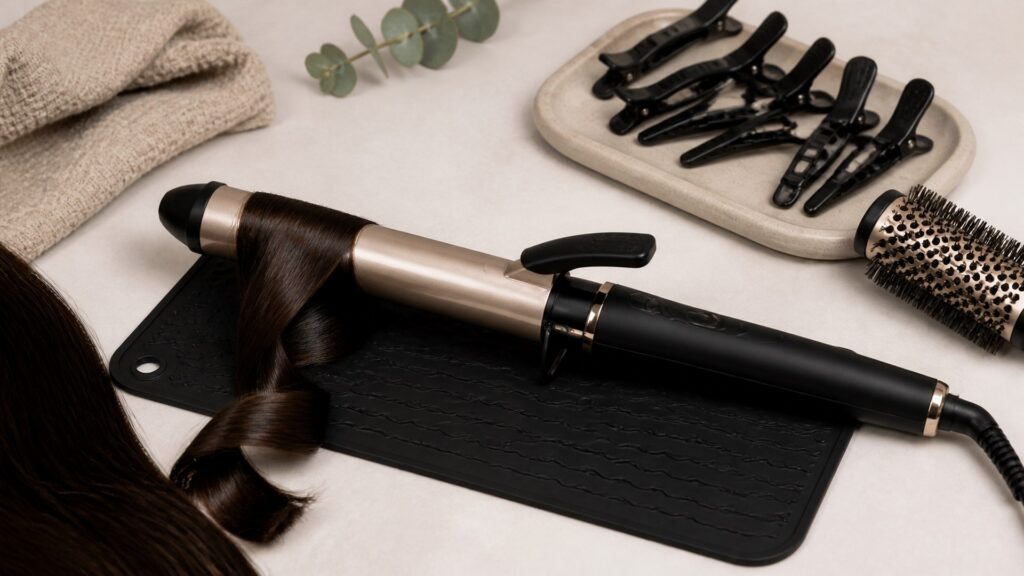
Buying framework
Define the thick hair job before comparing curling tools
Record density, strand width, length, damage, natural pattern, and desired curl before choosing barrel dimensions or power claims.
Recreate the setting: A longer barrel reduces overlapping on long dense sections, while diameter determines the curl shape rather than simply styling speed.
Write a pass condition: Stable recovery between sections matters because a tool that cools unevenly creates inconsistent curls and invites repeat passes.
Set the rejection line: Use adjustable temperature and begin below the assumed requirement, increasing cautiously only after a controlled hidden-section test.
Use profiles
Match the curling tool to the person and frequency
Section clips and a deliberate map save more time than loading too much hair onto a barrel that cannot heat evenly.
The low-maintenance buyer: A strong clamp must still release smoothly without crushing ends, creasing sections, or catching individual coarse strands.
The careful experimenter: Check total weight, handle diameter, cool-tip reach, cord drag, and button placement during a full-head rehearsal.
The targeted upgrader: Hair must be clean and completely dry unless the manufacturer specifically permits another condition with clear directions.
Specifications
Read curling tool specifications through real use
Allow each curl to cool before evaluating hold; immediate reheating can add damage without showing the true result.
Evidence from the first trial
Automatic shutoff, a stable stand, heat-safe mat, and clear cooling area reduce risk during a longer styling session.
Evidence after repetition
Remove styling residue from the cold barrel by the approved method to prevent drag, smoke, and uneven heat transfer.
Working behavior: Retire equipment with loose parts, damaged insulation, peeling surfaces, temperature swings, sparks, or unexplained burning odor.
Contact and comfort: Record density, strand width, length, damage, natural pattern, and desired curl before choosing barrel dimensions or power claims.
Package and control: A longer barrel reduces overlapping on long dense sections, while diameter determines the curl shape rather than simply styling speed.
Common mistakes
Avoid shortcuts that distort the thick hair decision
Stable recovery between sections matters because a tool that cools unevenly creates inconsistent curls and invites repeat passes.
Rewarding the loudest claim: Use adjustable temperature and begin below the assumed requirement, increasing cautiously only after a controlled hidden-section test.
Testing under ideal conditions: Section clips and a deliberate map save more time than loading too much hair onto a barrel that cannot heat evenly.
Ignoring the boundary: A strong clamp must still release smoothly without crushing ends, creasing sections, or catching individual coarse strands.
Decision guidance
Decide when basic, premium, or no purchase makes sense
Check total weight, handle diameter, cool-tip reach, cord drag, and button placement during a full-head rehearsal.
Choose a basic option: Hair must be clean and completely dry unless the manufacturer specifically permits another condition with clear directions.
Upgrade for evidence: Allow each curl to cool before evaluating hold; immediate reheating can add damage without showing the true result.
Wait when uncertainty remains: Automatic shutoff, a stable stand, heat-safe mat, and clear cooling area reduce risk during a longer styling session.
Ownership & compatibility
Keep the curling tool reliable after purchase
Remove styling residue from the cold barrel by the approved method to prevent drag, smoke, and uneven heat transfer.
Build the reset step: Retire equipment with loose parts, damaged insulation, peeling surfaces, temperature swings, sparks, or unexplained burning odor.
Watch compatibility: Record density, strand width, length, damage, natural pattern, and desired curl before choosing barrel dimensions or power claims.
Know the retirement signal: A longer barrel reduces overlapping on long dense sections, while diameter determines the curl shape rather than simply styling speed.
FAQ
Questions about curling tools for thick hair
Stable recovery between sections matters because a tool that cools unevenly creates inconsistent curls and invites repeat passes.
What should I check first when choosing a curling tool for thick hair?
How long should I test the curling tool?
When is a more expensive curling tool worthwhile?
Bottom line
Finish the thick hair choice with observable proof
Use adjustable temperature and begin below the assumed requirement, increasing cautiously only after a controlled hidden-section test.
Restate the actual role: Section clips and a deliberate map save more time than loading too much hair onto a barrel that cannot heat evenly.
Rehearse an ordinary day: A strong clamp must still release smoothly without crushing ends, creasing sections, or catching individual coarse strands.
Write the purchase reason: Check total weight, handle diameter, cool-tip reach, cord drag, and button placement during a full-head rehearsal.
Reading Shortcuts
Move directly to the thick hair decision stage you need.
Decision Reminders
Keep the evidence for thick hair visible while comparing.
- Role: The curling tool serves the named task.
- Proof: The trial observes consistent curl formation, controlled tension, predictable heat, and a comfortable styling pace.
- Care: Unplug after use, cool on a heat-safe surface, wipe residue, and inspect the cord.
Glossary Snippets
Useful language for comparing curling tools.
When a Top 10 List Helps
Use rankings to discover credible curling tools, then screen them for thick hair.
- The format is undecided: A broad list reveals plausible forms and price levels.
- A shortlist is needed: Rankings narrow discovery but do not replace fit testing.
Have finalists already? Open the comparison section.
When a Direct Comparison Helps
Compare finalists after establishing their suitability for thick hair.
- Two candidates remain: Side-by-side evidence exposes meaningful tradeoffs.
- An upgrade is uncertain: Compare whether added cost corrects the original weakness.
Still exploring? Start with the Top 10 section.