Dropbox Business vs DocuWare: Which Cloud Document Management System Is Better?

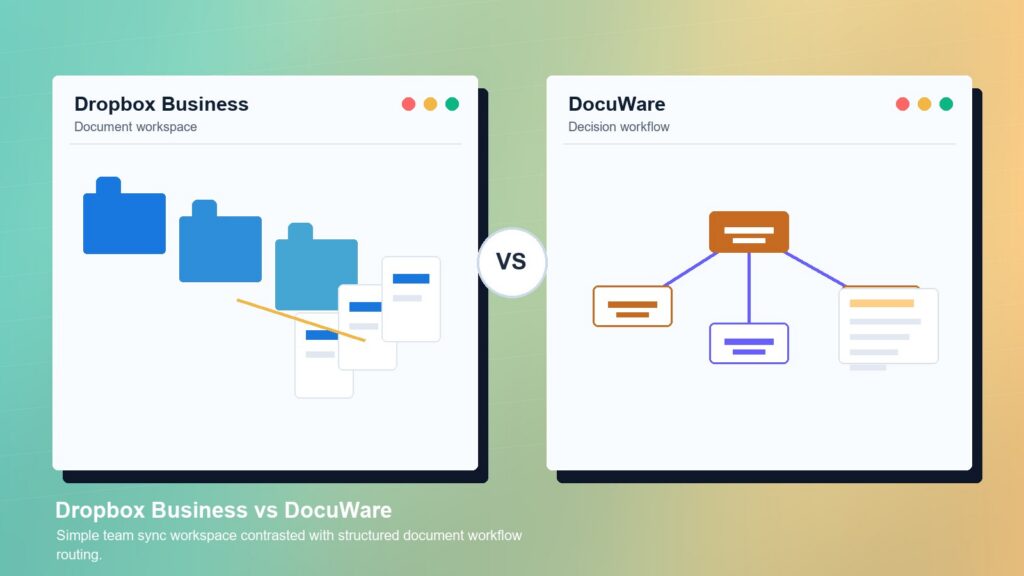
Dropbox Business and DocuWare solve different document problems. Dropbox Business is strongest when a team wants familiar shared folders, sync, links, recovery, and quick adoption. DocuWare is stronger when documents must be captured, indexed, routed, approved, retained, and retrieved through a repeatable process.

By: Review Streets Research Lab
Updated: September 8, 2026
Approx. 10-12 min read
Dropbox Business vs DocuWare business comparison image

Head-to-head

Dropbox Business vs DocuWare: Which Cloud Document Management System Is Better?

DocuWare is the stronger document-management choice when workflows drive the decision. Dropbox Business is better for simple file sync and team sharing.

Dropbox Business comparison image

Dropbox Business

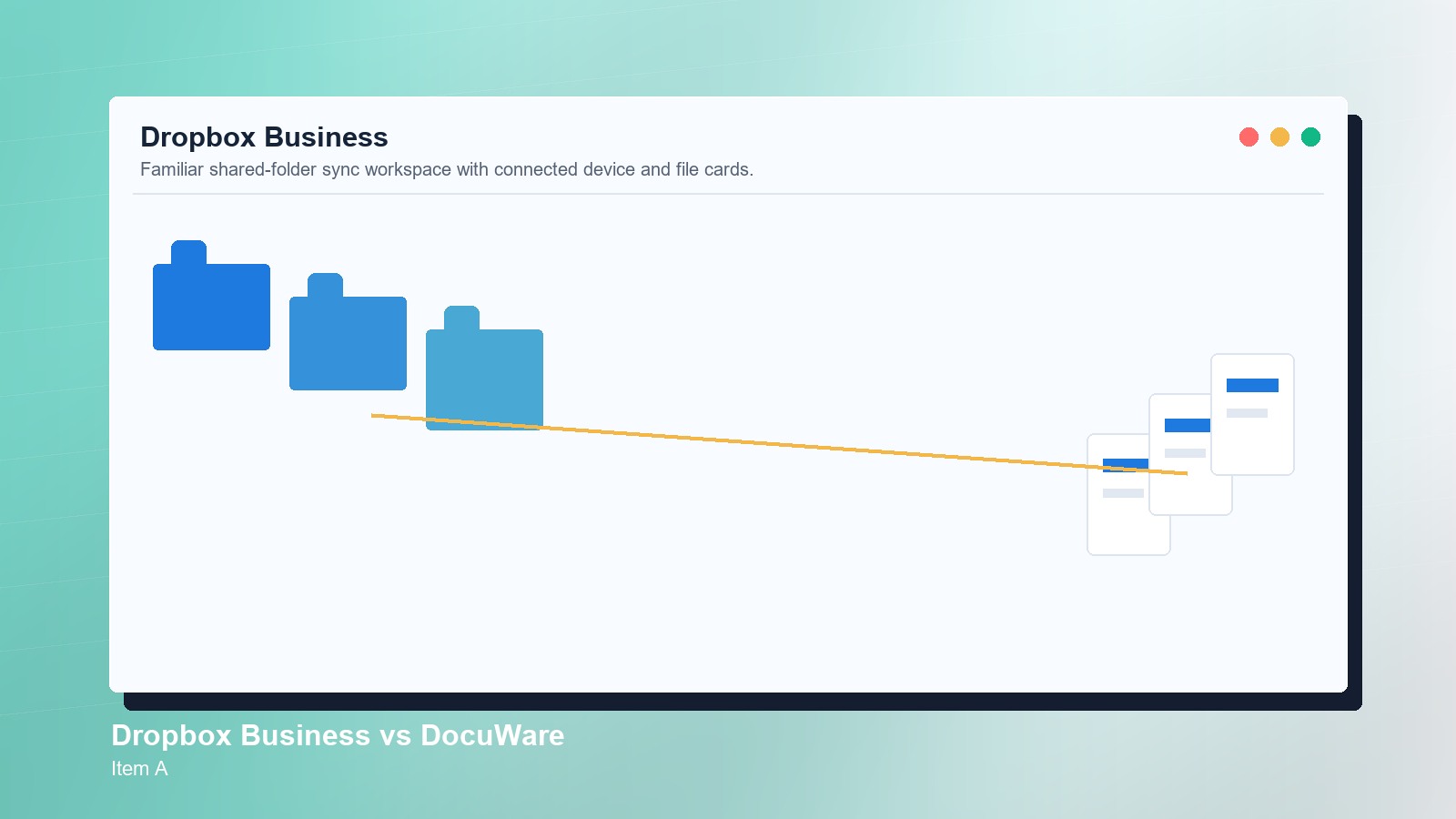
Dropbox Business is stronger when the team wants familiar folders, desktop sync, quick links, recovery controls, and low-friction collaboration without a heavy document-process rollout.

Score 8.5/10 Best for simple team file sync and sharing Focus Sync Why buy Fit
  • Very familiar shared-folder experience
  • Fast sync and link sharing
  • Low training burden for simple teams
VS
DocuWare comparison image

DocuWare

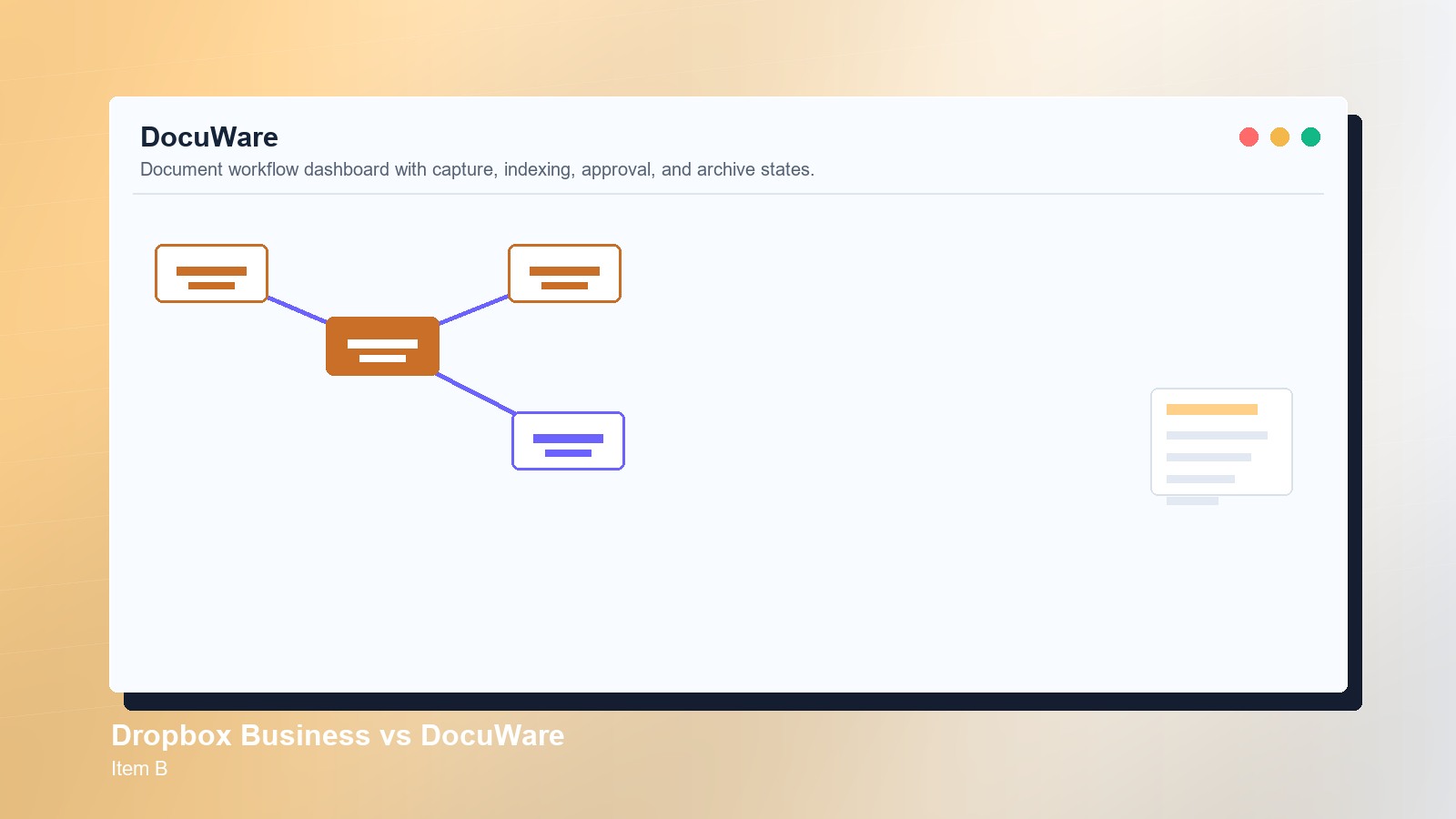
DocuWare is stronger when the buyer needs document capture, indexing, routing, approvals, invoice or record workflows, secure archiving, and repeatable process automation around stored files.

Score 8.6/10 Best for workflow-heavy document processing Focus Automation Why buy Fit
  • Strong document workflow automation
  • Good capture, indexing, and archive fit
  • Useful for approval-heavy back offices
Metric
Dropbox Business
DocuWare
Winner
Governance
Basic team controls
Structured document control
DocuWare
Workflow
Light document routing
Strong process automation
DocuWare
Search
Simple folder search
Capture and index search
DocuWare
Sharing
Fast shared links
Process-based sharing
Dropbox Business
Adoption
Very familiar folders
Process-led rollout
Dropbox Business
Best fit
Simple sync teams
Workflow-heavy documents
DocuWare
Real-world context
DocuWare wins when document management means process control. Dropbox Business remains useful when the business only needs a cleaner shared workspace with fast links, simple folders, and low training overhead.

Why people choose it

  • Very familiar shared-folder experience
  • Fast sync and link sharing
  • Low training burden for simple teams

Why people choose it

  • Strong document workflow automation
  • Good capture, indexing, and archive fit
  • Useful for approval-heavy back offices
Winner: DocuWare DocuWare wins for Cloud Document Management Systems buyers who need document processing, capture, indexing, and approval workflows. Dropbox Business is better when familiar file sharing is the main requirement.
Read FAQs

Deep dive

What actually matters in this matchup

This is a folder-sync versus document-process decision. We weighted familiar adoption, shared links, capture, indexing, approvals, archive rules, search, administrator oversight, and whether the business needs documents stored simply or routed reliably. That keeps the choice practical. That matters during rollout.

Everyday sharing: Dropbox Business is easier when employees already think in folders, synced devices, and quick file links. That familiarity matters. It becomes less persuasive when a document needs to move through approval steps, indexing rules, and controlled processing. That keeps the choice practical.

Process control: DocuWare earns the edge when documents enter the business through forms, scans, invoices, records, or department queues. Its value is not only storage; it is the ability to route files through a predictable process. That keeps the choice practical. That matters during rollout.

Search and retrieval: Dropbox Business can make files easier to find when folders are clean. DocuWare is more compelling when search depends on captured metadata, document type, approval state, archived records, or business context beyond the folder name. That keeps the choice practical.

Adoption tradeoff: Dropbox Business usually asks less of users at launch. DocuWare asks the team to define document categories and routing rules. That extra planning can pay off when informal sharing has already created delays or missing approvals. That keeps the choice practical.

Governance risk: Simple file sharing can drift when external links, duplicates, and local copies spread. DocuWare reduces a different risk: documents stuck outside the correct workflow. Buyers should decide which risk causes more operational pain. That keeps the choice practical. That matters during rollout.

Final choice: Choose DocuWare when document handling needs workflow discipline, capture, indexing, and approval control. Choose Dropbox Business when the goal is quick shared folders, simple links, desktop sync, and collaboration that users understand immediately. That keeps the choice practical. That matters during rollout.

Methodology

How we evaluated the matchup

This review weighs document-management fit against practical adoption, governance, workflow, and migration realities.

Scope: We evaluated Dropbox Business and DocuWare as cloud document management options for teams balancing adoption speed against structured document processing. Scores reflect official product information, category fit, and buyer workflow analysis rather than lab testing. That keeps the choice practical.

What we compared: The review weighs folder sync, shared links, recovery, capture, indexing, approval routing, archive needs, search quality, external access, administration, migration cleanup, and whether informal collaboration or controlled process is the real requirement. That keeps the choice practical.

Interpretation: DocuWare wins because this category rewards repeatable document workflows when files affect approvals, invoices, records, or compliance. Dropbox Business scores well for simplicity, but simple sharing is not always document management. That keeps the choice practical. That matters during rollout.
Buyer checks: Before choosing, verify current pricing, storage limits, workflow tools, capture methods, scan and import needs, user permissions, external links, recovery windows, retention rules, integrations, and support for migration or implementation. That keeps the choice practical. That matters during rollout.
FAQ

Dropbox Business vs DocuWare: common questions

Is Dropbox Business better than DocuWare?
Dropbox Business is better for familiar file sync, shared folders, quick links, recovery, and lightweight collaboration. DocuWare is better when document capture, indexing, routed approvals, archiving, and back-office process control are more important. That keeps the choice practical. That matters during rollout. That keeps the buying decision grounded.
Where does DocuWare beat Dropbox Business?
DocuWare beats Dropbox Business when documents need structured handling after they enter the organization. Approval queues, metadata capture, records retention, invoice processing, and controlled routing are stronger buying reasons for DocuWare. That keeps the choice practical. That matters during rollout. That keeps the buying decision grounded.
Which is easier for users?
Dropbox Business is usually easier for users because folders, links, and desktop sync feel familiar. DocuWare may require more training because users must follow document categories, workflow steps, indexing rules, and approval paths. That keeps the choice practical. That matters during rollout. That keeps the buying decision grounded.
Which is better for approval workflows?
DocuWare is better for approval workflows because its value centers on document routing and process automation. Dropbox Business can support collaboration, but it is less focused on structured intake, indexing, and approval tracking. That keeps the choice practical. That matters during rollout. That keeps the buying decision grounded.
Can Dropbox Business work as document management?
Yes, Dropbox Business can work for straightforward document management when the team mainly needs shared folders and reliable file access. It is less ideal when document status, routing, retention, and auditability matter. That keeps the choice practical. That matters during rollout. That keeps the buying decision grounded.
Should a company use both?
A company may use both when Dropbox Business handles simple collaboration and DocuWare manages formal document processes. The key is defining which system owns records, approvals, retention, and final document status. That keeps the choice practical. That matters during rollout. That keeps the buying decision grounded.
What should buyers demo first?
Test one synced folder, one external link, one captured document, one approval route, one archive search, and one permission change. The normal workflow should reveal whether simplicity or process control matters more. That keeps the choice practical. That matters during rollout. That keeps the buying decision grounded.
Is this review based on hands-on testing?
No. This review uses official product information, public documentation, and document-management workflow analysis. Buyers should confirm current pricing, plan limits, integrations, security controls, implementation support, and contract terms with each vendor. That keeps the choice practical. That matters during rollout. That keeps the buying decision grounded.

Key Takeaways

  • DocuWare wins for process control.
  • Dropbox wins for familiar sync.
  • Approval workflows change the answer.
  • Simple folders can be enough.
  • Capture and indexing need planning.
  • Choose by document risk.

Verdict

The Better Default for Document Workflow Control

DocuWare is the stronger default when documents need capture, indexing, approval routing, and process discipline.

#1 Winner

DocuWare

DocuWare wins because it handles structured document workflows better than a sync-first shared-folder platform.

  • Stronger workflow automation
  • Better capture and indexing fit
  • More useful for routed approvals

Runner-up

Jump to the Head-to-Head

Tip: If users only need to find and share files, Dropbox is easier; if documents must move through approvals, DocuWare has the clearer purpose.

Where to Buy

Use the official Dropbox Business and DocuWare pages to confirm current plans, demos, security details, and implementation options.

Vendor terms, demos, pricing, and feature availability change regularly. Some links may earn a commission and never affect rankings.

Accessories You’ll Want

  • Workflow inventory (lists every approval, exception, and department handoff before setup)
  • Indexing field map (keeps document types, vendors, dates, and owners searchable)
  • Shared-link audit (identifies documents that should not leave the controlled process)
  • Archive policy note (sets retention, deletion, and retrieval rules before migration)
  • Training checklist (shows users when to sync, route, approve, or archive documents)

Tip: Use the same sample documents in every demo so differences in workflow, search, permissions, and cleanup are easy to see.