Egnyte vs M-Files: Which Enterprise Document Management Software Is Better?

Egnyte and M-Files sit close together for enterprise document management because both address governance, search, and control. Egnyte is stronger when the enterprise needs visibility into sensitive files, access exposure, external sharing, and repository risk. M-Files is stronger when documents need metadata, lifecycle state, relationship-aware search, and workflow routing based on business context.

By: Review Streets Research Lab
Updated: September 8, 2026
Approx. 10-12 min read
Egnyte vs M-Files business comparison image

Head-to-head

Egnyte vs M-Files: Which Enterprise Document Management Software Is Better?

M-Files narrowly wins when the buyer defines enterprise document management around metadata and lifecycle control. Egnyte is better when sensitive-file governance and access review are the main priorities.

Egnyte comparison image

Egnyte

Egnyte is stronger when the business needs sensitive-content discovery, audit visibility, access reviews, controlled external collaboration, data governance, and stronger oversight across enterprise repositories.

Score 8.9/10 Best for governed enterprise file operations Focus Governance Why buy Fit
  • Strong sensitive-content governance
  • Useful audit and access visibility
  • Good fit for regulated file estates
VS
M-Files comparison image

M-Files

M-Files is stronger when the organization wants metadata-led document control, lifecycle governance, context-first search, workflow routing, Microsoft 365 alignment, and policy discipline around business information.

Score 9.0/10 Best for metadata-driven enterprise document control Focus Metadata Why buy Fit
  • Strong metadata-led organization
  • Context-first search and governance
  • Useful workflow and lifecycle controls
Metric
Egnyte
M-Files
Winner
Governance at scale
Sensitive-content visibility, access review, audit, and governance
Metadata-driven lifecycle governance, permissions, and audit
Egnyte
Workflow depth
Governed file workflows and repository processes
Metadata-led routing, document lifecycle workflow, and automation
M-Files
Search and metadata
Sensitive-content visibility across enterprise repositories
Context-first metadata search and relationship-aware retrieval
M-Files
Collaboration control
Controlled external access with governance oversight
Collaboration inside governed document context
Egnyte
Enterprise rollout
Needs permission cleanup and governance ownership
Needs metadata model and taxonomy ownership
Egnyte
Best fit
Governed enterprise file operations
Context-first enterprise document management
M-Files
Real-world context
M-Files wins when the enterprise needs to understand what each document represents and what should happen next. Egnyte remains a strong alternative when the bigger concern is where sensitive files live and who can access them.

Why people choose it

  • Strong sensitive-content governance
  • Useful audit and access visibility
  • Good fit for regulated file estates

Why people choose it

  • Strong metadata-led organization
  • Context-first search and governance
  • Useful workflow and lifecycle controls
Winner: M-Files M-Files wins for Enterprise Document Management Software buyers who prioritize metadata-driven lifecycle control, context-first search, and workflow routing. Egnyte is the better fit when file-risk visibility, access review, and governed repositories are the leading requirements.
Read FAQs

Deep dive

What actually matters in this matchup

This is the closest comparison in the batch because both tools serve mature document teams. We weighted metadata, lifecycle governance, search, workflow routing, sensitive-content visibility, access review, external sharing, audit needs, migration cleanup, and whether enterprise value comes from document context or file-risk oversight.

Document context: M-Files is stronger when the document itself needs structured meaning, such as customer, project, matter, owner, status, document type, or retention rule. Egnyte is stronger when the enterprise first needs to see sensitive content and access risk across repositories. That keeps the choice practical.

Governance emphasis: Egnyte has the better file-risk governance story for sensitive repositories, external sharing, and access review. M-Files has the better document-lifecycle story when governance depends on metadata, process state, and relationships between business records. That keeps the choice practical. That matters during rollout.

Search behavior: M-Files pulls ahead when users need to search by context instead of folder location. Egnyte is still strong when search and reporting must identify risky files, permission issues, or exposure patterns across enterprise file stores. That keeps the choice practical.

Workflow control: M-Files is better when workflows should change based on metadata and lifecycle state. Egnyte can support controlled file operations, but it is less centered on using document context as the core automation model. That keeps the choice practical. That matters during rollout.

Rollout reality: Egnyte may be easier to start when the first project is access cleanup and sensitive-file review. M-Files needs a metadata model and clear user training. The payoff is higher when document retrieval and lifecycle ownership are the persistent problems. That keeps the choice practical.

Final choice: Choose M-Files when enterprise document management depends on metadata, lifecycle workflow, relationship-aware search, and information governance. Choose Egnyte when the larger concern is sensitive-file visibility, access review, controlled sharing, and repository governance. That keeps the choice practical. That matters during rollout.

Methodology

How we evaluated the matchup

This review weighs enterprise document management software fit against practical adoption, governance, workflow, and migration realities.

Scope: We evaluated Egnyte and M-Files as enterprise document management software for buyers comparing file-risk governance with metadata-driven information management. Scores reflect official product information, public documentation, category fit, and enterprise workflow analysis. That keeps the choice practical. That matters during rollout.
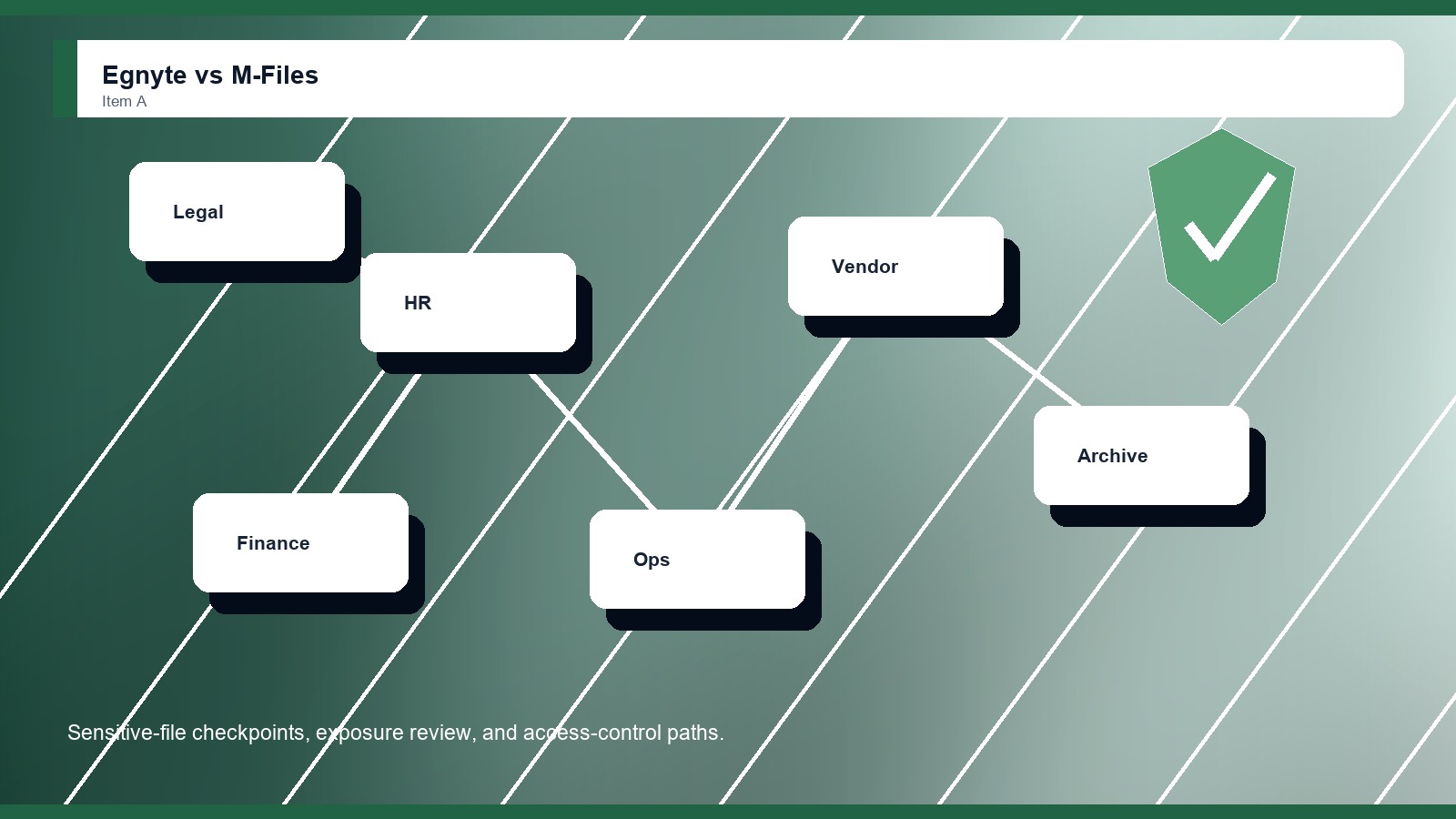
What we compared: The comparison weighs metadata design, lifecycle control, search, workflow routing, sensitive-content discovery, access review, external sharing, audit visibility, permissions, retention planning, migration cleanup, user adoption, and governance ownership. That keeps the choice practical. That matters during rollout.
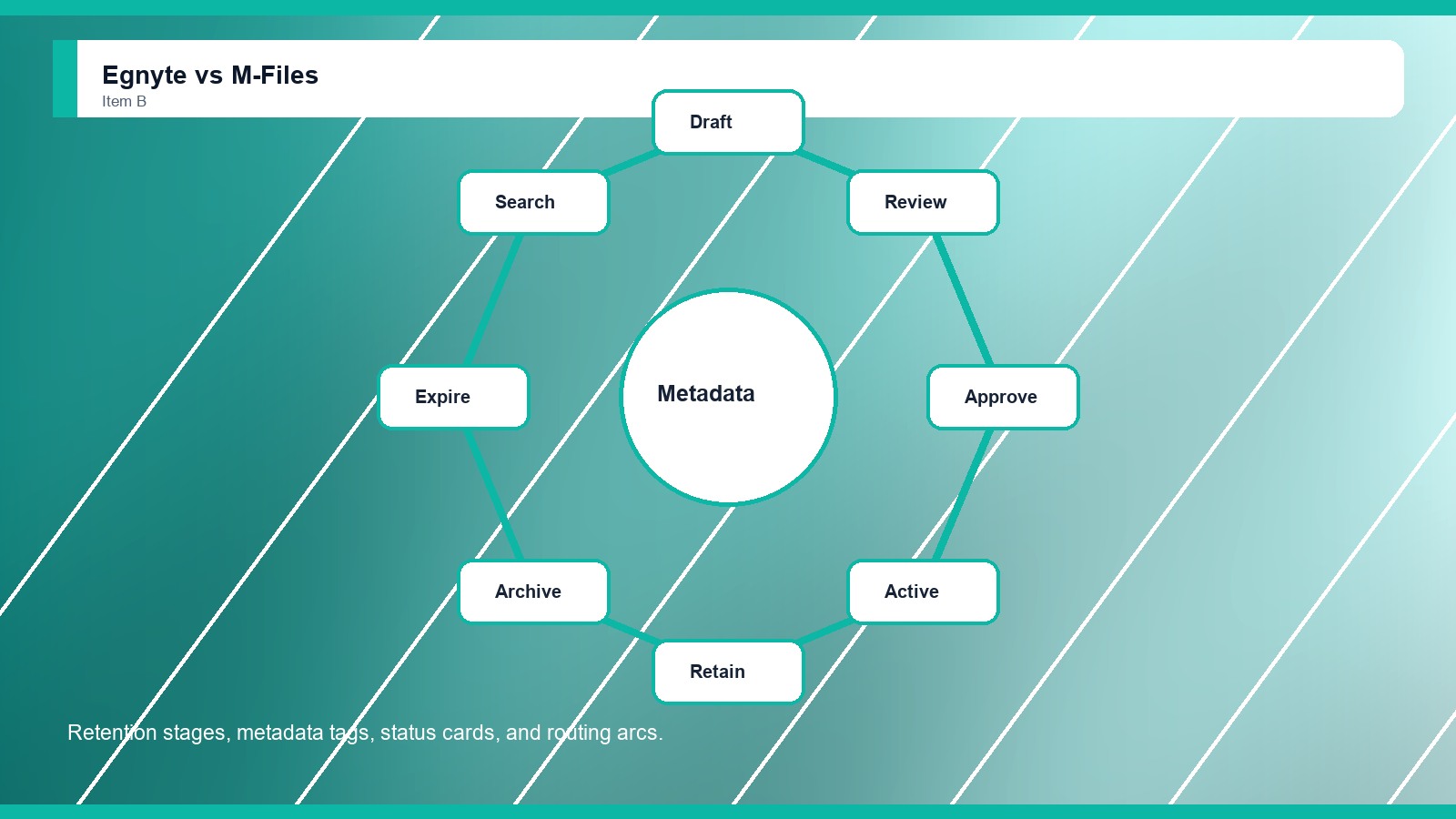
Interpretation: M-Files wins narrowly because enterprise document management rewards context, workflow state, and lifecycle governance. Egnyte remains the better answer when the buying committee starts with sensitive-content risk and access exposure. That keeps the choice practical. That matters during rollout.

Buyer checks: Before choosing, verify current pricing, plan limits, security controls, metadata configuration, workflow capabilities, audit reports, data classification, Microsoft 365 needs, retention policies, migration support, and the team that will maintain governance. That keeps the choice practical. That matters during rollout.

FAQ

Egnyte vs M-Files: common questions

Is Egnyte better than M-Files for enterprise document management?
Egnyte is better when the enterprise needs sensitive-file visibility, access review, external-sharing control, and repository governance. M-Files is better when metadata, lifecycle state, workflow routing, and context-first search define document-management success. That keeps the choice practical. That matters during rollout. That keeps the buying decision grounded.
Where does M-Files beat Egnyte?
M-Files beats Egnyte when documents need to be organized and automated by business context. Metadata, relationships, lifecycle stages, retention categories, and status-driven workflows are the biggest reasons to favor M-Files. That keeps the choice practical. That matters during rollout. That keeps the buying decision grounded.
Which is stronger for governance?
Egnyte is stronger for file-risk governance across repositories. M-Files is stronger for document-lifecycle governance tied to metadata and process state. The better answer depends on whether access exposure or document context is the larger problem. That keeps the choice practical. That matters during rollout.
Which is better for search?
M-Files is better when users need to search by customer, project, matter, status, or document type. Egnyte is better when search also needs to identify sensitive content, risky sharing, and permission exposure. That keeps the choice practical. That matters during rollout. That keeps the buying decision grounded.
Which rollout is easier?
Egnyte may be easier when the first project is repository cleanup and access review. M-Files requires more metadata planning, but that work is valuable when users cannot reliably find or route documents by context. That keeps the choice practical. That matters during rollout.
Can Egnyte and M-Files be used together?
Yes, but only with clear ownership. One platform should own governed repositories, metadata, retention, official records, and final document status. Otherwise, the combination can create duplicate files and inconsistent controls. That keeps the choice practical. That matters during rollout. That keeps the buying decision grounded.
What should buyers demo first?
Demo one sensitive repository, one metadata search, one lifecycle workflow, one external collaborator, one audit report, and one retention decision. The stronger product should answer the real enterprise document question faster. That keeps the choice practical. That matters during rollout. That keeps the buying decision grounded.
Is this review based on hands-on testing?
No. This review uses official product information, public documentation, and document-management workflow analysis. Buyers should confirm current pricing, plan limits, security features, integrations, implementation support, and contract terms with each vendor. That keeps the choice practical. That matters during rollout. That keeps the buying decision grounded.

Key Takeaways

  • M-Files wins by a narrow margin.
  • Egnyte wins file-risk moments.
  • Metadata drives lifecycle control.
  • Access review remains critical.
  • Search tests need real files.
  • Choose context or exposure oversight.

Verdict

The Better Default for Lifecycle-Aware Document Management

M-Files is the stronger default when enterprise document management depends on metadata, lifecycle workflow, and context-first search.

#1 Winner

M-Files

M-Files wins because its metadata-led lifecycle model gives enterprise buyers a stronger way to route, retrieve, and govern documents by context.

  • Stronger lifecycle governance
  • Better metadata-driven search
  • More useful context-based workflow

Runner-up

Jump to the Head-to-Head

Tip: Let the first demo question decide the order: if it is about exposure, start with Egnyte; if it is about document context, start with M-Files.

Where to Buy

Use the official Egnyte and M-Files pages to confirm current plans, demos, security details, and implementation options.

Vendor terms, demos, pricing, and feature availability change regularly. Some links may earn a commission and never affect rankings.

Accessories You’ll Want

  • Lifecycle state map (defines draft, review, approved, archived, retained, and expired document states)
  • Sensitive-file audit sample (tests whether risky content and access exposure are visible)
  • Metadata ownership plan (names who maintains fields, values, workflows, and exceptions)
  • Repository cleanup list (tracks duplicate folders, stale permissions, and inactive records)
  • Search-by-context test (uses real documents that users struggle to locate today)

Tip: Use the same sample documents in every demo so workflow, search, governance, and rollout differences are visible.