
Engine Filters Buying Guide for Aftermarket Part Selection
Aftermarket engine filters range from well-documented exact replacements to anonymous products with broad fit lists and context-free efficiency claims. Price, visible pleats, can weight, a micron number, or an OE-equivalent slogan cannot establish compatibility and performance.
Prove the application and operating requirement first. Then compare test context, balanced construction, seals and valves, manufacturing traceability, seller accountability, interval conditions, warranty administration, and the complete installed risk.
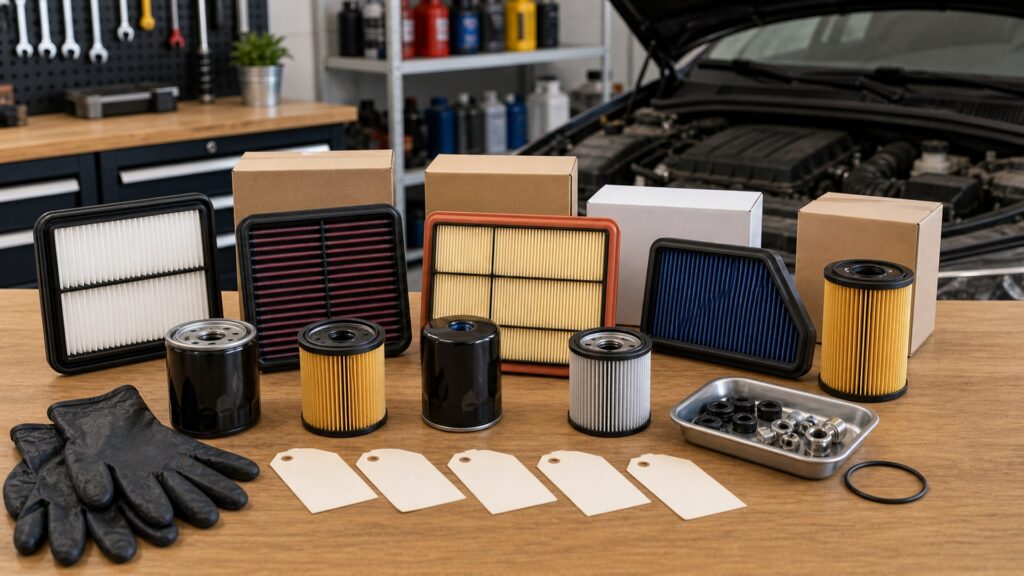
Buying framework
Compare evidence after the application is proven
Aftermarket filters vary in documentation, construction, testing, traceability, and seller support. Price tier and visible pleats are weak substitutes for application-specific evidence.
Lock the application first: Verify VIN, engine code, build date, filter position, housing, original number, dimensions, seals, valves, fittings, sensors, and service notes. Exclude any candidate with unresolved catalog overlap.
Define the operating requirement: Use the vehicle interval, fluid, flow path, severe duty, dust, fuel-water, pressure, temperature, and priming procedure. Decide whether the need is standard service or a documented special environment.
Ask what the performance claim means: For air filters look for efficiency, dust capacity, and pressure loss under a stated method such as ISO 5011. For oil and fuel filters require comparable context for efficiency, capacity, valves, pressure, and water handling.
Evaluate construction and traceability: Inspect seals, media support, pleat stability, end caps, seams, center tube, baseplate, can, threads, valves, bowls, drains, connectors, packaging, country or plant data, and lot code without assuming visual features prove performance.
Price the installed risk: Include seals, fluids, access, priming, downtime, returnability, warranty administration, seller identity, counterfeit exposure, and the cost of a leak or misapplication. Keep packaging through the first operating checks.
Who this is for
Aftermarket priorities depend on service strategy
Routine service, extended drains, dust exposure, diesel water separation, and fleet inventory require different supporting evidence.
Standard-interval owners: Choose a well-documented exact application that supports the vehicle schedule, complete sealing, and straightforward local replacement. Extended-service claims add little if the vehicle interval remains unchanged.
Extended-drain candidates: Require vehicle and lubricant approval, filter capacity and efficiency evidence for the proposed interval, stable duty, monitoring, and warranty compatibility. A mileage printed on the box is not a complete extended-drain program.
High-dust operators: Prioritize documented separation efficiency, capacity, pressure loss, seal quality, pleat support, housing integrity, and restriction monitoring. Washable or oiled designs require explicit vehicle and sensor compatibility.
Diesel owners: Verify fuel efficiency method, water separation, flow, pressure, primary or secondary stage, heater and sensor interfaces, seals, drain, priming, and authorized support. A poor fit can introduce air or contamination downstream.
Fleet and multi-vehicle buyers: Build an application-controlled inventory using exact part mappings and supersessions. Similar-looking filters should not share bins without barcode, position, engine, and interface verification.
What to pay attention to
Aftermarket evidence that can be compared honestly
A credible claim names the test, conditions, metric, and exact part or family rather than offering a context-free percentage.
Performance Evidence
Exact test method, efficiency, particle context, capacity, pressure loss, valves, water separation, and interval conditions.
Supply Evidence
Application notes, construction, seals, lot code, manufacturer, authorized seller, warranty, returns, and technical support.
Catalog precision: Look for VIN or engine notes, build breakpoints, OE cross-references, position, housing detail, images of interfaces, dimensions, and technical updates. A broad fit list without notes raises return and misapplication risk.
Efficiency and particle context: Efficiency must state what percentage of which particle distribution is captured under what method and conditions. Nominal, absolute, beta, and micron terms are not interchangeable without their definitions.
Capacity and pressure loss: Compare dirt-holding capacity and restriction or differential pressure at stated flow and endpoint. Higher capacity does not justify a longer vehicle interval automatically, and lower restriction is not useful if sealing or efficiency is sacrificed.
Valve and flow-control design: For oil filters verify bypass and anti-drainback requirements, spring or valve construction, standpipe compatibility, can strength, and filter-specific data where available. For fuel filters include water separation, drains, heaters, and sensor ports.
Seal and structural quality: Examine gasket contour, O-ring specification, bonding, pleat spacing and support, end-cap attachment, center tube, baseplate seam, thread finish, protective caps, bowl material, drain, and packaging damage. Reject obvious defects before installation.
Traceability and counterfeit resistance: Prefer identifiable manufacturer, exact part, lot or date code, tamper-evident packaging where used, authorized distribution, consistent labeling, technical contact, and verifiable warranty. A marketplace seller name alone is not a manufacturing record.
Warranty and service claim: Read coverage, duration, interval conditions, vehicle and commercial eligibility, required fluids, installation rules, records, return procedure, analysis rights, labor treatment, and exclusions for contamination or consequential damage.
Avoid these traps
Aftermarket comparisons that reward marketing instead of function
Color, weight, pleat count, price, and brand slogans can all distract from the exact application and documented performance.
Ranking by micron number alone: Without capture percentage, distribution, method, flow, and endpoint, the number cannot establish real filtration or restriction. Compare like-for-like technical data tied to the exact candidate.
Assuming heavier is stronger: Weight can come from can thickness, media, adhesive, hardware, or size and does not prove seam strength, collapse resistance, efficiency, capacity, or correct valves. Use published specifications and quality controls.
Buying a counterfeit-prone bargain: Unusually low price, inconsistent printing, missing lot code, altered seals, poor threads, or unknown fulfillment deserve scrutiny. Use authorized or accountable sellers and preserve packaging for verification.
Selecting a washable air filter universally: Oil, cleaning, media damage, airflow-sensor sensitivity, housing sealing, maintenance variability, and vehicle warranty terms can change the result. Use only an approved design and exact care procedure.
Letting the filter set the interval: The vehicle schedule, lubricant or fuel requirements, severe duty, condition monitoring, and warranty control together. An aftermarket mileage claim does not independently authorize extended operation.
Decision guidance
Choose the candidate with the strongest complete evidence
The best aftermarket filter is the one that fits the exact circuit, supports the real duty, and leaves a manageable service and warranty path.
If candidates are standard OE-equivalent lines: Compare application detail, seals, valve arrangement, manufacturer traceability, instructions, local availability, and warranty. Favor the part whose evidence is specific rather than the most elaborate packaging.
If one claims higher efficiency: Check the method, particle sizes, flow, pressure loss, capacity, exact part, and seal design. A context-free percentage or laboratory graphic should not outweigh verified application and balanced system performance.
If one claims a longer interval: Require vehicle and fluid approval, relevant capacity testing, stable duty, monitoring, records, and explicit warranty conditions. Otherwise use it within the normal schedule or choose a standard-service product.
If the seller cannot identify the manufacturer: Treat the warranty and quality chain as weak. Do not install safety- or engine-critical filtration parts when part identity, lot traceability, application support, and return accountability cannot be established.
If the new part shows defects or differs materially: Stop before installation. Photograph packaging and interfaces, compare with technical data and the old verified part, contact the manufacturer or seller, and return or replace the candidate rather than modifying it.
Ownership & compatibility
Keep the evidence attached to the installed part
Aftermarket value is easier to judge when lot data, operating interval, removed-filter condition, and support experience are recorded.
Photograph before installation: Capture packaging, labels, lot code, country or plant marks, seals, threads, valves or ports, media, damage, and the old verified part. Keep fuel and oil openings protected during comparison.
Record the service context: Save part and OE cross-reference, vehicle and engine, filter position, fluid, date, mileage or hours, duty, interval basis, seals, torque, priming, warning reset, leak result, and receipt.
Inspect the removed candidate later: At the next service, document sealing, media condition, collapse, debris, water, sludge, end caps, gasket, and housing. Do not infer efficiency from dirt color; use the observation to spot damage and abnormal conditions.
Track support quality: Note catalog corrections, return handling, technical responses, warranty requirements, replacement availability, and counterfeit reports. Support is part of total ownership when the same line will be used repeatedly.
FAQ
Aftermarket engine-filter FAQ
Answers about efficiency, micron claims, OE-equivalent labels, extended service, counterfeits, and washable filters.
What does OE-equivalent mean on a filter box?
Is a lower micron number always better?
What does ISO 5011 tell me?
Are more pleats automatically better?
Can an extended-service oil filter extend my oil change?
How can I reduce counterfeit risk?
Are washable engine air filters suitable for every vehicle?
Should I install a filter with bent pleats or damaged packaging?
What records help an aftermarket warranty claim?
Bottom line
Choose documented performance from an accountable supply chain
Verify the application first, then compare honest test context, balanced construction, traceability, interval support, and installed risk.
Filter by fit: Reject unresolved engine, housing, seal, valve, or fitting differences.
Demand context: Read efficiency, capacity, pressure loss, and water claims completely.
Trace the product: Prefer identifiable manufacturing, lot codes, and accountable sellers.
Keep the interval honest: Follow the vehicle, fluid, duty, monitoring, and warranty together.
Reading Shortcuts
Confirm application and condition first.
Decision Reminders
Checks to complete before committing.
- Confirm the exact application: Cross-check vehicle, engine, housing, and original part.
- Preserve removed-part clues: Contamination and damage can identify another fault.
- Keep the work clean: Keep downstream openings protected.
- Follow the procedure: Respect pressure, fluids, torque, priming, and resets.
- Inspect interfaces: Seals, caps, connectors, threads, and fittings must agree.
- Verify before release: Check leaks, warnings, starting, idle, and road behavior.
Glossary Snippets
Terms used in this decision.
When to Use a Top 10 Review
Use rankings after application and service scope are documented.
- Application confirmed: Filter with exact engine and interface evidence.
- Duty identified: Compare parts for the real interval and environment.
- Evidence published: Rank construction, testing, traceability, and support.
- Job scope complete: Include seals, fluids, tools, and verification.
Already down to 2–3 options? A Comparison is usually faster.
When to Use a Comparison
Compare finalists for the same verified application.
- Interfaces: Match dimensions, seals, valves, fittings, and connectors.
- Performance evidence: Compare documented efficiency, capacity, and service claims.
- Included content: List every seal, cap, sensor, boot, and fitting.
- Installed outcome: Price fluids, labor, priming, disposal, and downtime.
Still building a shortlist? Start with a Top 10.