
Epilators Buying Guide for Travel Grooming
An epilator that works well at home can become inconvenient in a suitcase if it switches on accidentally, requires a bulky charger, or cannot dry before checkout. Travel buyers need to think about transport and power as carefully as hair removal performance.
This guide explains how to compare compact epilators for trips, including travel locks, charging formats, voltage information, runtime, protective storage, cleaning, and accessory discipline. It also helps separate a truly portable setup from a full-size kit placed in a smaller pouch.
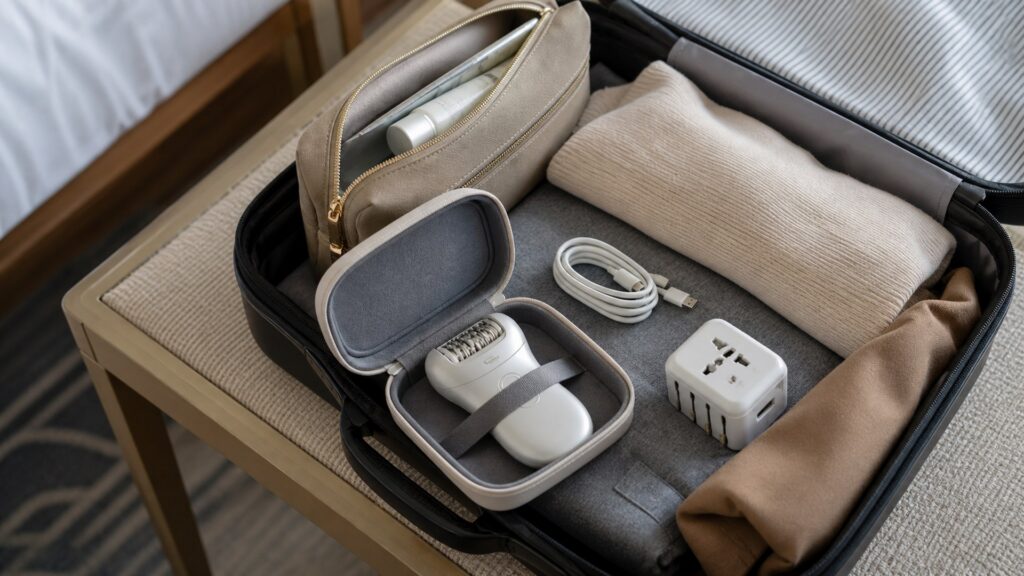
Travel framework
Build the travel routine from outlet to storage
Walk through charging, use, cleaning, drying, and repacking before choosing a model.
Map the trip length: A weekend may fit one full charge, while a longer trip may require a charger. Compare actual expected sessions with rated runtime and battery condition.
Check destination power: Read the adapter label for supported input voltage and frequency. A plug adapter changes plug shape; it does not convert voltage unless it is specifically a converter.
Plan protected transport: A travel lock and rigid or padded case reduce accidental activation and protect the tweezer head from impact and debris.
Traveler profiles
Match portability to the way you travel
Different luggage limits and grooming plans change the best setup.
Carry-on minimalist: Prioritize a compact cordless body, integrated travel lock, one essential cap, and a short cable. Leave rarely used attachments at home.
Long-stay traveler: Favor dependable runtime, clearly labeled worldwide-voltage charging, replaceable cable options, and a case with space for dry accessories.
Frequent business traveler: Look for quiet storage, fast setup, easy dry cleanup, and controls that cannot activate under pressure inside a packed bag.
Travel specifications
Focus on transport and charging details
The most useful travel specs prevent interruptions and damage.
Packing practicality
Case shape, lock feedback, cable bulk, and accessory restraint determine how easily the kit fits into real luggage.
Away-from-home reliability
Charger input, available runtime, drying requirements, and part protection determine whether the device remains usable across an entire trip.
Travel lock: Confirm the lock is intentional and easy to verify. A recessed button alone is not the same as a lock that disables operation.
Charger input: Look for the printed input range on the power supply and confirm compatibility with your destination. USB charging can simplify packing, but check the required wattage and cable type.
Cordless runtime: Choose enough margin for multiple sessions because batteries can deliver less runtime with age, cold storage, or incomplete charging.
Case ventilation: A protective case should keep the head clean without sealing damp parts. Pack only after the head and caps are completely dry.
Travel mistakes
Avoid portability assumptions
Small size does not guarantee a travel-ready design.
Assuming every charger is universal: Verify the input label. Plug fit and voltage compatibility are separate questions, and the wrong assumption can damage equipment.
Packing immediately after rinsing: Moisture trapped in a closed pouch can create odor and poor hygiene. Allow every washable part to dry fully.
Bringing the entire kit: Extra heads and accessories add bulk and can be lost. Pack the minimum set required for the areas you actually plan to groom.
Decision guidance
Choose the travel configuration that reduces failure points
Travel value comes from reliability and packability.
Choose a compact cordless model if: Space is tight and one charge comfortably covers the trip.
Choose a USB-chargeable model if: You already carry a compatible power adapter and the device clearly states its charging requirements.
Choose a full-size model with a case if: Performance and comfort matter more than minimal packing and your luggage allowance supports it.
Travel ownership
Protect the device between trips
Storage habits can matter more than occasional use.
Battery care: Do not leave the epilator depleted for long periods. Follow the manual for charging and storage temperature between trips.
Cable replacement: A detachable, common-format cable is easier to replace than a proprietary adapter, but only use charging equipment allowed by the manufacturer.
Post-trip cleanup: Remove trapped hair, clean approved components, dry everything, and inspect the case before returning the device to storage.
FAQ
Epilators Buying Guide for Travel Grooming FAQ
Travel-focused answers about luggage, overseas power, and keeping a portable epilator protected.
Can I pack an epilator in carry-on luggage?
Does a plug adapter make an epilator safe overseas?
What is the most important travel feature?
Bottom line
Pack a complete travel routine, not just a small device
The best travel epilator stays protected, powered, clean, and ready.
Start with power: Verify runtime and charger input before comparing cosmetic extras.
Protect the head: Use a lock and case that prevent activation, impact, and contamination.
Leave drying time: Clean early enough that every washable part can dry before repacking.
Reading Shortcuts
Jump to the decisions that matter most when epilators buying guide for travel grooming.
Decision Reminders
A quick checklist before you commit to an epilator.
- Verify voltage: Read the charger label instead of assuming international compatibility.
- Engage the lock: Test the travel lock before placing the device in luggage.
- Pack dry: Never seal damp heads or caps in a travel pouch.
Glossary Snippets
Plain-language definitions for common epilator terms.
When to Use a Top 10 Review
Use a ranked shortlist when you want to compare the strongest options by routine, comfort, and value.
- You are still defining your needs: A Top 10 can separate full-size, compact, wet/dry, and attachment-heavy models before you compare details.
- You want a manageable shortlist: Ranked picks help you focus on models that fit your body areas, routine, and preferred cleanup method.
Already down to 2-3 options? A Comparison is usually the faster decision tool.
When to Use a Comparison
Use a direct comparison after you have narrowed the field and need to judge practical tradeoffs.
- You have two or three finalists: Side-by-side coverage clarifies head width, speed control, attachments, runtime, cleaning, and warranty differences.
- The prices are close: A comparison shows whether the extra cost buys better control and useful accessories or merely a larger bundle.
Still exploring? Start with a Top 10 to identify the most suitable epilator type first.