
EV Charging Accessories Buying Guide for Home Charging Setup
A home charging installation plan starts with the parking position, electrical plan, equipment electrical directions, and local approval ahead of cable organizers or smart add-ons. For home charging installation plan, begin with the interfaces and restrictions that cannot be corrected by extra padding, stronger materials, faster charging, or more storage.
Build the residential charging layout decision from parking-to-inlet distance, dedicated circuit plan, and service capacity. Use the actual cabin, completed load, and governing electrical directions so each conclusion remains tied to this vehicle rather than a universal claim.
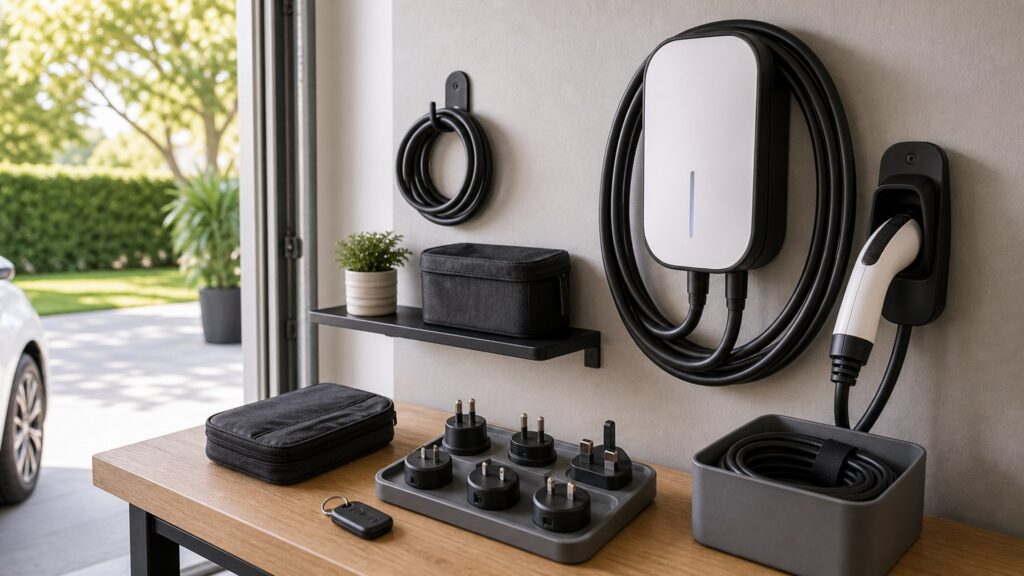
Buying framework
Set the decision order for residential charging organization
For residential charging layout, establish parking-to-inlet distance ahead of pricing and secondary features. The next gates cover dedicated circuit plan, service capacity, and permit and code review in the order a failed condition would end the installation.
Parking-To-Inlet Distance: Make parking-to-inlet distance the first measurement. Measure from the intended equipment location to every likely inlet position with the vehicle parked normally. A candidate that misses parking-to-inlet distance does not advance to comfort features.
Dedicated Circuit Plan: Make dedicated circuit plan the early compatibility screen. A qualified electrician should determine the branch circuit and installation method for the selected charging equipment. Remove products that cannot demonstrate dedicated circuit plan without altering original equipment.
Service Capacity: Make service capacity the loaded-use trial. Panel rating alone does not establish available capacity; the electrician must evaluate the home's actual electrical load. Keep the trial reversible until service capacity remains predictable under the complete load.
Permit And Code Review: Make permit and code review the final pre-purchase gate. Local permitting authorities decide applicable approval steps, and EV charging is treated as a continuous load under the NEC. Approve the installation only after permit and code review agrees with the governing electrical directions.
Who this is for
Match the design to the real routine
A home project begins at the parking space and electrical panel, not the product page. Required daily range, available service capacity, cable route, exposure, permits, and future vehicles determine an appropriate installed solution.
Garage Homeowner: Prioritize parking-to-inlet distance for this profile, then judge the residential charging layout finding with wall or pedestal position under the longest ordinary session. Discard options that need repeated repositioning.
Outdoor Driveway User: Make service capacity the opening screen for this user. During the residential charging layout mock-up, add weather exposure and observe the complete movement, temperature, or contact range.
Two-Ev Household: Give this buyer a parked trial centered on permit and code review and its controlling electrical directions. The residential charging layout choice advances only when cable management stays visible and directly reachable.
Renter Or Multifamily Resident: Favor reversible residential charging layout hardware for this routine. Photograph connector storage in the accepted position and schedule a future vehicle access review ahead of the return or installation window closes.
What to pay attention to
Turn specifications into visible consequences
Home charging ratings must be reconciled with the vehicle, branch circuit, service calculation, conductor route, mounting location, and local requirements. A qualified installer can translate nameplate amperage and environmental ratings into a compliant site-specific design.
Vehicle interface
Judge geometry, attachment, and access against residential charging organization.
Loaded operation
During the residential charging layout trial, include every regular occupant, device, cable, cargo item, or moving component that can alter cable management.
Wall Or Pedestal Position: Mounting height and structure should support the equipment, cable, and connector while keeping controls visible. Translate the published construction into a parked site review that shows whether connector storage changes under the full load. During residential charging layout, connect that observation to connector storage and write down the usable boundary.
Weather Exposure: The practical limit for weather exposure appears during adjustment and cleaning. Driveway installations require outdoor-rated equipment and a route that avoids standing water, impact, and trip exposure. Note any interference with network coverage. Use the residential charging layout finding to decide whether network coverage stays within its permitted range.
Cable Management: Treat the stated range for cable management as a starting point. Store the cord in broad loops or on a maker-approved support so neither end carries the hanging weight. Verify access again after all nearby equipment is positioned. Photograph this residential charging layout condition after loading, with future vehicle access scheduled for a later comparison.
Connector Storage: Material compatibility controls connector storage more than a broad durability claim. Place the holster where the coupler stays clean, protected from vehicles, and easy to return after every session. Examine connector storage directly because a universal label cannot establish residential charging layout compatibility. Replace a universal claim with direct residential charging layout evidence about parking-to-inlet distance at the contacting faces.
Network Coverage: A specification for network coverage matters only when it predicts loaded behavior. Smart charging features need dependable local connectivity, but loss of a cloud service should be understood ahead of purchase. Record the first warning, obstruction, or loss of function. Keep the measured dedicated circuit plan outcome with the residential charging layout notes for the final shortlist.
Avoid these traps
Shortcuts that hide incompatibility
A home installation cannot be chosen from charger nameplate power alone. Parking geometry, load calculation, branch-circuit design, code, permits, weather exposure, and utility programs all shape the correct result.
Buying before a site review: The desired station may not suit the panel, cable route, outdoor exposure, or vehicle inlet position. Establish the site's constraints and local approval path before locking in equipment.
Assuming panel space equals capacity: An open breaker position does not establish available service capacity. The applicable load calculation and equipment instructions determine whether the project needs managed charging, a smaller circuit, or electrical upgrades.
Choosing amperage first: Avoid selecting charging amperage before the circuit and service have been evaluated. A qualified electrician should follow the equipment instructions, applicable code, permit process, load calculation, and required protection for the specific site.
Overlooking daily cable handling: A compliant station can still be awkward if its cable crosses a walkway or barely reaches the inlet. Mock up the route for each parking direction and reserve a stable connector holster and broad-loop storage position.
Decision guidance
Let the limiting condition specify the design
Eliminate equipment that cannot reach the vehicle safely, fit the evaluated electrical capacity, meet installation requirements, or tolerate the mounting environment. Compare price and connected features only among configurations that clear those essential boundaries.
If parking-to-inlet distance defines the usable range: Use parking-to-inlet distance to establish the residential charging layout shortlist. Among compatible choices, prefer the option that keeps weather exposure straightforward without extra pressure or unsupported hardware.
When service capacity creates the main exposure: Reproduce the worst planned service capacity condition during the residential charging layout trial. Advance only designs that also keep connector storage visible, stable, and easy to examine.
Where cable management must stay accessible: Reject an residential charging layout arrangement that hides, tensions, or reroutes cable management. The surviving design should preserve network coverage without requiring a special user sequence.
If future vehicle access controls ownership effort: Weigh the cleaning, removal, and inspection work associated with future vehicle access. Favor the residential charging layout candidate whose wall or pedestal position can be rechecked without dismantling unrelated equipment.
Ownership & compatibility
Keep the installation inspectable and reversible
Once commissioned, a home station should remain firmly mounted, clean, dry within its rating, and free from cable damage. Keep installation records so future electricians can understand the circuit and any load-management controls.
Save commissioning records: Retain the permit, inspection result, circuit information, installer invoice, equipment manual, serial number, warranty, and load-management settings. Labeling should let a future owner or electrician identify the dedicated charging circuit accurately.
Inspect the parking interface: Keep the connector in its holster and support the cable off walking and driving paths. Periodically check mounting fasteners, jacket condition, strain relief, contact cleanliness, impact protection, and drainage around outdoor equipment.
Escalate electrical symptoms: Repeated trips, fault codes, buzzing, discoloration, loose receptacles, or unexpected heat require qualified evaluation. Do not defeat protection, reduce a fault to an app reset, or open serviceable areas beyond the manufacturer's directions.
FAQ
Questions about residential charging organization
These answers resolve narrow compatibility and ownership questions that should be checked ahead of or soon after installation.
How much home charging power do I need?
Should I choose plug-in or hardwired charging equipment?
Does my electrical panel have enough capacity?
Where should a home charger be mounted?
Are permits normally required for home EV charging?
Can charging be scheduled for off-peak electricity?
What cable length is practical in a garage?
How should outdoor home charging be protected?
Should a home setup allow for a second EV?
Bottom line
Specify the installation plan you can verify
The defensible residential charging layout choice fits the specific vehicle, respects the controlling electrical directions, and makes future vehicle access practical after installation.
Resolve the hard limits: Approve parking-to-inlet distance and permit and code review for the residential charging layout installation plan ahead of comparing convenience.
Load the complete system: Observe wall or pedestal position, cable management, and nearby movement while the residential charging layout arrangement matches daily use.
Retain the evidence: Keep measurements, photographs, and electrical directions so future vehicle access can detect a meaningful change.
Reading Shortcuts
Open the unresolved residential charging layout section: boundaries, specifications, user conditions, or focused questions.
Residential Charging Organization Checks
Complete the residential charging layout observations while stationary with the ordinary load present.
- Parking-To-Inlet Distance: Measure the available range.
- Dedicated Circuit Plan: Follow the applicable electrical directions.
- Service Capacity: Include the completed load.
- Permit And Code Review: Move nearby equipment fully.
- Wall Or Pedestal Position: Record the first conflict.
- Weather Exposure: Keep a reversible exit plan.
Glossary Snippets
Terms that describe the physical and operating limits behind residential charging layout.
When to Use a Top 10 Review
Use an residential charging layout ranking only after parking-to-inlet distance and cable management have removed incompatible charging hardware families.
- Parking-To-Inlet Distance: The primary boundary is known.
- Dedicated Circuit Plan: The permitted interface is documented.
- Service Capacity: The loaded condition has been reproduced.
- Permit And Code Review: The recurring ownership demand is understood.
Already down to 2–3 options? A Comparison is usually the faster next step.
When to Use a Comparison
Judge the final two choices with identical residential charging layout measurements, electrical directions, loads, and movement paths.
- Wall Or Pedestal Position: Both candidates preserve this function.
- Weather Exposure: Both remain stable under the planned load.
- Cable Management: Both permit direct inspection.
- Connector Storage: The difference changes a real ownership outcome.
Still exploring? Start with a Top 10 to build a shortlist first.