
EV Charging Accessories Buying Guide: How to Choose the Right One
Charging accessories belong to an electrical system, so connector fit, ratings, certification, environment, and cable handling matter before convenience. For overall accessory selection, begin with the interfaces and restrictions that cannot be corrected by extra padding, stronger materials, faster charging, or more storage.
Build the charging-interface compatibility decision from vehicle inlet compatibility, EVSE connector type, and voltage and current rating. Use the actual cabin, completed load, and governing equipment guidance so each conclusion remains tied to this vehicle instead of a universal claim.
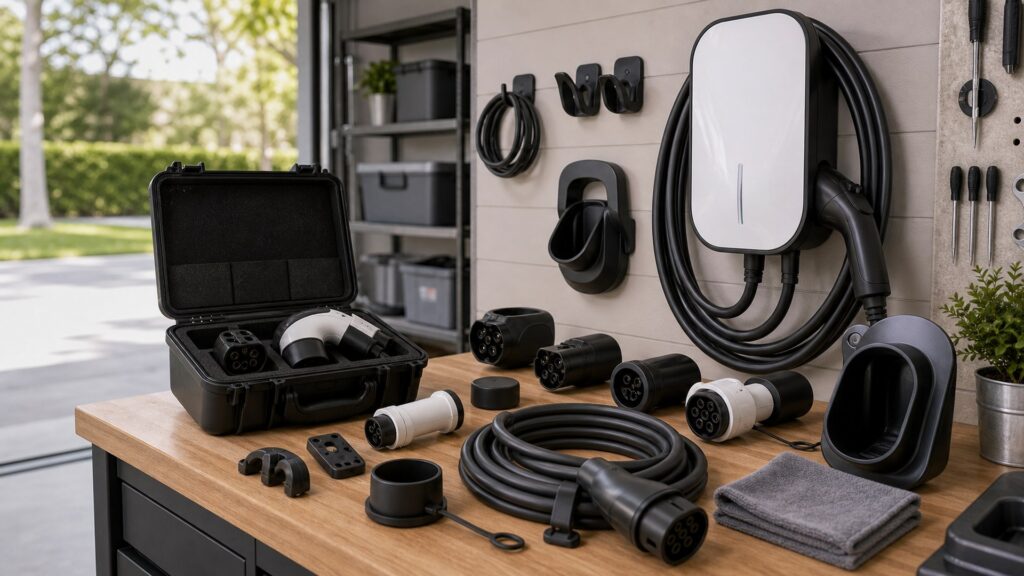
Buying framework
Set the decision order for charger-side fit
For charging-interface compatibility, establish vehicle inlet compatibility before pricing and secondary features. The next gates cover EVSE connector type, voltage and current rating, and NRTL safety listing in the order a failed condition would end the installation.
Vehicle Inlet Compatibility: Make vehicle inlet compatibility the first measurement. Confirm the vehicle inlet and charging equipment connector before buying any coupler, holder, or adapter. A candidate that misses vehicle inlet compatibility does not advance to comfort features.
Evse Connector Type: Make EVSE connector type the early compatibility screen. Connector labels such as J1772 or NACS describe a physical interface, not automatic electrical or vehicle compatibility. Remove products that cannot demonstrate EVSE connector type without altering original equipment.
Voltage And Current Rating: Make voltage and current rating the loaded-use trial. Every cord, plug, adapter, and supporting device must be rated for the voltage, current, and use its maker specifies. Keep the trial reversible until voltage and current rating remains predictable under the complete load.
Nrtl Safety Listing: Make NRTL safety listing the final pre-purchase gate. ENERGY STAR requires certified EVSE to be safety-listed by a nationally recognized testing laboratory. Approve the installation only after NRTL safety listing agrees with the governing equipment guidance.
Who this is for
Match the design to the real routine
Define the charging job before shopping: daily replenishment at home, backup charging on trips, cable organization, or connector protection. Electrical ratings, vehicle compatibility, and installation conditions narrow the field before convenience features matter.
New Ev Owner: Prioritize vehicle inlet compatibility for this profile, then judge the charging-interface compatibility evidence with indoor or outdoor rating under the longest ordinary session. Discard options that need repeated repositioning.
Multi-Brand Household: Make voltage and current rating the opening screen for this user. During the charging-interface compatibility mock-up, add cable reach and observe the complete movement, temperature, or contact range.
Outdoor Charging User: Give this buyer a parked trial centered on NRTL safety listing and its controlling equipment guidance. The charging-interface compatibility choice advances only when connector holster stays visible and directly reachable.
Frequent-Travel Driver: Favor reversible charging-interface compatibility hardware for this routine. Photograph cord support in the accepted position and schedule a storage and inspection review before the return or installation window closes.
What to pay attention to
Turn specifications into visible consequences
Compare EV charging specifications as one electrical system: the vehicle inlet, charging equipment, source circuit, cable, adapter if expressly allowed, and installation environment. The lowest compatible rating or instruction sets the operating boundary.
Vehicle interface
Judge geometry, attachment, and access against equipment compatibility.
Loaded operation
During the charging-interface compatibility trial, include every regular occupant, device, cable, cargo item, or moving component that can alter connector holster.
Indoor Or Outdoor Rating: Outdoor locations need equipment and accessories identified for the weather, exposure, and mounting method involved. Translate the published construction into a parked compatibility audit that shows whether cord support changes under the full load. During charging-interface compatibility, connect that observation to cord support and write down the usable boundary.
Cable Reach: The practical limit for cable reach appears during adjustment and cleaning. The cable should reach the inlet without tension, crossing a driving path, or inviting a tight bend at either end. Note any interference with adapter approval. Use the charging-interface compatibility evidence to decide whether adapter approval stays within its permitted range.
Connector Holster: Treat the stated range for connector holster as a starting point. A holster should support the coupler without contaminating or stressing its contacts and latch. Verify access again after all nearby equipment is positioned. Photograph this charging-interface compatibility condition after loading, with storage and inspection scheduled for a later comparison.
Cord Support: Material compatibility controls cord support more than a broad durability claim. Cable hooks and retractors must carry the cord without crushing it, creating sharp bends, or pulling on the connector. Examine cord support directly because a universal label cannot establish charging-interface compatibility compatibility. Replace a universal claim with direct charging-interface compatibility evidence about vehicle inlet compatibility at the contacting faces.
Adapter Approval: A specification for adapter approval matters only when it predicts loaded behavior. Use only adapters approved by the vehicle and charging-equipment makers for that exact connection and operating condition. Record the first warning, obstruction, or loss of function. Keep the measured EVSE connector type outcome with the charging-interface compatibility notes for the final shortlist.
Avoid these traps
Shortcuts that hide incompatibility
Accessory mistakes often begin with a plug that appears to fit while its electrical rating, permitted use, or weather protection does not. Verify the complete documented configuration before current flows.
Matching by connector shape: A physical connection does not prove that the vehicle, adapter, equipment, and power source support the same charging mode. Confirm model-specific documentation, current limits, and any software requirements.
Treating maximum power as the goal: Higher advertised output cannot exceed the vehicle's acceptance rate and may demand a more expensive circuit. Size the solution around required daily energy, available dwell time, and the approved electrical installation.
Improvising cable reach: Do not use an adapter, extension lead, receptacle arrangement, or mounting method outside the equipment and vehicle instructions. Charging is a sustained electrical load, so improvised compatibility can create heat, weather, and connection hazards.
Ignoring support dependencies: App scheduling and remote status may rely on Wi-Fi, cloud service, or a subscription. Confirm that safe basic charging remains possible if connectivity fails and understand the vendor's firmware and account requirements.
Decision guidance
Let the limiting condition choose the design
Let the first failed charging-interface compatibility boundary remove unsuitable accessory families. Price, appearance, and smart features belong only in comparisons where vehicle inlet compatibility and NRTL safety listing already pass.
If vehicle inlet compatibility defines the usable range: Use vehicle inlet compatibility to establish the charging-interface compatibility shortlist. Among compatible choices, prefer the option that keeps cable reach straightforward without extra pressure or unsupported hardware.
When voltage and current rating creates the main exposure: Reproduce the worst intended voltage and current rating condition during the charging-interface compatibility trial. Advance only designs that also keep cord support visible, stable, and easy to inspect.
Where connector holster must stay accessible: Reject an charging-interface compatibility arrangement that hides, tensions, or reroutes connector holster. The surviving design should preserve adapter approval without requiring a special user sequence.
If storage and inspection controls ownership effort: Evaluate the cleaning, removal, and inspection work associated with storage and inspection. Favor the charging-interface compatibility candidate whose indoor or outdoor rating can be rechecked without dismantling unrelated equipment.
Ownership & compatibility
Keep the installation inspectable and reversible
Charging equipment deserves a short inspection whenever it is connected or packed away. Connector contamination, cable strain, loose mounting, and abnormal heat are easier to address before they produce a fault during the next session.
Record the rated configuration: Keep the model, serial number, listing mark, electrical ratings, instructions, and purchase record together. Photograph the normal connection and cable route so an unexplained change in mounting or strain is apparent.
Protect contacts and cable: Cap or holster the connector as directed and coil cable in broad, relaxed loops. Remove grit without probing contacts, keep equipment dry within its rating, and never store a damp unit in a sealed travel case.
Respond to faults deliberately: If charging stops repeatedly, note the vehicle and equipment messages instead of cycling power indefinitely. Discontinue use for scorching, damaged insulation, loose contacts, water entry, or unusual heat and obtain qualified assessment.
FAQ
Questions about accessory-system review
These answers resolve narrow compatibility and ownership questions that should be checked before or soon after installation.
Which EV charging accessory should I choose first?
How do I confirm an accessory fits my vehicle?
What does a safety listing tell me?
Are EV charging extension cords acceptable?
How should a charging cable be stored?
When is a portable charger useful?
Do smart charging accessories require subscriptions?
How can I evaluate outdoor charging gear?
What signs mean charging gear should be removed from service?
Bottom line
Choose the connection you can verify
The defensible charging-interface compatibility choice fits the specific vehicle, respects the controlling equipment guidance, and makes storage and inspection practical after installation.
Resolve the hard limits: Approve vehicle inlet compatibility and NRTL safety listing for the charging-interface compatibility connection before comparing convenience.
Load the complete system: Observe indoor or outdoor rating, connector holster, and nearby movement while the charging-interface compatibility arrangement matches daily use.
Retain the evidence: Keep measurements, photographs, and equipment guidance so storage and inspection can detect a meaningful change.
Reading Shortcuts
Open the unresolved charging-interface compatibility section: boundaries, specifications, user conditions, or focused questions.
connection planning Checks
Complete the charging-interface compatibility observations while stationary with the ordinary load present.
- Vehicle Inlet Compatibility: Measure the available range.
- Evse Connector Type: Follow the applicable equipment guidance.
- Voltage And Current Rating: Include the completed load.
- Nrtl Safety Listing: Move nearby equipment fully.
- Indoor Or Outdoor Rating: Record the first conflict.
- Cable Reach: Keep a reversible exit plan.
Glossary Snippets
Terms that describe the physical and operating limits behind charging-interface compatibility.
When to Use a Top 10 Review
Use an charging-interface compatibility ranking only after vehicle inlet compatibility and connector holster have removed incompatible accessory families.
- Vehicle Inlet Compatibility: The primary boundary is known.
- Evse Connector Type: The permitted interface is documented.
- Voltage And Current Rating: The loaded condition has been reproduced.
- Nrtl Safety Listing: The recurring ownership demand is understood.
Already down to 2–3 options? A Comparison is usually the faster next step.
When to Use a Comparison
Judge the final two choices with identical charging-interface compatibility measurements, equipment guidance, loads, and movement paths.
- Indoor Or Outdoor Rating: Both candidates preserve this function.
- Cable Reach: Both remain stable under the intended load.
- Connector Holster: Both permit direct inspection.
- Cord Support: The difference changes a real ownership outcome.
Still exploring? Start with a Top 10 to build a shortlist first.