
EV Charging & Electric Vehicle Gear Buying Guide for Charging Cable Management
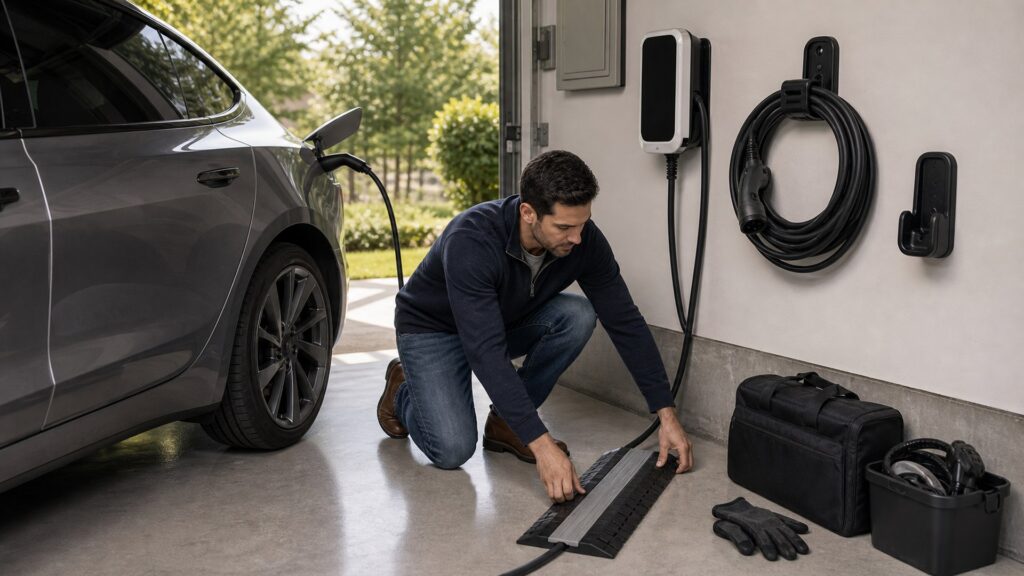
An EV charging cable is both an electrical assembly and a repeated physical workflow. It must reach the inlet without tension, avoid vehicle tires and pedestrian paths, preserve bend radius, stay out of water and contamination, return to a supported position, and remain usable in heat, cold, darkness, disability access, and changing parking positions.
This guide compares holsters, reels, hangers, pedestals, booms, guards, and simple routing by certified equipment instructions, cable length and mass, connector storage, bend and strain, trip and impact exposure, weather, user reach, cleaning, inspection, and emergency release. Cable organization must never modify or tightly constrain the listed charging assembly.
Buying framework
A four-stage test for parking-to-inlet geometry
Make each stage produce mechanical evidence that constrains the next one.
Quantify parking-to-inlet geometry: Quantify parking-to-inlet geometry with a stated pass condition. Use cable mechanical limits to reject mechanical choices whose performance cannot sustain the measured workload.
Confirm cable mechanical limits: Establish the supported boundary for cable mechanical limits. Name the approver, source, and corrective action before mechanical uncertainty reaches connector protection.
Map connector protection: Lay out connector protection at the actual vehicle or site. Include mechanical movement, access, exposure, and the fault route leading into user and site access.
Test user and site access: Run a realistic trial of user and site access. Confirm inspection and replacement still works when the preferred mechanical arrangement, control, or service is unavailable.
Who this is for
Match the plan to the user
Workload, authority, parking, and recovery needs separate these buyers.
Single-position home charging: A broad fixed hanger and well-placed holster often outperform a complicated reel when one natural loop stays supported and clear of tires and walking routes.
Changing vehicles or parking directions: Allow for inlet side, height, front-versus-rear parking, door movement, and the heaviest cable reach without pulling on the connector.
Outdoor and public installations: Protect the handle from drops and contamination, keep low loops away from water and snow equipment, and make inspection possible without dismantling storage hardware.
Drivers with limited reach or strength: Measure lift force, grip, holster height, return motion, lighting, and one-handed use with the actual cable at its coldest expected stiffness.
What to pay attention to
Specifications that change the installed result
Read each characteristic inside the complete mechanical system.
Parking-to-inlet geometry: Vehicle position, inlet side and height, cable sweep, door and hatch movement, pedestrian route, and future vehicles
Cable mechanical limits: Length, mass, minimum bend, torsion, strain relief, jacket temperature, crush, abrasion, and manufacturer instructions
Connector protection: Holster fit, support, latch, contamination, water, snow, dust cap, drop height, and removal force
User and site access: Reach range, lifting effort, lighting, one-hand use, mobility devices, children, public approach, and emergency release
Inspection and replacement: Cuts, flattening, kinks, exposed conductors, heat, discoloration, loose contacts, corrosion, latch wear, and service process
Avoid these traps
Planning errors that create expensive corrections
These mechanical failures usually begin before equipment reaches the site.
Buying the longest cable automatically: Extra length adds mass, storage burden, loops, and damage exposure without solving placement. Put this buying failure in the mechanical requirements and close it before ordering.
Coiling tightly during charging: Tight coils and improvised restraints can violate instructions, trap heat, and stress the jacket. Expose the coiling conflict through a realistic mechanical trial under normal use.
Using hooks with sharp edges: Small radii and concentrated loads deform cable and strain relief over repeated cycles. Assign a mechanical reviewer to the using gap before the system reaches users.
Repairing listed assemblies casually: Tape, splices, replacement handles, or third-party parts may defeat safety certification and warranty. Define mechanical recovery from the repairing error; reject unsupported improvisation.
Decision guidance
Choose the least complicated supported route
The supported mechanical branch meets the measured requirement and remains recoverable.
Use a fixed holster and hanger: One parking position and a natural broad loop keep the connector and cable supported. This remains the lean mechanical choice while evidence stays inside every verified mechanical limit.
Use a listed management accessory: The EVSE maker supports the reel, boom, pedestal, or retracting system for the cable. Price the complete mechanical path, including who operates it, provides mechanical support, and restores the site.
Change EVSE placement: Daily cable tension or traffic cannot be corrected by organizers alone. Let a measured mechanical constraint—not feature appeal—justify the added mechanical capability.
Replace damaged equipment: Inspection finds heat, cuts, crushing, corrosion, latch failure, exposed material, or unreliable connection. Commission the mechanical option; reject it without proven mechanical behavior and a usable fallback.
Ownership & compatibility
Keep performance verifiable after installation
Inspection, records, and exit planning protect the original decision.
Examine the full cable: Unwind and inspect the jacket, strain reliefs, connector, latch, contacts, storage points, and high-wear floor zones under good lighting.
Correct the route, not damage: Move the vehicle or approved hardware when tension and traffic persist; do not conceal cuts, flattening, heat, or kinks with tape or improvised supports.
Keep replacement rules visible: Record the listed assembly, compatible service parts, inspection interval, fault history, and manufacturer contact so unsafe equipment can be removed promptly.
FAQ
Questions buyers ask about parking-to-inlet geometry
Short answers for unresolved evidence and approval questions.
How should buyers evaluate parking-to-inlet geometry?
How should buyers evaluate cable mechanical limits?
How should buyers evaluate connector protection?
How should buyers evaluate user and site access?
How should buyers evaluate inspection and replacement?
How should buyers evaluate buying the longest cable automatically?
How should buyers evaluate coiling tightly during charging?
How should buyers evaluate using hooks with sharp edges?
How should buyers evaluate repairing listed assemblies casually?
Bottom line
A defensible purchase in three checks
Demand, mechanical fit, and lifecycle responsibility must all remain clear.
Define the need: Base the purchase on measured mechanical demand and a named pass condition.
Prove the fit: Verify compatibility, mechanical access, and failure behavior before acceptance.
Own the outcome: Keep inspections, mechanical support, and replacement planning active.
Reading Shortcuts
Jump to the evidence you need.
Decision Reminders
Keep these checks visible.
- Parking-to-inlet geometry: Quantify the evidence.
- Cable mechanical limits: Confirm the evidence.
- Connector protection: Map the evidence.
- User and site access: Test the evidence.
- Inspection and replacement: Document the evidence.
Glossary Snippets
Terms used in this guide.
When to Use a Top 10 Review
Rank products after compatibility is settled.
- Requirement: Normalize the needed outcome.
- Compatibility: Remove unsupported options.
- Installation: Compare the complete path.
- Ownership: Price support and exit.
Already down to 2–3 options? A Comparison is usually the faster next step.
When to Use a Comparison
Compare finalists under identical verified conditions.
- Same demand: Use one duty cycle.
- Same boundaries: Hold site limits constant.
- Same trial: Observe equivalent use.
- Same horizon: Include lifecycle costs.
Still exploring? Start with a Top 10 to build a shortlist first.