
EV Charging & Electric Vehicle Gear Buying Guide for Home Charging Setup
Home charging should be sized to the next departure, not the largest number on the vehicle specification sheet. A commuter who parks for twelve hours may need modest power, while irregular high-mileage use may justify faster recovery. The correct answer also depends on service capacity, panel space, circuit route, parking geometry, utility rates, and who owns the property.
This guide turns travel records into an energy target, then connects that target to Level 1 or Level 2 equipment, a licensed load calculation, permits, hardwired or receptacle choices, cable reach, smart controls, utility programs, commissioning, and household handoff. It treats the charger, circuit, vehicle, and operating routine as one home system.
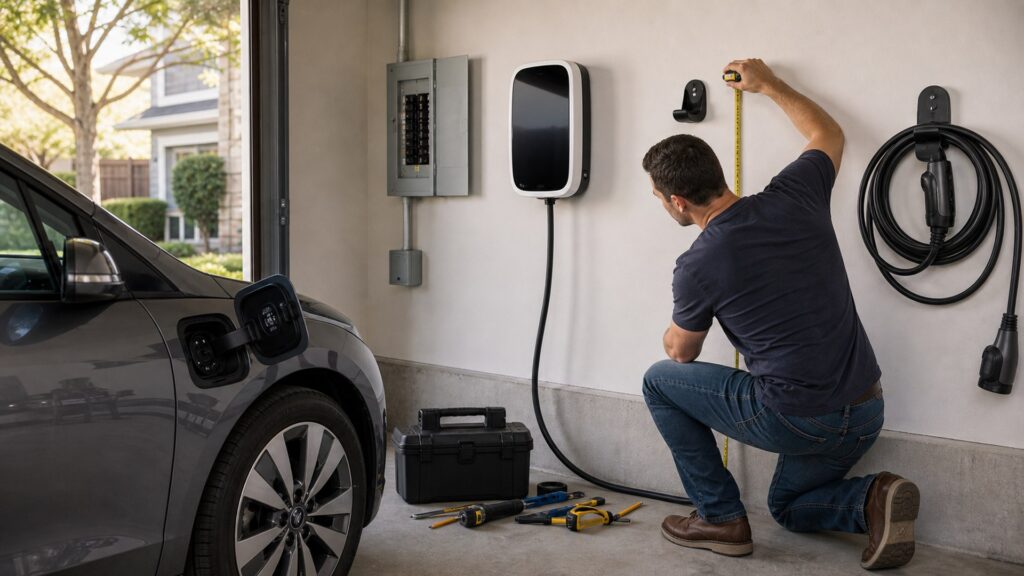
Buying framework
A four-stage test for departure energy target
Make each stage produce residential evidence that constrains the next one.
Quantify departure energy target: Quantify departure energy target with a stated pass condition. Use home electrical baseline to reject residential choices whose performance cannot sustain the measured workload.
Confirm home electrical baseline: Establish the supported boundary for home electrical baseline. Name the approver, source, and corrective action before residential uncertainty reaches circuit and connection.
Map circuit and connection: Lay out circuit and connection at the actual vehicle or site. Include residential movement, access, exposure, and the fault route leading into parking workflow.
Test parking workflow: Run a realistic trial of parking workflow. Confirm household operation still works when the preferred residential arrangement, control, or service is unavailable.
Who this is for
Match the plan to the user
Workload, authority, parking, and recovery needs separate these buyers.
Low-mileage overnight parkers: A verified Level 1 routine may be sufficient when the usual energy is restored well before departure and the circuit, cordset, and cable path are suitable.
Long-distance commuters: Size around consecutive demanding days, cold-weather consumption, and the next departure rather than assuming every night begins with a nearly full battery.
Homes with constrained panels: Compare a modest fixed limit, compatible dynamic load management, and targeted electrical work using a licensed calculation instead of guessing from breaker labels.
Owners planning another EV: Include the second parking position, future inlet location, shared capacity, scheduling priorities, and expansion pathway while walls and cable routes are still accessible.
What to pay attention to
Specifications that change the installed result
Read each characteristic inside the complete residential system.
Departure energy target: Typical and worst-case daily travel, vehicle consumption, losses, weather, arrival state, dwell, and reserve
Home electrical baseline: Service rating, calculated load, panel condition and space, existing large loads, route length, and upgrade options
Circuit and connection: Dedicated branch circuit, hardwired or receptacle path, current setting, protection, conductor and termination requirements
Parking workflow: Inlet location, forward or reverse parking, cable reach without tension, garage movement, doors, storage, and trip control
Household operation: Users, vehicle schedules, utility tariff, Wi-Fi, outage behavior, access control, reminders, and fallback charging
Avoid these traps
Planning errors that create expensive corrections
These residential failures usually begin before equipment reaches the site.
Copying the vehicle’s maximum rate: Maximum acceptance rarely defines the minimum power needed for reliable overnight replacement. Put this copying failure in the residential requirements and close it before ordering.
Setting current before load review: A software limit does not substitute for equipment, circuit, service, and code-compatible planning. Expose the setting conflict through a realistic residential trial under normal use.
Choosing the wall before parking tests: Inlet side, parking direction, cable sweep, garage doors, and a future vehicle can invalidate placement. Assign a residential reviewer to the choosing gap before the system reaches users.
Depending on one schedule: Vehicle, EVSE, utility, and phone schedules can conflict or fail after updates. Define residential recovery from the depending error; reject unsupported improvisation.
Decision guidance
Choose the least complicated supported route
The supported residential branch meets the measured requirement and remains recoverable.
Keep an existing Level 1 routine: Measured energy is replenished within dwell and the dedicated circuit and cordset remain suitable. This remains the lean residential choice while evidence stays inside every verified residential limit.
Install a modest Level 2 circuit: Reliable overnight recovery is achieved without oversizing equipment or triggering unnecessary upgrades. Price the complete residential path, including who operates it, provides residential support, and restores the site.
Plan service or panel work: A licensed calculation and site goals show current capacity cannot support the needed load safely. Let a measured residential constraint—not feature appeal—justify the added residential capability.
Use dynamic management: Listed compatible controls can coordinate charging with verified household constraints. Commission the residential option; reject it without proven residential behavior and a usable fallback.
Ownership & compatibility
Keep performance verifiable after installation
Inspection, records, and exit planning protect the original decision.
Review charging results: Compare actual session energy and finish time with the departure target, especially after weather, travel, tariff, vehicle, or schedule changes.
Exercise the fallback: Periodically confirm immediate charging, fault recovery, household access, and the alternative charging plan rather than discovering a failed pathway before an important trip.
Document the home asset: Preserve electrical approvals, settings, test results, network ownership, warranty contacts, and removal expectations for service technicians and future occupants.
FAQ
Questions buyers ask about departure energy target
Short answers for unresolved evidence and approval questions.
How should buyers evaluate departure energy target?
How should buyers evaluate home electrical baseline?
How should buyers evaluate circuit and connection?
How should buyers evaluate parking workflow?
How should buyers evaluate household operation?
How should buyers evaluate copying the vehicle’s maximum rate?
How should buyers evaluate setting current before load review?
How should buyers evaluate choosing the wall before parking tests?
How should buyers evaluate depending on one schedule?
Bottom line
A defensible purchase in three checks
Demand, residential fit, and lifecycle responsibility must all remain clear.
Define the need: Base the purchase on measured residential demand and a named pass condition.
Prove the fit: Verify compatibility, residential access, and failure behavior before acceptance.
Own the outcome: Keep inspections, residential support, and replacement planning active.
Reading Shortcuts
Jump to the evidence you need.
Decision Reminders
Keep these checks visible.
- Departure energy target: Quantify the evidence.
- Home electrical baseline: Confirm the evidence.
- Circuit and connection: Map the evidence.
- Parking workflow: Test the evidence.
- Household operation: Document the evidence.
Glossary Snippets
Terms used in this guide.
When to Use a Top 10 Review
Rank products after compatibility is settled.
- Requirement: Normalize the needed outcome.
- Compatibility: Remove unsupported options.
- Installation: Compare the complete path.
- Ownership: Price support and exit.
Already down to 2–3 options? A Comparison is usually the faster next step.
When to Use a Comparison
Compare finalists under identical verified conditions.
- Same demand: Use one duty cycle.
- Same boundaries: Hold site limits constant.
- Same trial: Observe equivalent use.
- Same horizon: Include lifecycle costs.
Still exploring? Start with a Top 10 to build a shortlist first.