
EV Charging Safety Buying Guide for Charging Cable Management
Cord management is safety cord hardware in practice: it prevents trips, drive-over damage, coupler strain, sharp bends, and contamination between charging sessions. The useful comparison starts with specified limits and a walk-through of the real cable route, not the highest advertised charging number.
Work in this order: establish usable cord length first and evaluate walking-path clearance separately. Confirm tire and door exposure, bend radius, coupler holster, and hanger geometry from current documentation. Reproduce retractor force with the EV parked, then define jacket inspection before handling cycle service.
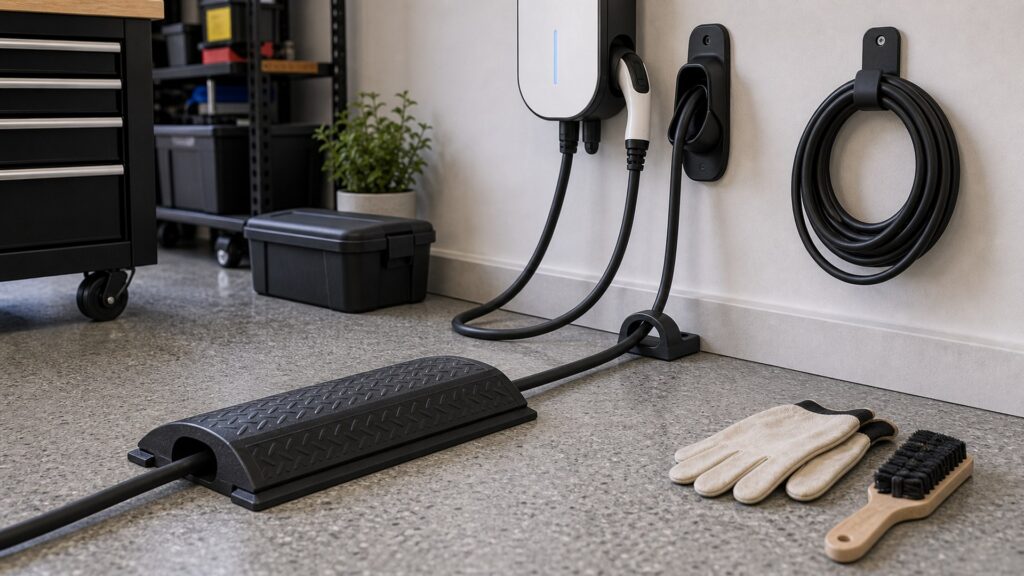
Buying framework
Resolve the purchase in four stages
Each stage answers a different question: what the cable route allows, what the cord hardware supports, how the parked EV changes the layout, and how the result will be checked after installation.
Usable Cord Length: Measure along the intended route with enough relaxed handling slack; catalog length is not the same as usable reach around walls and parked cars. Establish this working limit before choosing a station.
Walking-Path Clearance: The stored and connected positions should both avoid stairs, doorways, sidewalks, and the path passengers use to enter the EV. Carry the result into the electrical and parking plan.
Tire And Door Exposure: Place the lead where tires, garage doors, carts, tools, and moving storage cannot pinch or crush it. Use this finding to remove unsupported configurations early.
Bend Radius: Use broad supported loops and follow the maker's minimum-bend guidance, especially beside strain reliefs and plug bodies. Do not advance until the full-length connection is specified.
Who this is for
Match the cord hardware to the repeated use pattern
The same hardware can suit one handling cycle and obstruct another. Weight the profile that creates the strictest recurring constraint.
Narrow home garage: A wall-mounted loop can work when it stays outside the door swing and still reaches the inlet with the car parked correctly.
Outdoor driveway: Use elevated storage and a route that remains clear during rain, snow, lawn work, and nighttime access.
Shared parking area: Make the return position unambiguous so one user's compact storage does not leave a hazard for the next driver.
High-cycle fleet bay: Choose durable supports, visible inspection points, and a replacement process that does not keep a damaged lead in service.
What to pay attention to
Translate specifications into cable route consequences
Ratings matter when they predict what happens at the coupler, cord, mounting point, electrical supply, or user path. Check the full-length mounted chain rather than one impressive component.
Specified working limit
Use markings and current handling guidance to define coupler holster and hanger geometry for the exact model.
Observed operation
Put cold-weather handling through the normal EV position, people, weather, and charging demand rather than judging an idle display.
Coupler Holster: A compatible holder should support the coupler's weight, shield contacts as directed, and allow the latch to rest without side load. Contrast the marked limit with the proposed mounting position.
Hanger Geometry: Wide smooth supports distribute weight better than narrow hooks that concentrate pressure on one section of jacket.Test the claim with the full-length EV and cord cord layout.
Retractor Force: A retractor must not snap the coupler, pull sideways on the inlet, or keep tension on the connection while charging.Observe this interface through connection, charging, and storage.
Cold-Weather Handling: Cold cord jackets may stiffen substantially, so test return-to-holder effort and loop size at the cable route's lowest normal temperature.Condition note the most demanding normal wear point, not an empty-bay demonstration.
Contact Cleanliness: Keep dust, metal particles, road salt, mud, and standing water away from contacts and never probe or wipe energized interfaces casually.Keep the result with the commissioning or purchase condition note.
Avoid these traps
Shortcuts that hide a real compatibility problem
These errors substitute a label, ideal parking position, or first successful session for visible finding that the full-length cord layout remains supported.
Coiling as tightly as possible: Small loops save wall space but increase jacket stress and can force a sharp turn at a strain relief.
Counting total length as reach: Vertical drops, the holder position, EV orientation, and handling slack consume cord before it reaches the inlet.
Using a strong spring retractor: Excess force can load the latch, scratch the EV, or turn the coupler into a moving object when released.
Ignoring the underside: Abrasion and flattening often occur where a cord touches concrete, a threshold, or a tire, not where it is easiest to see.
Decision guidance
Use the first limiting wear point to narrow the field
Remove choices that fail a specified electrical, environmental, EV, or routing working limit. Contrast compact storage only among configurations that remain valid as a full-length system.
If the cord crosses a walkway: Relocate the EVSE or redesign overhead or wall support using an approved method; a loose floor cover is rarely a dependable daily solution.
When the inlet location varies: Choose a route with controlled slack and a holder position that serves each normal parking orientation without crossing a tire path.
For very cold sites: Favor manageable jacket construction and generous storage loops, then confirm the coupler can be returned safely while wearing gloves.
If damage appears: Stop charging, isolate the cord hardware as instructed, and obtain qualified evaluation; tape or a new hanger does not restore a compromised charging lead.
Ownership & compatibility
Keep the charging cord layout inspectable
Handling cycle handling and cable route changes can alter a sound initial installation. A focused check of jacket inspection reveals change before the household treats a workaround as normal.
Look over the cord before plugging in: Run your hand visually along the de-energized jacket and check strain reliefs, latch, contacts, and holder for visible damage or debris.
Store without torsion: Let twists relax before placing the cord in broad loops so the jacket does not fight the support or pull at an end fitting.
Condition note recurring wear: Repeated marks at the same threshold or corner identify a routing defect that should be corrected instead of merely watched.
FAQ
Questions buyers ask about charging cord management
Use these answers to close narrow gaps after the EV, charging mode, electrical cable route, and parking layout have been identified.
What proves usable cord length is suitable?
How should a buyer evaluate walking-path clearance?
When does tire and door exposure rule out a support method?
Which visible finding governs bend radius?
How can I verify coupler holster?
What should I document about hanger geometry?
Why does retractor force matter in daily use?
Can compact storage features compensate for weak cold-weather handling?
What belongs in the final contact cleanliness inspection?
Bottom line
Choose the system you can explain and recheck
A strong support method meets the real energy need, stays inside every connected limit, and leaves clear visible finding for another owner, installer, or technician.
Set the working limit first: Resolve usable cord length, walking-path clearance, and the governing approvals before cost or connected features influence the shortlist.
Reproduce normal use: Confirm retractor force across each parking position, with the lead connected and the expected demand applied.
Keep a service baseline: Document the accepted wear point and use jacket inspection to catch wear, environmental change, or a new incompatibility.
Reading Shortcuts
Jump to the unresolved part of the decision.
Decision Reminders
Full-length these checks at the actual parking and electrical cable route.
- Usable Cord Length: Verify the marked working limit.
- Walking-Path Clearance: Measure the real wear point.
- Tire And Door Exposure: Use current model handling guidance.
- Bend Radius: Include the full-length load.
- Coupler Holster: Condition note the first conflict.
- Hanger Geometry: Keep the result serviceable.
Glossary Snippets
Definitions that clarify usable cord length and the wider charging system.
When to Use a Top 10 Inspection
Use ranked candidates after usable cord length and bend radius have removed incompatible options.
- Usable Cord Length: The required working limit is known.
- Walking-Path Clearance: The cable route wear point is measured.
- Tire And Door Exposure: The supported interface is specified.
- Bend Radius: The demanding handling cycle has been reproduced.
Already down to 2–3 options? A Comparison is usually the faster next step.
When to Use a Comparison
Put finalists through the same cable route checks instead of comparing unrelated feature lists.
- Coupler Holster: Both choices meet this limit.
- Hanger Geometry: Both use the supported cord layout.
- Retractor Force: Both remain practical when connected.
- Cold-Weather Handling: The difference changes ownership work.
Still exploring? Start with a Top 10 to build a shortlist first.