
EV Charging Safety Buying Guide for Outdoor Charging Installations
Outdoor EV charging can be safe, but the equipment rating, mounting, drainage, cable path, and impact exposure all have to match the actual parking site. The useful comparison starts with documented limits and a walk-through of the real site, not the highest advertised charging number.
Work in this order: establish location rating first and evaluate water drainage separately. Confirm connector storage, temperature range, mounting support, and vehicle impact protection from current documentation. Reproduce cable routing with the vehicle parked, then define seasonal inspection before routine service.
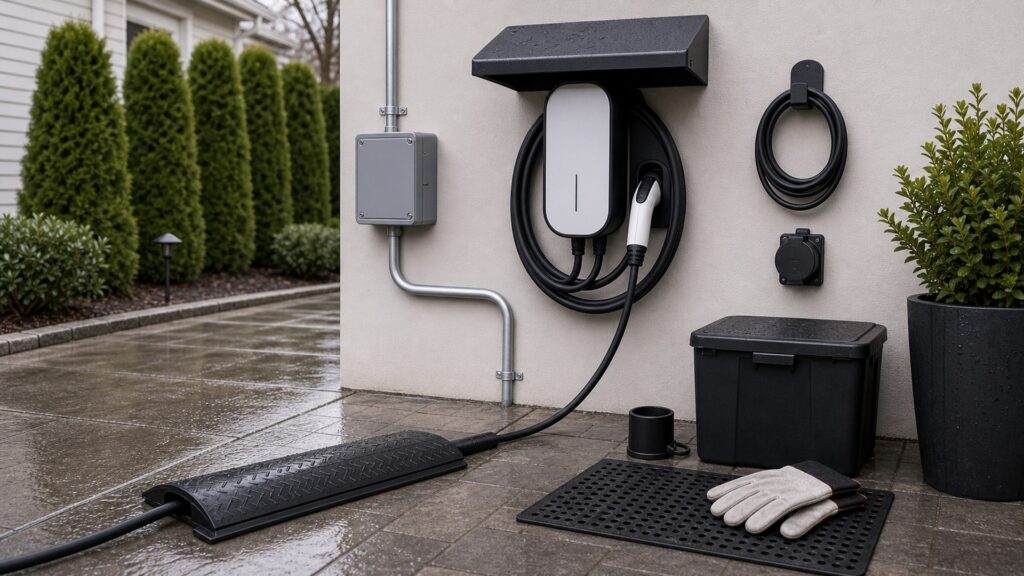
Buying framework
Resolve the purchase in four stages
Each stage answers a different question: what the site allows, what the equipment supports, how the parked vehicle changes the layout, and how the result will be checked after installation.
Location Rating: Use EVSE identified for the exact outdoor or wet location; a vague weather-resistant claim does not define permitted exposure. Establish this boundary before choosing a station.
Water Drainage: Choose a position above predictable runoff and ponding, with conduit and enclosure openings oriented so water cannot collect around electrical parts. Carry the result into the electrical and parking plan.
Connector Storage: A stable holster keeps contacts out of dirt and directs the connector as its manufacturer intends between sessions. Use this finding to remove unsupported configurations early.
Temperature Range: Check the marked operating range because heat, direct sun, and winter cold can affect displays, electronics, and cable flexibility. Do not advance until the complete connection is documented.
Who this is for
Match the equipment to the repeated use pattern
The same hardware can suit one routine and obstruct another. Weight the profile that creates the strictest recurring constraint.
Open-driveway household: Prioritize a true outdoor rating, runoff control, and a cable route that stays visible after dark.
Carport installation: Treat wind-driven rain and exposed edges as outdoor conditions unless the product documentation says otherwise.
Curbside property: Resolve property permission, pedestrian clearance, cord protection, and vehicle impact before selecting power.
Commercial outdoor site: Add frequent inspections, protected hardware, signage, and a documented response for damaged or wet equipment.
What to pay attention to
Translate specifications into site consequences
Ratings matter when they predict what happens at the connector, cable, mounting point, electrical supply, or user path. Check the complete installed chain rather than one impressive component.
Documented boundary
Use markings and current instructions to define mounting support and vehicle impact protection for the exact model.
Observed operation
Put snow and vegetation clearance through the normal vehicle position, people, weather, and charging demand rather than judging an idle display.
Mounting Support: The wall, pedestal, or post must carry repeated cord handling without loosening, twisting, or transferring load to a fitting. Compare the marked limit with the proposed mounting position.
Vehicle Impact Protection: Setbacks, bollards, wheel stops, or protected placement may be necessary where bumpers, doors, trailers, or snowplows could strike the station.Test the claim with the complete vehicle and cable arrangement.
Cable Routing: The ordinary route should keep the lead out of traffic lanes, door paths, sharp edges, and places where people walk.Observe this interface through connection, charging, and storage.
Snow And Vegetation Clearance: Leave room for snow storage, plowing, leaf buildup, irrigation spray, and seasonal plant growth around controls and ventilation.Record the most demanding ordinary condition, not an empty-bay demonstration.
Entry-Point Sealing: Use fittings and sealing methods approved for the enclosure and wiring method rather than filling every opening with improvised sealant.Keep the result with the commissioning or purchase record.
Avoid these traps
Shortcuts that hide a real compatibility problem
These errors substitute a label, ideal parking position, or first successful session for evidence that the complete arrangement remains supported.
Buying by an IP or weather slogan: Environmental language is useful only when the marked rating and instructions cover the exact mounting orientation and exposure.
Mounting at the lowest convenient point: A low enclosure may sit in runoff, snow, landscaping debris, or bumper range even when the wall itself is sheltered.
Leaving the cord on pavement: Ground contact invites abrasion, contamination, trip hazards, plow damage, and water around the connector.
Sealing away drainage: Unapproved caulk can trap moisture or defeat designed drain paths; follow the enclosure and fitting instructions instead.
Decision guidance
Use the first limiting condition to narrow the field
Remove choices that fail a documented electrical, environmental, vehicle, or routing boundary. Compare convenience only among configurations that remain valid as a complete system.
If the bay floods or ponds: Move the equipment or redesign drainage; do not treat a taller pedestal as proof that every connection is protected.
When winter dominates: Favor a cable and holder that remain manageable in the published cold range, with room for gloves and snow removal.
Where vehicles maneuver tightly: Place the unit beyond the swept path or specify suitable physical protection before adding convenience features.
For an exposed wall: Choose the complete outdoor-rated assembly and verify how sun, rain, conduit entries, and connector storage are handled together.
Ownership & compatibility
Keep the charging arrangement inspectable
Routine handling and site changes can alter a sound initial installation. A focused check of seasonal inspection reveals change before the household treats a workaround as normal.
Walk the site after bad weather: Look for standing water, loosened hardware, damaged jackets, debris in the holster, and any fault indication before reconnecting.
Keep the connector supported: Return it to its designed holder so contacts stay cleaner and cable weight does not hang from the latch.
Recheck changing surroundings: Landscaping, new parking patterns, snow banks, and resurfacing can create a hazard that was absent at commissioning.
FAQ
Questions buyers ask about outdoor charging installations
Use these answers to close narrow gaps after the vehicle, charging mode, electrical site, and parking layout have been identified.
What proves location rating is suitable?
How should a buyer evaluate water drainage?
When does connector storage rule out a choice?
Which evidence governs temperature range?
How can I verify mounting support?
What should I document about vehicle impact protection?
Why does cable routing matter in daily use?
Can convenience features compensate for weak snow and vegetation clearance?
What belongs in the final entry-point sealing review?
Bottom line
Choose the system you can explain and recheck
A strong choice meets the real energy need, stays inside every connected limit, and leaves clear evidence for another owner, installer, or technician.
Set the boundary first: Resolve location rating, water drainage, and the governing approvals before cost or connected features influence the shortlist.
Reproduce ordinary use: Confirm cable routing across each parking position, with the lead connected and the expected demand applied.
Keep a service baseline: Document the accepted condition and use seasonal inspection to catch wear, environmental change, or a new incompatibility.
Reading Shortcuts
Jump to the unresolved part of the decision.
Decision Reminders
Complete these checks at the actual parking and electrical site.
- Location Rating: Verify the marked boundary.
- Water Drainage: Measure the real condition.
- Connector Storage: Use current model instructions.
- Temperature Range: Include the complete load.
- Mounting Support: Record the first conflict.
- Vehicle Impact Protection: Keep the result serviceable.
Glossary Snippets
Definitions that clarify location rating and the wider charging system.
When to Use a Top 10 Review
Use ranked candidates after location rating and temperature range have removed incompatible options.
- Location Rating: The required boundary is known.
- Water Drainage: The site condition is measured.
- Connector Storage: The supported interface is documented.
- Temperature Range: The demanding routine has been reproduced.
Already down to 2–3 options? A Comparison is usually the faster next step.
When to Use a Comparison
Put finalists through the same site checks instead of comparing unrelated feature lists.
- Mounting Support: Both choices meet this limit.
- Vehicle Impact Protection: Both use the supported arrangement.
- Cable Routing: Both remain practical when connected.
- Snow And Vegetation Clearance: The difference changes ownership work.
Still exploring? Start with a Top 10 to build a shortlist first.