
EV Charging Stations Buying Guide for Charging Cable Management
A charging cable is handled far more often than the station bolted to the wall. Every session bends the jacket, loads the strain relief, carries the connector past painted bodywork, and creates a temporary route through the parking space. Poor organization turns that ordinary movement into cumulative damage.
Cable management should therefore be designed in two states: connected and stored. The lead must reach the inlet without tension while charging, then return to a holder that supports its weight and keeps contacts out of dirt and water. The best arrangement makes the safe action the easy, obvious action after every drive.
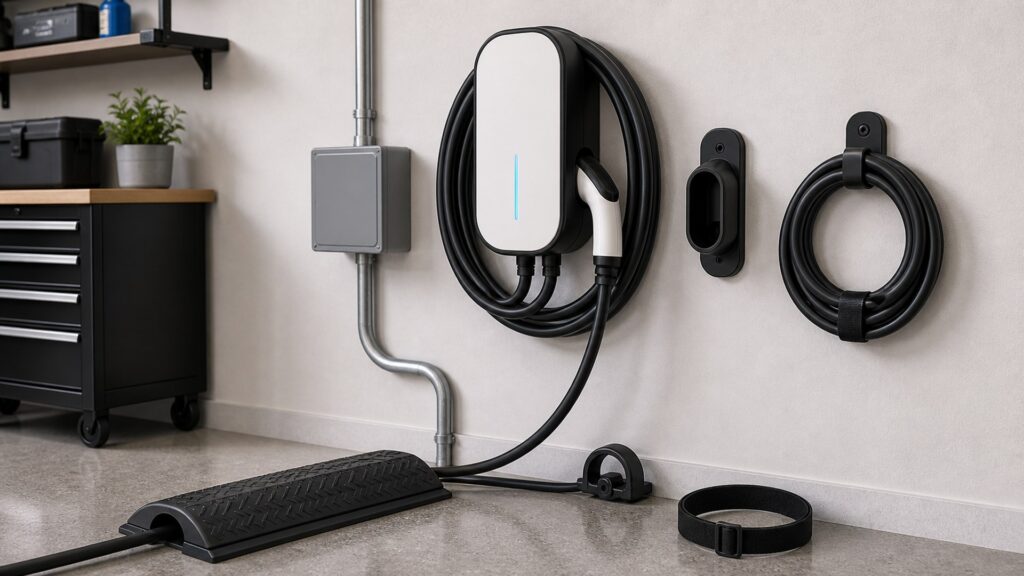
Buying framework
Trace the cable's complete journey
Stand at the parked vehicle and follow the lead from station to inlet, then back to storage. Four observations reveal more than a catalog photograph.
Measure the working route: Use the actual parking position and inlet location. Include the vertical drop, corners, and enough slack to insert the connector without pulling on the latch or rubbing the car.
Mark every conflict zone: Identify tire paths, door edges, garage-door tracks, stairs, bicycles, carts, snow storage, and passenger walkways. The routine cable path should avoid them rather than depend on careful placement.
Study the return motion: A driver should be able to support the connector, relax any twist, and place the cord in broad loops. If storage requires lifting a heavy coil overhead, it will soon be skipped.
Make damage easy to see: Arrange loops so the jacket, both strain reliefs, plug, coupler, and latch remain inspectable. Hidden underside wear is common where a cable repeatedly touches concrete or a threshold.
Who this is for
Match the organizer to the parking space
The same cord behaves differently in a narrow garage, an exposed driveway, or a bay used dozens of times a day. Choose for the handling pattern, not for visual tidiness alone.
Tight single-car garage: A side-wall hanger can keep the cord beyond the door swing, but it must still serve the inlet without cutting across the walking strip. Test with shelves and bins in their normal positions.
Outdoor driveway: Elevated connector storage and generous loops help keep contacts and jacket away from runoff, grit, lawn tools, and snow. Use hardware and mounting methods approved for outdoor exposure.
Shared residential parking: The storage position needs to be unmistakable. A clear home for the connector prevents one user from leaving a tripping or drive-over hazard for the next.
Vehicles with different inlet locations: Controlled slack matters more than an extremely long loose cable. Check front, rear, left, and right inlet positions that the station is expected to serve.
High-cycle fleet bay: Durable supports, visible wear points, and a quick out-of-service process matter more than decorative concealment. Drivers should not be encouraged to keep using a damaged lead to avoid downtime.
What to pay attention to
Small hardware choices change cable life
Hooks, holsters, and retractors touch the charging assembly every day. Their shape and force can either spread loads gently or concentrate them where damage begins.
Connected route
Judge where the cable lies while the car is charging, including doors, tires, walkways, and the inlet connection.
Stored condition
Look at loop diameter, connector support, contamination protection, and the effort required to put the cord away.
Hanger width: A wide, smooth support distributes the cord's weight over a larger curve. Narrow pegs and sharp-edged brackets can leave one compressed spot in the jacket.
Loop diameter: Store the lead in broad coils consistent with manufacturer guidance. Tight circles save wall space but repeatedly flex the same areas and can torque the connector body.
Connector support: The holster should carry the connector rather than letting cable weight hang from its latch. Check insertion depth, drainage orientation, and whether gloved hands can release it cleanly.
Retractor pull: Enough force to lift slack may be useful; enough force to tug on a connected inlet is not. Evaluate the pull throughout the travel, including the last foot near the vehicle.
Usable versus advertised length: A portion of the stated cable length is consumed by the mounted height, storage path, and safe curves. Measure the route rather than subtracting straight-line distances.
Jacket behavior in temperature extremes: Cold can make a cord resist coiling, while sun and heat affect handling and aging. Confirm the station's operating range and try the storage motion under the site's demanding season.
Avoid these traps
Tidiness can still hide bad mechanics
A cable may look neatly stored while enduring a sharp bend, constant spring force, or concentrated weight. Evaluate what the organizer does to the lead, not just what it does for the wall.
Coiling as tightly as possible: Compact loops repeatedly flex the jacket and strain relief. Give the cord more wall area so it can rest in broad curves without fighting its natural twist.
Treating total length as usable reach: The final feet near the inlet need relaxed handling slack. A cable stretched diagonally across a bay is too short for that parking position, even if the connector technically reaches.
Choosing the strongest retractor: Excessive pull can load the latch, drag the coupler across paint, or make it recoil toward a person. Force should manage slack without remaining on the connected vehicle.
Letting the cord touch the floor at one spot: Repeated contact at a threshold or curb can abrade the same section unnoticed. Inspect underneath and alter the support when marks recur in a consistent location.
Adding an improvised extension: Ordinary extension cords and unapproved cable additions are not a cable-management solution. Relocate the station or have the installation redesigned using equipment and methods intended for EV charging.
Decision guidance
Let the obstacle choose the support method
Begin with the specific conflict—walkway, changing inlet position, outdoor grit, or heavy daily cycling. Then select the simplest approved hardware that removes it without stressing the cable elsewhere.
If a walkway cannot be avoided: Reconsider station placement or use a properly designed wall or overhead route. A loose floor cover creates its own edge, movement, and inspection problems in daily use.
If several inlet positions must be served: Use a central mounting point and controlled slack that can travel without crossing tire paths. Mock up each orientation before drilling the wall or setting a pedestal.
If cold weather stiffens the lead: Favor generous loop space and a holder reachable with gloves. A retractor that works in summer may become awkward when the jacket resists bending.
If handling damage keeps returning: The layout is failing. Stop using a compromised cord, obtain qualified evaluation, and correct the repeated pinch, abrasion, or tension point before replacement equipment enters service.
Ownership & compatibility
Inspect where hands and surfaces meet the cable
Cable care is mostly observation. A brief look during ordinary handling can catch changes before a connector, jacket, or support becomes unsafe.
Before plugging in: Look over the de-energized visible jacket, strain relief, latch, and contacts. Do not connect equipment showing cuts, scorching, bent parts, contamination, or unusual looseness.
While returning the cord: Let twists relax instead of forcing them into a tight coil. Support the connector with one hand so it does not swing against the vehicle or wall.
After severe weather: Check outdoor holders for standing water, ice, grit, corrosion, and displaced hardware. Clear the route only using methods permitted for the installed equipment.
When wear repeats: Photograph the location and date of recurring marks. That record helps distinguish a one-time scrape from a geometry problem that should be redesigned.
FAQ
Cable-management questions worth settling
The answers below focus on reach, support, storage, and signs that the layout needs to change.
How much extra cable slack is appropriate?
Can an EV charging cable lie on concrete?
Are automatic cable retractors safe for EV charging?
What makes a good connector holster?
Should the cable be coiled while charging?
How do I manage a cable for two parking positions?
Can I repair a cut charging-cable jacket with tape?
Why does my cable become difficult to store in winter?
How often should charging cables be inspected?
Bottom line
A safe cable route should feel ordinary
Drivers should not need to step over, stretch, untangle, or carefully balance the connector. Good management quietly protects the cable through every connect-and-store cycle.
Map both states: Approve the path while charging and the shape while stored. Either state can create wear or a trip hazard.
Support broad curves: Use hardware that carries weight without pinching the jacket or leaving force on the vehicle inlet.
Fix patterns, not symptoms: Repeated scuffs, twists, or floor contact identify a layout defect. Change the route before a replacement cord develops the same damage.
Reading Shortcuts
Find the cable route, storage, or inspection question quickly.
Before You Commit
Walk the connected and stored cord paths before mounting hardware.
- Usable reach: Write down the demanding requirement.
- Ground clearance: Confirm the installed electrical boundary.
- Supported bend radius: Read the control behavior, including offline operation.
- Holster geometry: Reproduce the physical route at the parking space.
- Retraction force: Identify the consequence of one failed component.
Terms in This Guide
Terms that describe cable support, bending, and connector storage.
When a Top 10 List Helps
Use rankings after the hanger or retractor geometry has been measured.
- Usable reach: The actual demand is documented.
- Ground clearance: The electrical limit is established.
- Holster geometry: The site geometry has been measured.
- Retraction force: The important failure mode is understood.
Already choosing between finalists? A Comparison is the more focused format.
When to Compare Two Finalists
Compare two organizers against the same cord, inlet, and parking space.
- Ground clearance: Both remain inside the approved boundary.
- Supported bend radius: Their control rules are stated clearly.
- Holster geometry: Each works in the measured parking layout.
- Weather flexibility: The remaining difference affects daily use.
Need a broader shortlist first? Visit the Top 10 collection.