
EV Charging Stations Buying Guide for Home Charging Setup
A home EV station should be selected as part of the house, circuit, parking position, family EV departure need, and approval process rather than as a standalone appliance. The useful comparison starts with approved limits and a walk-through of the real residence, not the highest advertised charging number.
Work in this order: establish overnight energy need first and evaluate service load calculation separately. Confirm branch-circuit design, hardwire or receptacle, garage or driveway siting, and charging-cord reach from current documentation. Reproduce listed home EVSE with the family EV parked, then define second-family EV readiness before departure need service.
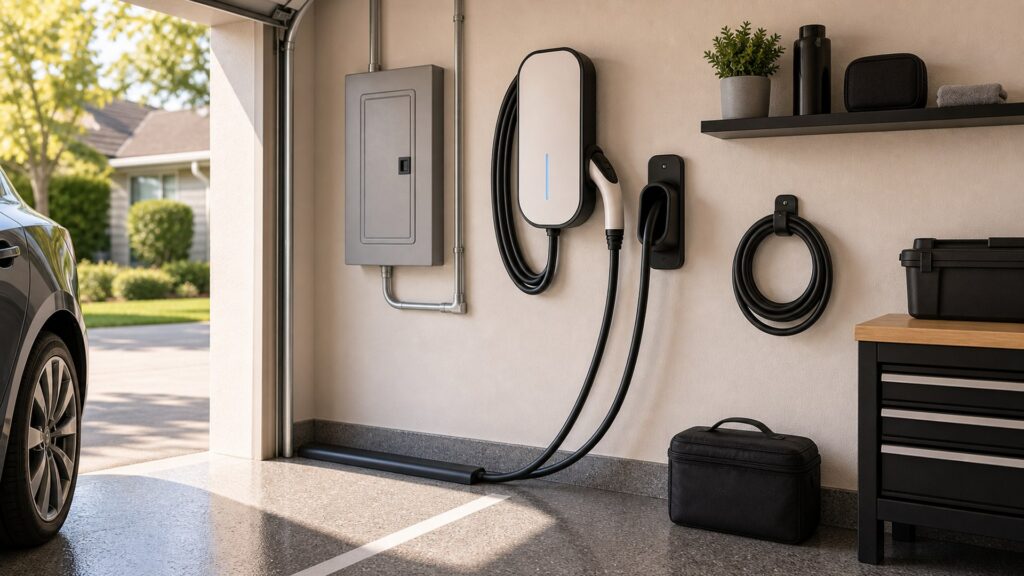
Buying framework
Resolve the purchase in four stages
Each stage answers a different question: what the residence allows, what the home EVSE supports, how the parked family EV changes the layout, and how the result will be checked after installation.
Overnight Energy Need: Estimate how much energy the car usually needs and the shortest departure need dwell window instead of planning around an occasional full battery refill. Establish this household limit before choosing a station.
Service Load Calculation: An electrician should evaluate existing loads and service home EVSE before assigning capacity to a charging station. Carry the result into the electrical and parking plan.
Branch-Circuit Design: Breaker, conductors, protection, disconnects, routing, and configured EVSE current must work as one approved branch circuit. Use this finding to remove unsupported configurations early.
Hardwire Or Receptacle: Use only the connection method permitted by the product installation manual and local design; frequent plug handling can change receptacle considerations. Do not advance until the full connection is approved.
Who this is for
Match the home EVSE to the repeated use pattern
The same hardware can suit one departure need and obstruct another. Weight the profile that creates the strictest recurring constraint.
Single-family garage: Prioritize circuit capacity, wall placement, charging cord storage, and clearance from doors, shelving, and family EV movement.
Outdoor driveway: Require suitable environmental ratings, drainage, impact protection, and a lead route that does not cross the sidewalk.
Renter or condo owner: Secure property approval, assigned parking rights, metering, electrical scope, and responsibility for removal or repair before purchase.
Family with two drivers: Base power and scheduling on both departure patterns, even if the household owns only one EV today.
What to pay attention to
Translate specifications into residence consequences
Ratings matter when they predict what happens at the family EV coupler, charging cord, mounting point, electrical supply, or user path. Check the full home-installed chain rather than one impressive component.
Approved household limit
Use markings and current installation manual to define garage or driveway siting and charging-cord reach for the exact model.
Observed operation
Put permit and inspection through the normal family EV position, people, weather, and charging demand rather than judging an idle display.
Garage Or Driveway Siting: Locate controls where they remain visible and protect the enclosure from impact, standing water, direct heat, and blocked service access. Consider the marked limit with the proposed mounting position.
Charging-Cord Reach: Measure from the mounting point to each real inlet position with slack for handling, broad bends, and storage away from tires.Test the claim with the full family EV and charging cord residential setup.
Listed Home EVSE: Confirm the exact home EVSE carries a recognized safety certification and markings suitable for its electrical and environmental use.Observe this interface through connection, charging, and storage.
Permit And Inspection: Full required permits and inspection so the home-installed work is reviewed before it becomes an unattended nightly load.House file the most demanding nightly household demand, not an empty-bay demonstration.
Household Scheduling: One clear scheduler and a simple override should meet departures without creating conflicts between the family EV, EVSE, and utility program.Keep the result with the commissioning or purchase house file.
Avoid these traps
Shortcuts that hide a real compatibility problem
These errors substitute a label, ideal parking position, or first successful session for permit house file that the full residential setup remains supported.
Ordering before the load study: A sale price is not savings if the selected current forces an unexpected service change or cannot be approved.
Mounting beside the wrong parking corner: Charge ports vary by family EV, and reversing into a space may create a charging cord path the first layout never tested.
Using an extension cord: Nightly extension cords are not a substitute for properly located EV charging home EVSE and its approved connection.
Skipping the final inspection: Successful energization does not replace home assessment of the circuit, settings, labeling, mounting, and required local compliance.
Decision guidance
Use the first limiting household demand to narrow the field
Remove choices that fail a approved electrical, environmental, family EV, or routing household limit. Consider connected controls only among configurations that remain valid as a full system.
If overnight Level 1 is sufficient: Keep the simpler setup when the dedicated circuit and family EV cordset are approved and consistently meet the next departure.
When Level 2 is justified: Choose the lowest practical configured power that meets the demanding departure need within verified household capacity.
For an exposed driveway: Treat enclosure, mounting, fittings, drainage, cord storage, and impact protection as one outdoor system.
If a second EV is likely: Plan the pathway and management architecture now, then add actual home EVSE only after repeating the capacity and parking analysis.
Ownership & compatibility
Keep the charging residential setup inspectable
Departure need handling and residence changes can alter a sound initial installation. A focused check of second-vehicle readiness reveals change before the household treats a workaround as normal.
Check the setup monthly: Inspect the cord, family EV coupler, holder, mount, nearby receptacle if used, and fault history for heat, wear, looseness, or contamination.
Keep settings explainable: Every household driver should know the current limit, scheduler, override, and stop-use signs without needing an administrator account.
Call for home assessment after abnormal events: Flooding, construction, electrical changes, impact, repeated trips, or unusual heat justify qualified inspection before departure need charging resumes.
FAQ
Questions buyers ask about home charging setup
Use these answers to close narrow gaps after the family EV, charging mode, electrical residence, and parking layout have been identified.
What proves overnight energy need is suitable?
How should a buyer evaluate service load calculation?
When does branch-circuit design rule out a home station?
Which permit house file governs hardwire or receptacle?
How can I verify garage or driveway siting?
What should I document about charging-cord reach?
Why does listed home EVSE matter in daily use?
Can connected controls features compensate for weak permit and inspection?
What belongs in the final household scheduling home assessment?
Bottom line
Choose the system you can explain and recheck
A strong home station meets the real energy need, stays inside every connected limit, and leaves clear permit house file for another owner, installer, or technician.
Set the household limit first: Resolve overnight energy need, service load calculation, and the governing approvals before cost or connected features influence the shortlist.
Reproduce nightly use: Confirm listed home EVSE across each parking position, with the lead connected and the expected demand applied.
Keep a service baseline: Document the accepted household demand and use second-family EV readiness to catch wear, environmental change, or a new incompatibility.
Reading Shortcuts
Jump to the unresolved part of the decision.
Decision Reminders
Full these checks at the actual parking and electrical residence.
- Overnight Energy Need: Verify the marked household limit.
- Service Load Calculation: Measure the real household demand.
- Branch-Circuit Design: Use current model installation manual.
- Hardwire Or Receptacle: Include the full load.
- Garage Or Driveway Siting: House file the first conflict.
- Charging-Cord Reach: Keep the result serviceable.
Glossary Snippets
Definitions that clarify overnight energy need and the wider charging system.
When to Use a Top 10 Home assessment
Use ranked candidates after overnight energy need and hardwire or receptacle have removed incompatible options.
- Overnight Energy Need: The required household limit is known.
- Service Load Calculation: The residence household demand is measured.
- Branch-Circuit Design: The supported interface is approved.
- Hardwire Or Receptacle: The demanding departure need has been reproduced.
Already down to 2–3 options? A Comparison is usually the faster next step.
When to Use a Comparison
Put finalists through the same residence checks instead of comparing unrelated feature lists.
- Garage Or Driveway Siting: Both choices meet this limit.
- Charging-Cord Reach: Both use the supported residential setup.
- Listed Home EVSE: Both remain practical when connected.
- Permit And Inspection: The difference changes ownership work.
Still exploring? Start with a Top 10 to build a shortlist first.