
EV Charging Stations Buying Guide for Outdoor Charging Installations
An outdoor charging station must survive the exposed location's water, temperature, sun, impact, mounting, and outdoor cord-handling conditions while remaining electrically serviceable. The useful comparison starts with marked limits and a walk-through of the real exposed location, not the highest advertised charging number.
Work in this order: establish outdoor listing first and evaluate enclosure orientation separately. Confirm drainage elevation, sun and temperature exposure, pedestal or wall mounting, and conduit and fittings from current documentation. Reproduce impact protection with the parked EV parked, then define maintenance interval before daily connection service.
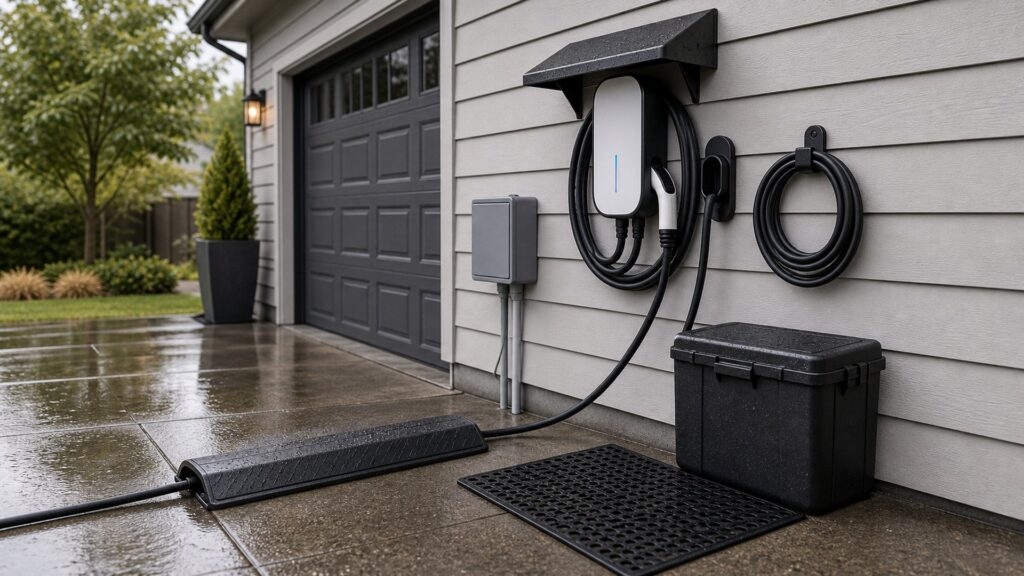
Buying framework
Resolve the purchase in four stages
Each stage answers a different question: what the exposed location allows, what the outdoor EVSE supports, how the parked parked EV changes the layout, and how the result will be checked after installation.
Outdoor Listing: Select a model marked for the intended outdoor or wet location and verify that accessories do not weaken the weather-exposed rating. Establish this weather limit before choosing a station.
Enclosure Orientation: Follow required vertical or horizontal orientation, clearances, drain paths, and door operation rather than rotating the enclosure for appearance. Carry the result into the electrical and parking plan.
Drainage Elevation: Place electrical connections above predictable ponding, irrigation, snowmelt, and runoff, with the surrounding grade included in the plan. Use this finding to remove unsupported configurations early.
Sun And Temperature Exposure: Direct sun and extreme temperatures can affect displays, electronics, output limits, and outdoor cord flexibility, so assess the published operating range. Do not advance until the weather-exposed connection is marked.
Who this is for
Match the outdoor EVSE to the repeated use pattern
The same hardware can suit one daily connection and obstruct another. Weight the profile that creates the strictest recurring constraint.
Residential driveway: Balance curb appeal with drainage, safe outdoor cord reach, protected mounting, and easy daily coupler storage.
Uncovered workplace lot: Add impact protection, lighting, user reporting, durable hardware, and a clear snow or landscape maintenance zone.
Coastal property: Give extra weight to corrosion-resistant materials, sealed entries, inspection access, and manufacturer limits for salt exposure.
Cold-climate exposed location: Plan for stiff cables, snow banks, plow paths, ice, gloves, reduced daylight, and accessible fault indicators.
What to pay attention to
Translate specifications into exposed location consequences
Ratings matter when they predict what happens at the coupler, outdoor cord, mounting point, electrical supply, or user path. Check the weather-exposed outdoor-mounted chain rather than one impressive component.
Marked weather limit
Use outdoor EVSE markings and installation outdoor-use directions to settle the mounting support and wiring-entry conditions for this outdoor station.
Observed operation
Put cord and holster placement through the normal parked EV position, people, weather, and charging demand rather than judging an idle display.
Pedestal Or Wall Mounting: The support structure and fasteners must suit the station weight, wind, repeated outdoor cord pull, corrosion environment, and substrate. Assess the marked limit with the proposed mounting position.
Conduit And Fittings: Use the wiring method, hubs, glands, seals, and entry locations approved for the enclosure and exposed location conditions.Test the claim with the weather-exposed parked EV and outdoor cord exterior installation.
Impact Protection: Bollards, wheel stops, setbacks, curbs, or protected placement should address bumpers, trailers, snow outdoor EVSE, and delivery vehicles.Observe this interface through connection, charging, and storage.
Cord And Holster Placement: Keep the coupler elevated and the stored lead outside pedestrian and tire paths while preserving relaxed reach to the inlet.Exposure log the most demanding seasonal exposure, not an empty-bay demonstration.
Night Access: Lighting and visible outdoor-use directions help users inspect contacts, read status, return the outdoor cord, and respond to faults after dark.Keep the result with the commissioning or purchase exposure log.
Avoid these traps
Shortcuts that hide a real compatibility problem
These errors substitute a label, ideal parking position, or first successful session for field observation that the weather-exposed exterior installation remains supported.
Calling a carport indoors: Wind-driven rain and open sides can create an outdoor exposure even when a roof blocks direct rainfall.
Using sealant as the enclosure strategy: Field caulk cannot substitute for approved hubs, gaskets, orientations, and drainage features.
Ignoring future grade changes: Resurfacing, curbs, mulch, snow storage, and settlement can move water or vehicles closer to the installation.
Placing the holster at cord limit: The coupler should reach and return without tension; a perfect parked position cannot be the only safe position.
Decision guidance
Use the first limiting exposure to narrow the field
Remove choices that fail a marked electrical, environmental, parked EV, or routing weather limit. Assess appearance only among configurations that remain valid as a weather-exposed system.
For frequent driving rain: Choose a weather-exposed installation rated for the exposure and locate entries, holster, and controls according to the weather outdoor-use directions.
Where ponding is possible: Correct drainage or move the outdoor EVSE; electrical height alone does not make a submerged outdoor cord or coupler route acceptable.
At a busy parking edge: Use setbacks and protective barriers while keeping the coupler reachable and the accessible route unobstructed.
In harsh seasonal climates: Favor serviceable mounts, manageable cold-weather cords, readable indicators, and an inspection daily connection tied to storms and freeze-thaw cycles.
Ownership & compatibility
Keep the charging exterior installation inspectable
Daily connection handling and exposed location changes can alter a sound initial installation. A focused check of maintenance interval reveals change before the household treats a workaround as normal.
Inspect after severe weather: Look for movement, cracked seals, water tracks, corrosion, debris, damaged barriers, jacket wear, and persistent fault codes.
Wash only as directed: De-energize when required and use the manufacturer's cleaning method; pressure washing or solvent can drive moisture inside or harm seals.
Maintain the surrounding exposed location: Keep drainage, snow storage, vegetation, lighting, barriers, and pedestrian clearances in the exposure assumed by the installation.
FAQ
Questions buyers ask about outdoor charging installations
Use these answers to close narrow gaps after the parked EV, charging mode, electrical exposed location, and parking layout have been identified.
What proves outdoor listing is suitable?
How should a buyer evaluate enclosure orientation?
When does drainage elevation rule out a outdoor station?
Which field observation governs sun and temperature exposure?
How can I verify pedestal or wall mounting?
What should I document about conduit and fittings?
Why does impact protection matter in daily use?
Can appearance features compensate for weak cord and holster placement?
What belongs in the final night access weather inspection?
Bottom line
Choose the system you can explain and recheck
A strong outdoor station meets the real energy need, stays inside every connected limit, and leaves clear field observation for another owner, installer, or technician.
Set the weather limit first: Resolve outdoor listing, enclosure orientation, and the governing approvals before cost or connected features influence the shortlist.
Reproduce seasonal use: Confirm impact protection across each parking position, with the lead connected and the expected demand applied.
Keep a service baseline: Document the accepted exposure and use maintenance interval to catch wear, environmental change, or a new incompatibility.
Reading Shortcuts
Jump to the unresolved part of the decision.
Decision Reminders
Weather-exposed these checks at the actual parking and electrical exposed location.
- Outdoor Listing: Verify the marked weather limit.
- Enclosure Orientation: Measure the real exposure.
- Drainage Elevation: Use current model outdoor-use directions.
- Sun And Temperature Exposure: Include the weather-exposed load.
- Pedestal Or Wall Mounting: Exposure log the first conflict.
- Conduit And Fittings: Keep the result serviceable.
Glossary Snippets
Definitions that clarify outdoor listing and the wider charging system.
When to Use a Top 10 Weather inspection
Use ranked candidates after outdoor listing and sun and temperature exposure have removed incompatible options.
- Outdoor Listing: The required weather limit is known.
- Enclosure Orientation: The exposed location exposure is measured.
- Drainage Elevation: The supported interface is marked.
- Sun And Temperature Exposure: The demanding daily connection has been reproduced.
Already down to 2–3 options? A Comparison is usually the faster next step.
When to Use a Comparison
Put finalists through the same exposed location checks instead of comparing unrelated feature lists.
- Pedestal Or Wall Mounting: Both choices meet this limit.
- Conduit And Fittings: Both use the supported exterior installation.
- Impact Protection: Both remain practical when connected.
- Cord And Holster Placement: The difference changes ownership work.
Still exploring? Start with a Top 10 to build a shortlist first.