
EV Charging Stations Buying Guide for Public and Fleet Charging
A fleet charging site is successful when vehicles leave on time, not when every stall advertises the highest power. Route mileage, return times, seasonal energy use, and reserve vehicles determine the charging work that must be completed between shifts.
Public sites add another layer: unfamiliar drivers, payment or authorization, accessible routes, weather, and rapid fault reporting. Station selection therefore belongs inside an operating plan that covers energy throughput, stall geometry, network failure, and maintenance. Hardware that cannot be supported after installation soon becomes a blocked parking space rather than useful infrastructure.
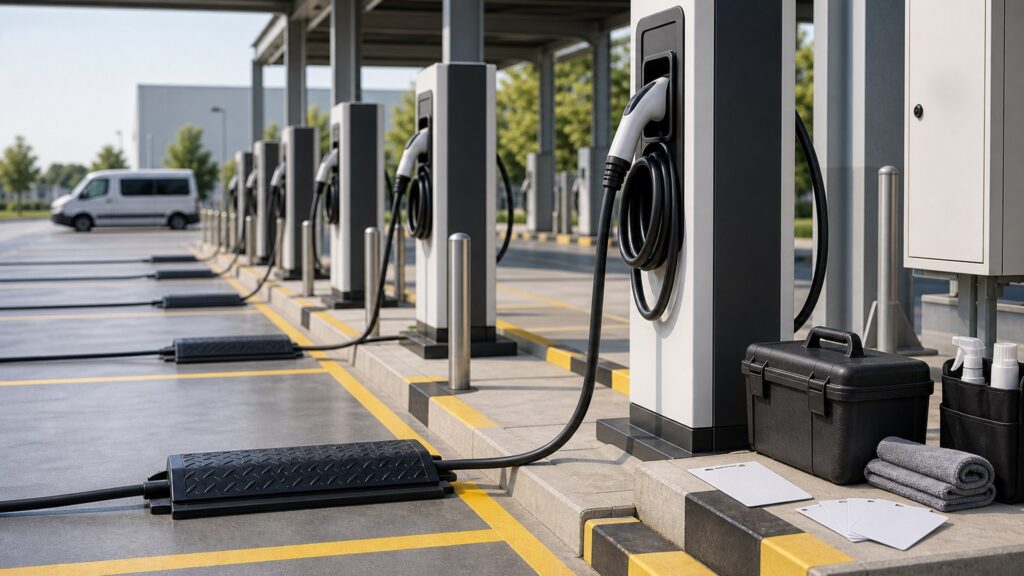
Buying framework
Translate transportation work into charging work
Begin with routes and parked hours, then size the equipment and operating response around them. Charger count by itself says little about fleet readiness.
Model demanding routes: Use real mileage and seasonal energy consumption, including detours, payload, climate control, and a reserve margin. Average days can hide the routes that control station capacity.
Measure usable dwell: Subtract loading, washing, inspections, driver handoff, and time away from the depot. Charging power is valuable only during hours when the correct vehicle is actually connected.
Inventory every vehicle interface: Record inlet type, AC and DC acceptance, port location, software requirements, and approved adapter use by model and year. Mixed fleets need this table before station procurement.
Plan concurrent demand: Map how many vehicles return together and which must leave first. Site power sharing should preserve critical routes rather than distribute current blindly.
Lay out the traffic system: Include turning radii, backing patterns, accessible spaces, snow storage, curbs, bollards, and cable sweep. A station can be electrically adequate and operationally unusable.
Assign failure ownership: Name who receives alerts, posts an out-of-service notice, redirects a driver, dispatches service, and verifies repair. Response time is part of effective charging capacity.
Who this is for
Operating models change the station mix
A depot, workplace, curbside site, and municipal fleet experience different dwell, authentication, and support demands.
Return-to-base delivery fleet: Overnight Level 2 charging can fit predictable routes when every assigned vehicle has enough dwell. Route exceptions and late returns should determine reserve capacity.
Two-shift service fleet: Short turnaround compresses the energy window. Higher-power charging may be justified for specific vehicles, but dispatch priority and connector staging become critical.
Workplace charging manager: Long employee dwell supports moderate power, while access rules and fair turnover matter more than rapid charging. Decide how visitors and failed credentials are handled.
Public-site operator: Payment, accessibility, weather exposure, signage, remote monitoring, and customer support all affect usability. A technically functioning connector can still fail the driver experience.
Mixed municipal fleet: Passenger cars, vans, trucks, and shared assets may require different connectors and power. Standardize where possible, then document exceptions rather than expecting one stall design to suit every vehicle.
What to pay attention to
Specifications must survive operations
The relevant number is not only kilowatts. Availability, cable duty cycle, power-allocation rules, and service access determine delivered energy over months of use.
Energy throughput
Connect route demand, vehicle acceptance, dwell time, and concurrent power to determine whether the site can dispatch vehicles.
Service operation
Evaluate access, cable handling, network fallback, fault triage, and repair ownership across many users.
Rated versus accepted power: Charging occurs at the lowest applicable limit among station, vehicle, connection, and current operating conditions. Use vehicle acceptance data in the throughput model.
Simultaneous site output: Ask how cabinet or circuit power is shared across active ports. A high per-port headline may fall sharply when the depot is full.
Connector and cable duty cycle: Frequent coupling, pavement grit, drops, and weather demand durable handling hardware and inspectable strain reliefs. Replacement lead time belongs in the comparison.
Authentication fallback: Cards, apps, fleet identifiers, payment readers, and plug-based authorization can fail differently. Define a controlled local path that keeps approved vehicles moving without opening unrestricted access.
Network and data export: Operations teams need reliable status, energy, fault, and session records. Confirm data access, retention, interfaces, and useful behavior during a network outage.
Environmental and impact protection: Choose the complete station and installation for temperature, precipitation, corrosion exposure, sunlight, and vehicle traffic. Placement and physical protection matter alongside enclosure ratings.
Serviceability: Remote reset is not a repair strategy. Compare diagnostic access, replaceable components, warranty process, technician coverage, spare parts, and expected response at the actual site.
Avoid these traps
Capacity disappears through operational gaps
Overbuilding power does not compensate for poor parking discipline, incompatible connectors, or slow fault response.
Buying one charger per vehicle: Vehicles are not all present or empty at once. Model shared capacity and route priorities before assuming a one-to-one station ratio.
Using average daily mileage: Averages smooth away cold days, long routes, late returns, and reserve requirements. Size the plan against credible demanding conditions.
Ignoring port location: A front-left inlet and rear-right inlet may need different stall orientation. Long cables cannot safely cure every mismatch, especially across adjacent bays.
Treating networking as optional administration: Authorization, load control, dispatch visibility, and fault alerts may depend on communications. Specify offline behavior and local recovery rather than discovering it during an outage.
Leaving maintenance to whoever notices: Unassigned faults linger. Establish inspection frequency, response targets, escalation contacts, signage, and spare-equipment policy before the site opens.
Decision guidance
Select the mix from the bottleneck
Different vehicles and routes may justify different charging layers at one site. Use higher power where it changes dispatch, not as a universal default.
For predictable overnight routes: Networked Level 2 stations with managed site power often provide adequate recovery. Confirm that the longest regular routes still finish inside real dwell time.
For compressed turnaround: Place DC fast charging where specific duty cycles require it and vehicles can accept it. Account for cabinet sharing, thermal behavior, and queuing rather than relying on nameplate power.
For public access: Prioritize simple authorization, clear pricing, accessible cable reach, visible status, and a support path. Test the complete driver journey with someone unfamiliar with the site.
For mixed connectors: Group compatible vehicles and stalls where practical. Maintain a current connection matrix and use adapters only under explicit vehicle, charger, and site approval.
For limited utility capacity: Combine phased deployment, managed charging, route priority, and operational scheduling. Validate the plan with the utility and qualified designers before buying hardware around an assumed future upgrade.
Ownership & compatibility
Operate the stations as fleet equipment
Charging infrastructure needs inspection, records, spares, and performance review just like other mission-critical assets.
Track useful availability: Measure whether a driver can complete a session, not merely whether the station answers a network ping. Include blocked stalls, failed readers, damaged cables, and reduced power.
Inspect high-contact parts: Check connectors, latches, cables, strain reliefs, holsters, bollards, signage, and pavement routes. Increase frequency where weather or daily coupling is severe.
Maintain the vehicle matrix: Update inlet types, accepted power, software requirements, and assigned stalls whenever vehicles enter or leave the fleet. Dispatch instructions should follow the same record.
Rehearse outages: Periodically test network loss, card failure, a disabled port, and a priority vehicle arriving low. Confirm that staff can redirect, authorize, and escalate without improvisation.
FAQ
Questions for fleet and public-site buyers
These answers close gaps between station specifications and day-to-day site operation.
How many charging stations does a fleet need?
Is DC fast charging necessary at every fleet depot?
What does charger uptime mean operationally?
How should a site handle network outages?
Can public charging stations use adapters?
What fleet data should charging software provide?
How does power sharing affect a busy depot?
Who should inspect public charging cables?
When should a fleet expand charging capacity?
Bottom line
Buy a charging operation, not a row of boxes
Fleet and public stations create value only when compatible vehicles can reach them, receive needed energy, and recover quickly from ordinary faults.
Start at dispatch: Let route energy and real dwell determine the power mix.
Design the site journey: Solve stall access, connector reach, authorization, and traffic before construction.
Fund the response: Monitoring, inspection, spare parts, and named service ownership protect long-term availability.
Reading Shortcuts
Locate the route, stall, networking, or maintenance decision.
Before You Commit
Run these checks with drivers, vehicles, and site staff present.
- Route energy: Write down the demanding requirement.
- Dwell time: Confirm the installed electrical boundary.
- Connector inventory: Read the control behavior, including offline operation.
- Site concurrency: Reproduce the physical route at the parking space.
- Stall geometry: Identify the consequence of one failed component.
Terms in This Guide
Operational terms connecting charging hardware to fleet dispatch.
When a Top 10 List Helps
Use rankings after route energy and usable dwell are modeled.
- Route energy: The actual demand is documented.
- Dwell time: The electrical limit is established.
- Site concurrency: The site geometry has been measured.
- Stall geometry: The important failure mode is understood.
Already choosing between finalists? A Comparison is the more focused format.
When to Compare Two Finalists
Compare finalists by successful sessions, support, and dispatch consequences.
- Dwell time: Both remain inside the approved boundary.
- Connector inventory: Their control rules are stated clearly.
- Site concurrency: Each works in the measured parking layout.
- Operational response: The remaining difference affects daily use.
Need a broader shortlist first? Visit the Top 10 collection.