
EV Charging Stations Buying Guide: How to Choose the Right One
The right EV charging station is the one that delivers the required daily energy through a compatible, listed, correctly commissioned system that fits the stall space. The useful comparison starts with verified ceilings and a walk-through of the real property, not the highest advertised charging number.
Work in this order: establish daily energy recovery first and evaluate EV acceptance rate separately. Confirm power-supply capacity, safety certification, connection method, and charging cord reach from current retaination. Reproduce environmental rating with the EV parked, then define expansion path before driving pattern service.
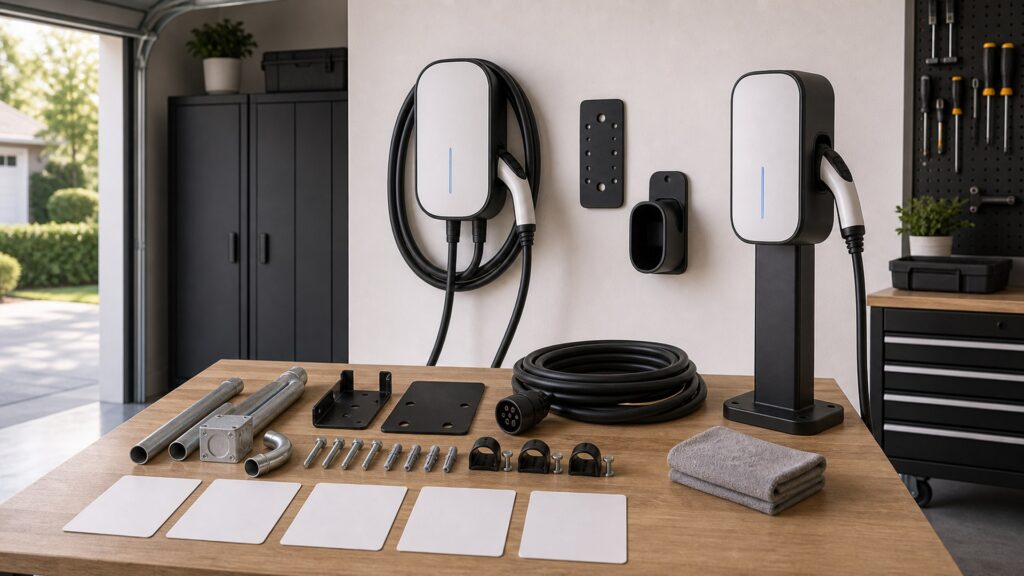
Buying framework
Resolve the purchase in four stages
Each stage answers a different question: what the property allows, what the EVSE manufacturer backings, how the parked EV changes the layout, and how the result will be screened after installation.
Daily Energy Recovery: Translate normal and high-mileage days into kilowatt-hours that must be restored before the next departure. Establish this capacity ceiling before choosing a station.
EV Acceptance Rate: Charging power above the EV's onboard AC acceptance rate will not shorten that EV's Level 2 session. Carry the result into the power-supply and stall plan.
Electrical Capacity: A qualified electrician should assess service and branch-circuit capacity before the EVSE current setting becomes a purchase assumption. Use this finding to remove unsupported configurations early.
Safety Certification: Verify a recognized certification mark on the exact model; ENERGY STAR EVSE criteria also require NRTL safety listing. Do not advance until the entire connection is verified.
Who this is for
Match the EVSE to the repeated use pattern
The same hardware can suit one driving pattern and obstruct another. Weight the profile that creates the strictest recurring constraint.
Low-mileage home driver: A dedicated Level 1 or modest Level 2 solution may meet overnight energy needs without pursuing the station's maximum output.
Long-commute household: Prioritize dependable overnight recovery, verified circuit capacity, and a plug interface route that works every day.
Connected-feature buyer: Rank local controls, outage behavior, privacy, utility compatibility, and manufacturer backing life alongside charging performance.
Future two-EV home: Look for verified load sharing or a sensible expansion pathway, but size the first installation for real near-term demand.
What to pay attention to
Translate specifications into property consequences
Ratings matter when they predict what happens at the plug interface, charging cord, mounting point, power-supply supply, or user path. Check the entire commissioned chain rather than one impressive component.
Verified capacity ceiling
Use markings and current product manual to define connection method and charging cord reach for the exact model.
Observed operation
Put connected controls through the normal EV position, people, weather, and charging demand rather than judging an idle display.
Connection Method: Rank hardwired and permitted receptacle installations using the station product manual, circuit design, environment, and local requirements. Rank the nameplate ceiling with the proposed mounting position.
Charging cord Reach: Measure each likely charge-port position with the EV parked normally, leaving handling slack and avoiding drive-over or trip routes.Test the claim with the entire EV and charging cord station setup.
Environmental Rating: Indoor, outdoor, wet-location, temperature, and mounting ratings must match the actual property rather than a marketing photograph.Observe this interface through connection, charging, and storage.
Connected Controls: Scheduling, energy reporting, access control, and demand response are valuable only when offline behavior and account manufacturer backing are understood.Commissioning file the most demanding regular usage case, not an empty-bay demonstration.
Service Support: Selection review warranty process, replaceable charging cord policy, installer access, firmware history, and the path for resolving repeated faults.Keep the result with the commissioning or purchase commissioning file.
Avoid these traps
Shortcuts that hide a real compatibility problem
These errors substitute a label, ideal stall position, or first successful session for evidence that the entire station setup remains supported.
Shopping by maximum amperage: Unused output can increase installation cost without changing charging time when the EV or available circuit is the lower ceiling.
Treating a plug as the installation plan: A receptacle, breaker, conductor route, enclosure, and continuous load still require a entire approved design.
Measuring with an empty stall space: The charging cord must reach the real inlet around the parked EV without tension or a path under tires and doors.
Assuming smart means independent: Cloud accounts, Wi-Fi, subscriptions, and vendor servers can affect features, so basic charging and local ceilings need verified fallback behavior.
Decision guidance
Use the first limiting usage case to narrow the field
Remove choices that fail a verified power-supply, environmental, EV, or routing capacity ceiling. Rank smart extras only among configurations that remain valid as a entire system.
Choose Level 1 when: The regular overnight window restores required energy and the dedicated circuit and supplied EVSE are approved for the location.
Choose Level 2 when: Daily mileage, irregular schedules, or multiple drivers require faster AC recovery and the power-supply selection review manufacturer backings the configured current.
Favor hardwiring when: The station and property design benefit from a permanent outdoor or high-current connection and the qualified installer recommends it.
Pay for connectivity when: Scheduling, utility integration, access control, or reporting solves a real operating problem and acceptable offline operation remains.
Ownership & compatibility
Keep the charging station setup inspectable
Driving pattern handling and property changes can alter a sound initial installation. A focused screen of expansion path reveals change before the household treats a workaround as normal.
Keep the commissioning commissioning file: Save circuit details, current setting, permits, product manual, network account information, and photographs of the accepted charging cord route.
Inspect the handled interfaces: Watch for jacket damage, loose mounts, contaminated contacts, abnormal heat, and repeated faults before they grow into downtime.
Revisit the design after changes: A different EV, added household load, new rate plan, or second station can invalidate earlier capacity and scheduling assumptions.
FAQ
Questions buyers ask about overall station selection
Use these answers to close narrow gaps after the EV, charging mode, power-supply property, and stall layout have been identified.
What proves daily energy recovery is suitable?
How should a buyer evaluate EV acceptance rate?
When does power-supply capacity rule out a station?
Which evidence governs safety certification?
How can I verify connection method?
What should I retain about charging cord reach?
Why does environmental rating matter in daily use?
Can smart extras features compensate for weak connected controls?
What belongs in the final service manufacturer backing selection review?
Bottom line
Choose the system you can explain and rescreen
A strong station meets the real energy need, stays inside every connected ceiling, and leaves clear evidence for another driver, installer, or technician.
Set the capacity ceiling first: Resolve daily energy recovery, EV acceptance rate, and the governing approvals before cost or connected features influence the shortlist.
Reproduce regular use: Confirm environmental rating across each stall position, with the lead connected and the expected demand applied.
Keep a service baseline: Document the accepted usage case and use expansion path to catch wear, environmental change, or a new incompatibility.
Reading Shortcuts
Jump to the unresolved part of the decision.
Decision Reminders
Entire these screens at the actual stall and power-supply property.
- Daily Energy Recovery: Verify the nameplate capacity ceiling.
- EV Acceptance Rate: Measure the real usage case.
- Electrical Capacity: Use current model product manual.
- Safety Certification: Include the entire load.
- Connection Method: Commissioning file the first conflict.
- Charging cord Reach: Keep the result serviceable.
Glossary Snippets
Definitions that clarify daily energy recovery and the wider charging system.
When to Use a Top 10 Selection review
Use ranked candidates after daily energy recovery and safety certification have removed incompatible options.
- Daily Energy Recovery: The required capacity ceiling is known.
- EV Acceptance Rate: The property usage case is measured.
- Electrical Capacity: The supported interface is verified.
- Safety Certification: The demanding driving pattern has been reproduced.
Already down to 2–3 options? A Comparison is usually the faster next step.
When to Use a Comparison
Put finalists through the same property screens instead of comparing unrelated feature lists.
- Connection Method: Both choices meet this ceiling.
- Charging cord Reach: Both use the supported station setup.
- Environmental Rating: Both remain practical when connected.
- Connected Controls: The difference changes drivership work.
Still exploring? Start with a Top 10 to build a shortlist first.