
EV Power Management Buying Guide for Charging Cable Management
Power management can direct current to the vehicle that needs it most, but electricity cannot reach a car safely when the assigned cable is stretched across another bay or left beneath a tire. Cable layout is therefore part of the managed charging plan, not a separate housekeeping detail.
The station, controller, parking positions, connector storage, and driver status must work together. A reduced-current port should not look like a damaged cable, and a priority change should not send drivers searching for another lead. Plan the physical route and the allocation rules at the same time, then test both with every normal vehicle position.
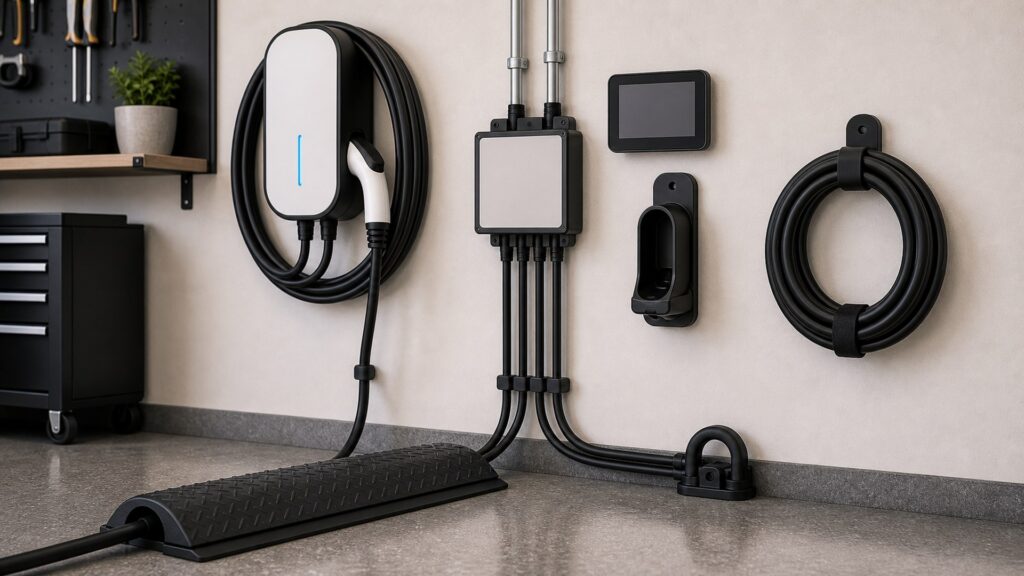
Buying framework
Connect the allocation map to the parking map
Draw the electrical relationships and the cable routes on the same plan. Four checks reveal conflicts before wall stations, pedestals, or retractors are fixed in place.
Assign a connector to each position: Record inlet location and parking direction for every vehicle. The normal cable should reach with relaxed slack and remain outside doors, tires, walkways, and adjacent stalls.
Make curtailed power obvious: Drivers should see whether a port is waiting for capacity, paused by a schedule, or reporting a hardware fault. Ambiguous status invites unnecessary unplugging and cable swapping.
Protect the connected lead: Load sharing may lengthen a session, increasing the time a cable remains across the site. Its route must stay safe throughout the entire dwell window, not only during connection.
Test reassignment physically: When priority moves to another vehicle, confirm that the intended connector is accessible and supported. A software rule cannot solve an unreachable inlet.
Who this is for
Cable handling changes with the charging operation
A home garage, tandem driveway, and depot use different numbers of hands, ports, and connection cycles.
Two-car home garage: Dedicated cable positions reduce confusion. Choose power-sharing hardware whose cords serve both parked vehicles without a crossover at the garage centerline.
Tandem driveway: The rear car may receive priority but remain inaccessible. Mounting, cable length, and parking order should support the household's actual departure sequence.
Workplace row: Different drivers need clear port status and a consistent return position. Loose cables can block accessible routes even when the energy system is functioning correctly.
Fleet depot: High connection counts favor durable holsters, visible inspection points, and rapid fault isolation. Keep spare-cable and out-of-service procedures separate from dispatch priorities.
What to pay attention to
Read cable and controller specifications together
The relevant characteristics describe both how current moves and how the connector is handled during that movement.
Energy path
Follow current allocation from controller to port and confirm that status is visible at the connector drivers use.
Handling path
Trace the cable while stored, connected, shared, and returned after a curtailed or completed session.
Per-port status: Look for local indications of charging, waiting, curtailment, completion, and fault. Remote dashboards should agree with what the driver sees at the stall.
Usable cord length: Mounting height, turns, storage loops, and handling slack reduce nominal reach. Measure the complete route to the inlet while other vehicles are present.
Minimum-current behavior: A low allocation may pause a vehicle or cause repeated restarts. That behavior changes how long the cable remains connected and what status the driver needs.
Retractor tension: A managed cable should lift slack without pulling on the connected coupler. Evaluate force near full extension and during current changes or vehicle wake-up.
Replaceable lead support: For high-use sites, check whether damaged tethered cables, holsters, and strain supports can be serviced without replacing the entire station.
Avoid these traps
Software cannot compensate for a poor cable route
Common failures begin when planners treat power allocation and physical handling as unrelated projects.
Adding longer cords by default: Extra length creates more floor exposure, storage weight, and tangles. Use the shortest approved lead that serves every intended inlet with safe slack.
Letting drivers swap connectors freely: Unplanned swapping can defeat port priorities and create crossover routes. If flexibility is required, document which connectors can serve which vehicles and how status follows them.
Reading curtailment as cable failure: A waiting port may be operating normally. Provide status that separates energy management from connector, latch, or insulation faults.
Hiding cable damage in the organizer: Tight retractors and closed cabinets can conceal abrasion or strain-relief wear. Keep high-stress areas accessible for inspection.
Decision guidance
Choose around the recurring movement
The right combination depends on whether cables stay assigned, move between stalls, or cycle through many drivers.
For fixed home positions: Use dedicated holsters and predictable port assignments. Let the controller move current while the cables remain physically simple.
For changing inlet locations: Choose central placement or approved overhead support, then test every parking orientation before accepting the allocation scheme.
For shared public stalls: Prioritize visible port state and a return position that keeps the next user out of traffic and pedestrian paths.
For high-cycle fleets: Select serviceable cables and documented fault codes. A fast dispatch response needs to identify damaged hardware separately from managed curtailment.
Ownership & compatibility
Inspect the points that move most often
Power controls may remain stable while cable hardware wears through repeated handling.
Review wear by port: Track jacket marks, latch looseness, failed starts, and retractor problems with the port's session record. Repeated issues can reveal a routing defect.
Keep status labels current: If priorities or port assignments change, update stall markings and driver instructions at the same time.
Recommission after relocation: Moving a station, holster, parking stripe, or vehicle assignment changes both cable geometry and the usefulness of the power-management rules.
FAQ
Cable questions in managed charging systems
These answers address the interaction between current allocation and physical connector handling.
Does load sharing require special charging cables?
Can drivers move a cable between managed ports?
Why is a connected car receiving very little current?
Should a retractor pull on the connector while charging?
How can cable length affect power-management priorities?
Can a damaged cable be bypassed by using another port?
Do lower charging currents reduce cable wear?
What cable events belong in charging records?
When should cable routing be redesigned?
Bottom line
Manage the current and the cord as one system
Energy reaches the intended vehicle only when the chosen port, cable route, and driver information all support the controller's decision.
Map assignment to reach: Every priority vehicle needs a safe physical connection.
Explain the port state: Drivers should recognize waiting, charging, completion, and fault conditions.
Inspect movement points: Holsters, strain reliefs, retractors, and floor-contact zones deserve recurring attention.
Reading Shortcuts
Jump to port assignment, cable handling, or fault isolation.
Before You Commit
Walk each route with every normal vehicle parked.
- Port-to-vehicle assignment: Match the priority map to physical connectors.
- Current allocation visibility: Read local status before moving a cable.
- Cable duty cycle: Support the coupler without inlet tension.
- Connector support: Record repeated wear by port.
Terms in This Guide
Terms linking managed current to cable handling.
When a Top 10 List Helps
Rank systems after cable routes and port identities are fixed.
- Port-to-vehicle assignment: Each assigned lead reaches safely.
- Current allocation visibility: Drivers can read curtailment locally.
- Cable duty cycle: Storage supports broad cable curves.
- Connector support: Faults can be isolated by port.
Already comparing finalists? Use a Comparison for a narrower decision.
When to Compare Two Finalists
Compare finalists with the same cars, parking, and current-sharing sequence.
- Current allocation visibility: Both show the same site limit clearly.
- Cable duty cycle: Both preserve safe connector support.
- Connector support: Both remain serviceable after cable wear.
- Parking geometry: The difference affects daily handling.
Need a broader shortlist first? Visit the Top 10 collection.