
EV Power Management Buying Guide for Home Charging Setup
Home charging does not operate in an empty electrical system. A heat pump, electric water heater, range, dryer, and other loads can claim capacity at the same time the car is connected. Power management can adjust EV charging around those changes when its electrical boundary is properly designed.
The purchase should begin with the house rather than the controller. A qualified assessment identifies what must be measured, where sensors belong, and which charging station can accept the commands. The final test is practical: large home loads switch on, charging backs down as intended, then recovers without losing its safe limit or confusing the driver.
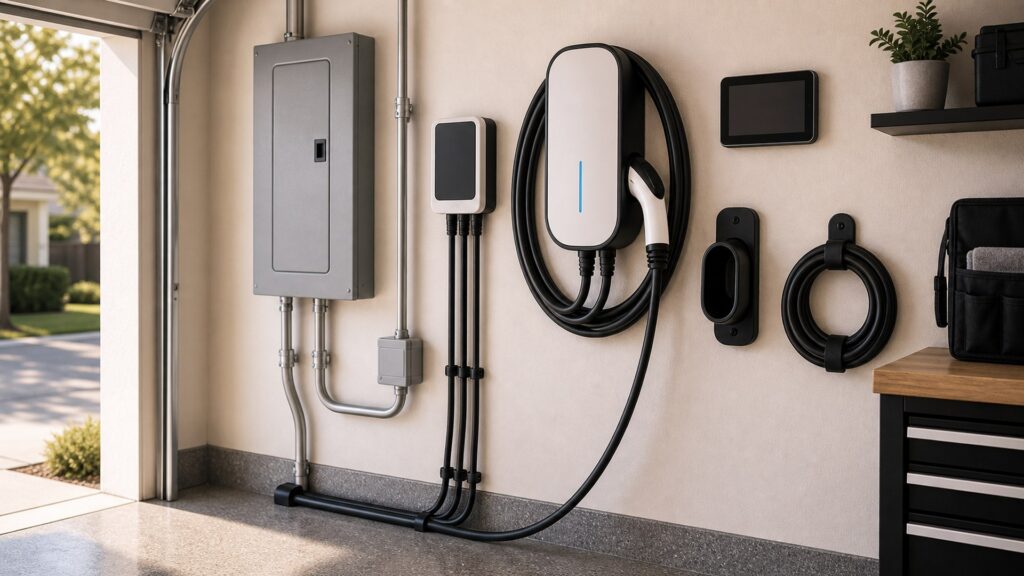
Buying framework
Design around the home's changing demand
Four decisions connect the electrical assessment to daily charging. None can be replaced by an app's estimate of available power.
Define the protected boundary: Use the dwelling load calculation and equipment ratings to establish the limit charging must respect. The manager should be selected to enforce that design, not to justify a predetermined charging rate.
Locate every measured load: Map the service, feeders, phases, solar, storage, and large appliances. Sensor placement determines whether the controller sees the demand that matters.
Pair controller and charger: Require documentation for the exact EVSE, firmware, connection method, and number of ports. A generic smart-home claim is not evidence of current control.
Commission a busy house: Run representative appliances while the vehicle charges. Observe current reduction, minimum-current behavior, recovery, status indications, and the response to a lost sensor or control link.
Who this is for
The house determines the value of management
Dynamic control is most useful where home demand is variable or spare capacity is limited. It may add little to a generously sized service with a modest charging target.
Older home with constrained service: Managed charging may use available capacity more efficiently, provided the existing equipment condition and electrical design are suitable. It does not repair an obsolete or damaged panel.
Highly electrified household: Heat pumps, electric cooking, water heating, and laundry can create strong peaks. Whole-home sensing lets charging yield temporarily without hard-coding an overly conservative nightly limit.
Two-car garage: The system may need both whole-home management and sharing between EVSE. Confirm how priorities, minimum current, and simultaneous connection behave together.
Solar-and-storage home: Generation and batteries complicate current flow and sensor placement. Use equipment designed for the actual topology, with qualified commissioning in import, export, charging, and discharging states.
What to pay attention to
Read the installation diagram before the feature list
The physical sensing and local control path reveal whether the product matches the house. Cloud dashboards are useful only after that path is sound.
Home load interaction
Observe how charging changes when heating, cooking, water heating, and other substantial household loads operate.
Installation resilience
Verify sensing, local control, EVSE compatibility, fault behavior, and records that survive account or network changes.
Phase and conductor support: Confirm the service configuration, conductor size, sensor window, current range, and orientation. Each measured phase must map correctly to the controller.
Control range: Check the minimum and maximum EV charging current the system can command. Some vehicles may pause when allocation drops below a usable level.
Recovery behavior: After a large appliance turns off, charging should return predictably without overshoot or rapid cycling. The commissioning test should capture this transition.
Local operation: Determine which sensing, limiting, override, and status functions remain available when Wi-Fi or internet service is absent.
Fault indication: The owner and electrician should be able to distinguish ordinary curtailment from a reversed sensor, lost communication, controller fault, or disabled EVSE.
Expansion capacity: Review supported EVSE count, sensor inputs, controlled loads, communications distance, and firmware requirements before relying on future second-vehicle claims.
Avoid these traps
Home automation cannot rescue a weak electrical plan
The controller belongs inside the design. It is not a shortcut around service condition, permits, compatible equipment, or correct sensing.
Choosing by panel label alone: Service size does not reveal spare capacity or equipment condition. Use a complete qualified assessment of the home's loads and distribution.
Putting sensors wherever they fit: Convenient placement may omit a feeder, reverse direction, or misassign phases. Follow the approved diagram and verify readings against known loads.
Depending on cloud commands: Essential limiting should follow the documented local architecture. Internet loss must not turn a capacity-control system into an uncontrolled charger.
Never retesting after electrification: A new heat pump, battery, solar inverter, or electric water heater changes the load and current-flow picture. Review and recommission the management system.
Decision guidance
Choose only the control the house needs
More integration adds setup and support dependencies. Use the narrowest system that reliably protects the identified boundary.
When one EV is the only flexible load: A dedicated EV load manager may be simpler than a broad home automation platform. Confirm local measurement and direct EVSE control.
When several loads must be coordinated: A panel or home energy manager may be appropriate if it explicitly supports the circuits, service topology, and EVSE involved.
When a second EV is imminent: Select management that combines whole-home limiting with documented station sharing, then plan cable routes and circuit work separately.
When solar or storage is present: Favor topology-specific guidance and clear import/export measurement. Do not assume a basic service monitor interprets bidirectional current correctly.
When the proposed system lacks a testable failure state: Do not install it as the capacity solution. Ask for a supported design whose local behavior can be commissioned and recorded.
Ownership & compatibility
Keep the electrical story with the house
Future owners and electricians need to know what the sensors protect and why charging changes at certain times.
Label and document: Retain diagrams, sensor locations, phase mapping, configured limits, compatible EVSE versions, account ownership, and commissioning results with the panel records.
Investigate repeated curtailment: Frequent low charging may reflect real household peaks, an undersized target, sensor trouble, or changed loads. Diagnose the cause instead of raising the limit casually.
Recommission after changes: Repeat applicable tests following service work, charger replacement, new major appliances, solar, batteries, or added charging ports. Confirm both limiting and normal recovery.
FAQ
Home power-management questions
These answers clarify how dynamic charging fits into the house electrical system.
Can power management avoid a home electrical service upgrade?
Where are home load-management sensors installed?
Will charging stop whenever the oven turns on?
Does the internet need to stay connected?
Can one controller manage two home chargers?
How can I tell normal curtailment from a fault?
Will solar panels increase available EV charging power?
What happens if a current transformer is reversed?
When should a homeowner call the installer again?
Bottom line
Let the car use only the capacity the house can spare
Good home power management is quiet, local, and explainable. It yields to real household demand and restores charging without asking the driver to supervise every appliance.
Start with the dwelling: Establish the electrical boundary and load pattern first.
Verify the control chain: Match sensors, controller, communications, and EVSE using current documentation.
Test a busy evening: Prove reduction, recovery, and fault behavior with representative loads.
Leave a durable record: Future changes are safer when the original design can be reconstructed.
Reading Shortcuts
Find the household-load, sensor, charger, or fault discussion.
Before You Commit
Exercise these checks during a representative busy evening.
- Household load profile: Write down the demanding requirement.
- Service measurement: Confirm the installed electrical boundary.
- Charging response: Read the control behavior, including offline operation.
- Local fail-safe: Reproduce the physical route at the parking space.
- EVSE support: Identify the consequence of one failed component.
Terms in This Guide
Home-control terms linking service demand to EV charging current.
When a Top 10 List Helps
Rank systems after the dwelling boundary and compatible charger are known.
- Household load profile: The actual demand is documented.
- Service measurement: The electrical limit is established.
- Local fail-safe: The site geometry has been measured.
- EVSE support: The important failure mode is understood.
Already choosing between finalists? A Comparison is the more focused format.
When to Compare Two Finalists
Compare finalists under the same large-appliance sequence and outage test.
- Service measurement: Both remain inside the approved boundary.
- Charging response: Their control rules are stated clearly.
- Local fail-safe: Each works in the measured parking layout.
- Commissioning record: The remaining difference affects daily use.
Need a broader shortlist first? Visit the Top 10 collection.