
EV Power Management Buying Guide for Outdoor Charging Installations
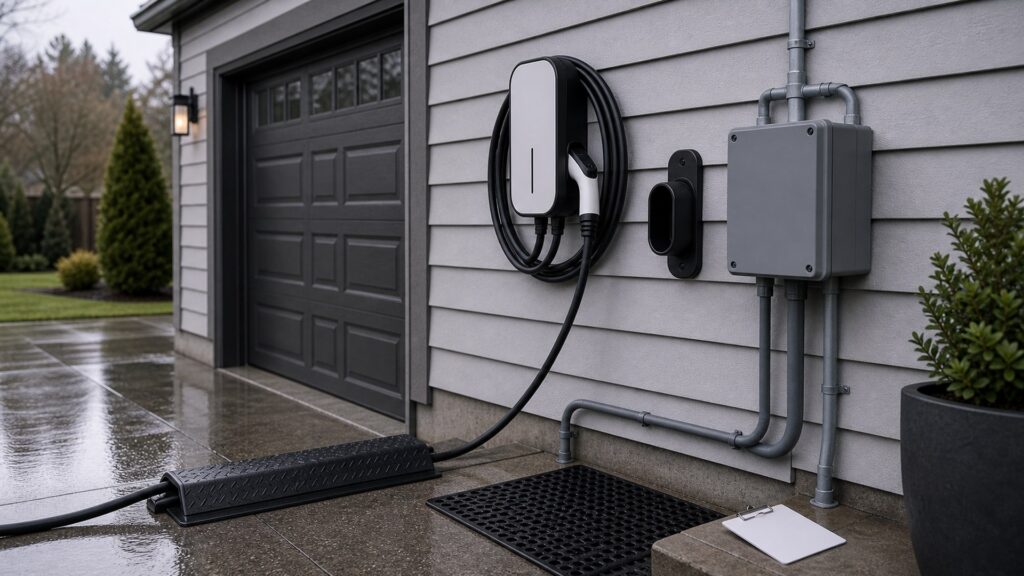
Outdoor power management often splits one system across very different conditions. The service sensors may sit inside a panel, the controller in a utility space, and the charging station at a driveway pedestal exposed to heat, rain, snow, and vehicle traffic.
The design must preserve one dependable control path across those locations. Weather ratings apply to every exposed component, while communications must survive distance and metal barriers. A safe failure state matters because a lost signal can look exactly like available capacity unless the system is designed to respond conservatively and tell the owner what happened.
Buying framework
Divide the site into environmental zones
Mark where each sensor, controller, power supply, junction, antenna, and EVSE will live. Then verify ratings and communication across the boundaries between those zones.
Protect the correct electrical limit: Establish whether management covers the service, an outdoor feeder, or a group of stations. The sensing point must observe the loads that can consume that allowance.
Classify each location: A carport or cabinet is not automatically equivalent to indoors. Use product markings and installation instructions for water, temperature, sunlight, condensation, and orientation.
Prove the link: Test wired routes or local wireless communication at the final mounting positions with enclosures closed and site equipment operating. Document the response to loss of communication.
Commission for weather recovery: Check behavior after power interruption, cold start, heat, and representative outdoor loads. Seasonal follow-up may be necessary when installation occurs in mild conditions.
Who this is for
Exposure and distance reshape the design
The important difference is not residential versus commercial alone; it is where measurement, control, and charging equipment are separated.
Driveway charger near the house: An indoor service monitor may communicate easily with a nearby wall station, but water paths, cable routing, and the exterior penetration still need deliberate treatment.
Detached carport: Distance and intervening construction can challenge communications. A wired path or approved local controller may be more dependable than an assumed indoor Wi-Fi signal.
Curbside or remote pedestal: Property limits, pedestrian space, impact protection, long conductor routes, and exposed communications hardware become central. Confirm ownership and access before choosing controls.
Small outdoor fleet row: Several ports add power sharing and repeated handling. The operator needs local status, network fallback, weather-resistant cable management, and assigned maintenance.
Cold- or hot-climate property: Temperature range affects controllers, displays, cables, batteries in backup equipment, and enclosures. Use ratings for the real seasonal extremes rather than annual averages.
What to pay attention to
The weakest exposed component sets the boundary
A weather-rated EVSE does not protect an indoor-only sensor module mounted nearby. Review the complete management chain.
Environmental integrity
Follow ratings, enclosure orientation, entries, drainage, temperature, and corrosion exposure for every control component.
Remote control path
Verify sensing and EVSE commands across distance, obstructions, outages, and seasonal conditions.
Enclosure and location marking: Confirm whether each component is permitted outdoors, in wet or damp locations, and in the planned orientation. Do not extend one enclosure's rating to external power supplies or connectors.
Operating temperature: Check cold start and high-temperature limits for controllers, sensors, communications gear, and EVSE. Direct sun can make an enclosure hotter than the reported air temperature.
Conduit entries and drainage: Use approved fittings, seals, and orientations while preserving designed drain paths. Improvised caulk can trap moisture or hide deterioration.
Communication supervision: The system should detect a lost link rather than interpret silence as low demand. Review retry timing, local indication, event records, and the safe charging state.
Surge and power recovery: Outdoor wiring may experience disturbances and outages. Confirm the approved protective design and how limits, clocks, priorities, and communications return after power restoration.
Remote diagnostics: Status and logs can reduce unnecessary site visits, but local inspection remains essential for water, corrosion, impact, and cable damage that software cannot see.
Avoid these traps
Outdoor ratings do not transfer between components
A complete system can fail at a small power supply, junction, antenna, or cable entry that was treated as an accessory.
Calling a carport indoors: Wind-driven rain, temperature, condensation, and exposed edges may still govern. Follow the marked location rating and installation instructions.
Testing wireless before closing cabinets: Metal doors and final mounting can alter signal strength. Validate communications with the site in its finished condition.
Sealing every opening with caulk: Unapproved sealing can block drainage, conceal water paths, or conflict with enclosure design. Use the specified fittings and methods.
Assuming a lost link means low load: The management system must recognize communication failure and preserve the electrical boundary. Undefined behavior is not an acceptable outdoor fallback.
Decision guidance
Choose the shortest dependable control path
Reduce unnecessary outdoor electronics where practical, but do not compromise measurement of the real electrical limit.
When the EVSE is close to the service equipment: An indoor controller with a documented local link may simplify environmental protection. Verify signal through the final wall and enclosure.
When distance or obstructions are substantial: A wired communication route or weather-rated intermediate equipment may offer clearer supervision. Coordinate it with the electrical conduit plan.
When several outdoor ports share power: Use explicitly supported site sharing with local current enforcement and recognizable port status. Test simultaneous connection and loss of one station.
When flooding or ponding is credible: Redesign location, drainage, and electrical installation. Power management cannot compensate for equipment or connections placed in an unsuitable water path.
When winter access is difficult: Prioritize local fault visibility, maintainable enclosures, cold-rated cable handling, and a safe way to reach components without crossing snow storage or vehicle lanes.
Ownership & compatibility
Let weather set the inspection calendar
Storms and seasons can change mounts, seals, vegetation, drainage, communications, and electrical demand.
Inspect after major weather: Look for water entry, blocked drainage, displaced covers, corrosion, impact, loose hardware, cable damage, and fault records before returning questionable equipment to service.
Compare seasonal readings: Review sensor values, communication quality, and curtailment during hot and cold periods. Unexpected drift deserves investigation, not a higher limit.
Control the surroundings: Snow banks, irrigation, plant growth, resurfacing, new fences, and parked equipment can alter exposure or wireless paths. Recheck the site when surroundings change.
Preserve labels and diagrams: Outdoor equipment is often serviced by different people. Durable identification of sensors, enclosures, circuits, communication paths, and safe failure behavior prevents mistaken substitutions.
FAQ
Outdoor power-management questions
These answers focus on the exposed parts of sensing and control rather than repeating general charger-weather advice.
Can the load-management controller be installed outdoors?
Will Wi-Fi reliably connect an outdoor charger to an indoor monitor?
What should happen if an outdoor EVSE loses the control signal?
Does a weatherproof enclosure prevent condensation?
Can current sensors be located far from the outdoor charger?
How does cold weather affect power-management equipment?
Should outdoor management equipment share the EVSE enclosure?
What outdoor changes require recommissioning?
How often should an outdoor power-management system be inspected?
Bottom line
Weather-test the entire control chain
Outdoor charging remains managed only when measurement and commands survive the distance and exposure between the service and the vehicle.
Rate every component: Include sensors, power supplies, junctions, and communications hardware.
Supervise the link: A dropped signal needs a conservative state and visible evidence.
Respect water paths: Location, entries, drainage, and mounting work together.
Return after the season changes: Confirm that heat, cold, storms, and site changes have not altered the commissioned behavior.
Reading Shortcuts
Open the environmental, communications, failure, or seasonal section.
Before You Commit
Inspect these points at every indoor-to-outdoor system boundary.
- Environmental rating: Write down the demanding requirement.
- Sensing location: Confirm the installed electrical boundary.
- Communication path: Read the control behavior, including offline operation.
- Outdoor failure state: Reproduce the physical route at the parking space.
- Conduit and enclosure details: Identify the consequence of one failed component.
Terms in This Guide
Terms for protecting outdoor sensing and remote charging control.
When a Top 10 List Helps
Rank solutions after exposure zones and communication distance are established.
- Environmental rating: The actual demand is documented.
- Sensing location: The electrical limit is established.
- Outdoor failure state: The site geometry has been measured.
- Conduit and enclosure details: The important failure mode is understood.
Already choosing between finalists? A Comparison is the more focused format.
When to Compare Two Finalists
Compare finalists during a link loss and demanding weather condition.
- Sensing location: Both remain inside the approved boundary.
- Communication path: Their control rules are stated clearly.
- Outdoor failure state: Each works in the measured parking layout.
- Seasonal commissioning: The remaining difference affects daily use.
Need a broader shortlist first? Visit the Top 10 collection.