
EV Power Management Buying Guide: How to Choose the Right One
EV power management is useful when charging demand must coexist with a finite electrical service, several charging ports, or other large loads. Its job is not to make the building supply larger. It measures or coordinates demand and keeps EV charging inside the approved site limit.
That control chain deserves the same scrutiny as the charger. Sensor placement, communication, response logic, compatible equipment, and failure behavior determine whether the promised limit is real. Choose a system that a qualified installer can commission under changing loads and that another technician can understand years later without guessing at hidden cloud rules.
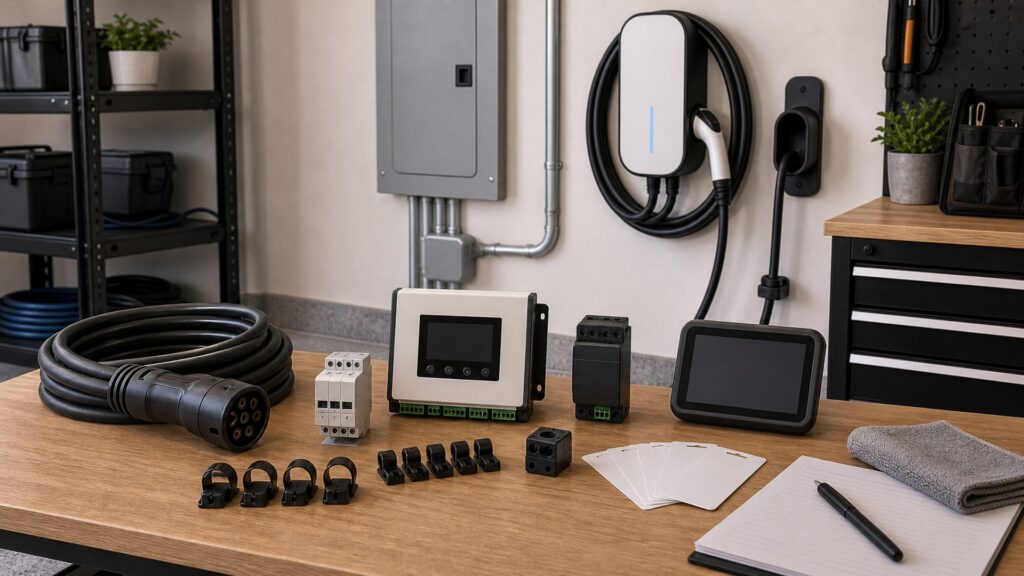
Buying framework
Follow the limit from calculation to charging current
A credible system can answer five linked questions: what boundary applies, what is measured, who commands the EVSE, how quickly it reacts, and what happens when part of the chain fails.
Establish the boundary: Use the applicable load calculation and electrical design to define the current or demand that charging must not push beyond. Do not select a controller first and invent its target later.
Map the sensing point: Identify which conductors, phases, feeders, or loads are measured. The sensor location decides what the controller can actually see and which demand remains outside its calculation.
Trace the control path: Document how the manager tells each EVSE to reduce, pause, or resume. Supported wired, local wireless, or native station communication is more meaningful than two products appearing in the same app.
Examine dynamic behavior: Ask how the system responds when an oven, heat pump, water heater, or second EV starts and stops. Stable recovery matters as much as fast curtailment.
Define loss of control: Unplug a sensor or communication link during commissioning as permitted. The published fail-safe behavior should preserve the approved electrical boundary and produce a useful fault indication.
Who this is for
Power management solves several different problems
A capacity-constrained home, a two-EV garage, and a commercial depot do not need the same measurements or control hierarchy.
Home with limited spare service capacity: Dynamic control may allow useful Level 2 charging by reducing EV demand when other household loads are high. The result still requires an approved design and compatible equipment.
Two-EV household: Power sharing can divide a known charging allowance between cars. Departure priorities and minimum operating current become as important as the total site limit.
Home with electrification plans: A future heat pump, water heater, or induction range changes the load picture. Choose an architecture that can be recommissioned after those additions rather than one frozen around today's panel.
Small workplace or multifamily site: Several users introduce fairness, access, communications, and billing concerns. Separate the electrical limit from policies that allocate energy among drivers.
Fleet depot: Route priority and concurrent return patterns may require layered control across chargers, cabinets, and utility demand. Operations staff also need diagnostics and an outage procedure.
What to pay attention to
The important specifications describe a control system
A current rating without sensing topology and failure behavior is incomplete. Read how the system observes the building and what commands remain local.
Measurement and control
Follow how current is sensed, interpreted, and translated into an EV charging limit.
Failure and expansion
Examine offline behavior, diagnostics, compatible EVSE, and how later circuits or vehicles enter the controlled boundary.
Sensor type and range: Confirm current-transformer or meter range, conductor size, phase configuration, accuracy, and required orientation. Oversized or misplaced sensors can produce weak measurements even when installation appears tidy.
Sampling and response: The controller must recognize changing non-EV loads soon enough to maintain its designed limit without creating unstable stop-start behavior. Look for documented operation, not an unsupported speed claim.
Control granularity: Some systems vary current smoothly; others pause ports or allocate fixed blocks. The method affects charging continuity, minimum-current behavior, and fairness among vehicles.
Local versus cloud dependency: Determine which measurements and commands stay on site. Essential limiting should not disappear because an account, internet link, or vendor server is unavailable.
Compatible station list: Use the current supported-device documentation, including firmware and port count. A protocol name alone may not guarantee every control feature or failure state.
Diagnostics: Status should distinguish sensor reversal, lost communication, controller fault, and ordinary load curtailment. Clear records shorten troubleshooting and prevent unsafe guesses.
Expansion limits: Check the maximum sensors, EVSE, phases, controlled circuits, and hierarchy depth. Expansion claims matter only when the electrical design and commissioning process also support the added load.
Avoid these traps
Power management is not extra electrical capacity
Most errors come from treating controls as a substitute for design or assuming that connected products automatically cooperate.
Skipping the load calculation: A controller needs a legitimate boundary to enforce. It cannot decide whether the service, feeder, panel, or circuit is suitable on its own.
Measuring the wrong conductors: Sensors placed on only part of the relevant load can leave the controller blind. Verify phase mapping, direction, and every load included in the design.
Assuming app compatibility equals control compatibility: Two devices may share dashboards without providing a hard, supported current-limiting relationship. Require documentation for the exact models and control mode.
Testing only at steady load: Commissioning with an empty house misses the dynamic job. Switch representative large loads and charging ports through realistic sequences while observing the configured boundary.
Decision guidance
Match the controller to the boundary it must protect
Choose topology before features. The location of the constraint—service, feeder, branch circuit, group of EVSE, or utility demand—determines the useful product family.
If the whole service is constrained: Use service-level measurement and compatible dynamic EV charging control designed for the dwelling's phase and conductor arrangement.
If several EVSE share one allowance: Choose native or explicitly supported power sharing with defined allocation, minimum-current, offline, and priority behavior.
If only one branch circuit is shared: Use equipment and wiring methods specifically approved for that circuit arrangement. Do not generalize a whole-home load manager into an unsupported transfer or sharing scheme.
If utility demand charges matter: Look for demand-window control and records suited to the tariff. Peak management is a different objective from simply staying below an instantaneous service limit.
If the site will expand: Select a system with documented sensor, port, and controller capacity, then reserve communications and electrical pathways. Recommission after each material addition.
If the control chain cannot be explained: Pause the purchase and involve the qualified designer or installer. A feature-rich system is a poor choice when no one can state its safe local failure behavior.
Ownership & compatibility
Preserve the commissioning baseline
Power management can operate unnoticed for years, which makes clear records and periodic proof especially important.
Keep diagrams and settings: Store sensor locations, phase mapping, current limits, compatible-device versions, and test results with the electrical documents. Label hardware so a later technician can match the physical system to the record.
Review fault history: Repeated curtailment may reflect normal peak load, while communication or sensor faults require investigation. Do not simply raise the configured limit to silence an alert.
Retest after changes: Panel work, new appliances, solar, storage, EVSE replacement, and vehicle additions can alter measurement or demand. Repeat the relevant commissioning sequence after each change.
Plan for vendor dependence: Understand firmware support, account requirements, replacement controllers, and data access. Essential local limiting should remain supportable even if optional cloud services change.
FAQ
EV power-management fundamentals
These answers clarify what the controller does, what it cannot do, and what proof should exist after installation.
Does EV power management increase electrical service capacity?
What does dynamic load management measure?
Can power management work without the internet?
How quickly should EV charging respond to a new household load?
Can any smart charger join a load-management system?
What happens when a current sensor fails?
Is power sharing the same as whole-home load management?
What should be recorded at commissioning?
When must a power-management design be reviewed again?
Bottom line
Choose a control chain that can be proven
The manager, sensors, communications, and EVSE should operate as one documented system that respects the approved current ceiling.
Start with the limit: Define what must be protected before selecting the controller.
Follow the signal: Know what is measured and how the station receives a command.
Test failure as well as success: Commission changing loads, lost communications, and recovery, then retain the evidence.
Reading Shortcuts
Follow the sensing, control, failure, or expansion question.
Before You Commit
Ask the installer to demonstrate these control-chain checkpoints.
- Defined electrical boundary: Write down the demanding requirement.
- Measurement method: Confirm the installed electrical boundary.
- Response speed and logic: Read the control behavior, including offline operation.
- Failure state: Reproduce the physical route at the parking space.
- EVSE compatibility: Identify the consequence of one failed component.
Terms in This Guide
Core terms for measuring and limiting EV charging demand.
When a Top 10 List Helps
Use rankings after the protected boundary and sensing topology are defined.
- Defined electrical boundary: The actual demand is documented.
- Measurement method: The electrical limit is established.
- Failure state: The site geometry has been measured.
- EVSE compatibility: The important failure mode is understood.
Already choosing between finalists? A Comparison is the more focused format.
When to Compare Two Finalists
Compare controllers by local limiting, diagnostics, and commissioned failure behavior.
- Measurement method: Both remain inside the approved boundary.
- Response speed and logic: Their control rules are stated clearly.
- Failure state: Each works in the measured parking layout.
- Commissioning evidence: The remaining difference affects daily use.
Need a broader shortlist first? Visit the Top 10 collection.