
Exterior Accessories & Protection Buying Guide for Cargo and Storage Expansion
External storage solves a space problem by moving gear to the roof, hitch, bed, or rear door. That move also changes loading height, wind exposure, axle load, leverage, visibility, and access. A carrier should therefore be chosen by the cargo's size and mass, not by advertised volume alone.
Record the vehicle's payload, axle, roof, receiver, rail, and attachment limits, then include the empty carrier and every adapter in the calculation. Check how the loaded system opens, locks, drains, and restrains cargo under braking and bumps. The best expansion adds usable space while leaving the vehicle stable, legal, serviceable, and practical to load.
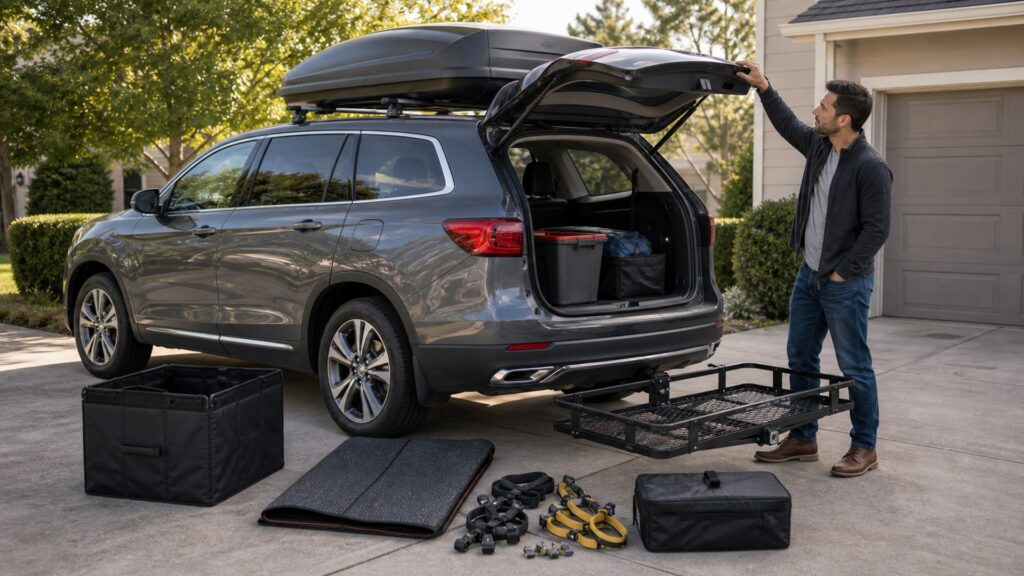
Buying framework
Place cargo where its mass causes the fewest compromises
Volume is only one variable. Location determines the load path, handling effect, access, and securement problem.
Describe the load: List dimensions, mass, fragility, weather sensitivity, and loading frequency before choosing a carrier.
Calculate the system: Add carrier, brackets, locks, adapters, and cargo, then compare every applicable vehicle and component limit.
Choose the location: Keep dense items low and near the vehicle center when possible; reserve roofs and rear overhangs for suitable loads.
Plan restraint and access: Identify rated anchors, lid clearance, hatch movement, plate and lamp visibility, and emergency-tool access while fully loaded.
Who this is for
Match storage to the trip pattern
A daily tool box and an occasional vacation box reward different compromises. Frequency determines how much loading effort and permanent weight make sense.
Occasional travelers: Removable roof boxes or hitch trays avoid carrying drag and mass year-round. Confirm home storage for the empty carrier and practice mounting before departure.
Families with bulky soft gear: Weather-resistant boxes protect strollers, duffels, and sports gear while keeping the cabin clear. Opening size and hatch clearance matter more than maximum volume.
Trades and frequent cargo users: Bed boxes and racks need durable latches, repeatable securement, and access with gloves. Preserve bed drains, tie-downs, tonneau operation, and rear visibility.
Adventure-equipment carriers: Long or dirty gear benefits from racks and external trays, but each item needs independent restraint. Protect sharp edges and keep recovery, spare, and roadside equipment reachable.
What to pay attention to
Cargo specifications that change the drive
A useful rating describes the complete loaded system and its attachment. Read dimensions and limits together.
Capacity & Placement
Tare mass, payload, axle effect, roof or hitch limits, volume, and center of mass.
Containment & Access
Anchors, lid, seals, locks, hatch travel, lamps, camera, and removal.
Internal dimensions: Tapered ends, hinges, struts, wheel wells, and dividers reduce usable space. Compare the actual cargo outline with the opening and interior.
Lowest load rating: The vehicle, rack, crossbars, receiver, carrier, anchors, and tiedowns form one system; the lowest applicable limit controls.
Mount spacing: Crossbar spread, hitch insertion, bed-rail position, and clamp location affect load distribution and stability.
Closure and sealing: Latches should compress the seal evenly while drains or overlap manage water. Water-resistant does not mean safe for submersion or loose liquids.
Loaded clearance: Measure overall height, rear overhang, hatch arc, exhaust distance, ground clearance, and camera or lamp obstruction after cargo is secured.
Avoid these traps
Storage expansion errors that move risk outside
A closed lid can hide poor loading. The carrier must contain mass, not merely enclose it.
Ignoring carrier weight: The empty box, tray, rack, and adapters consume capacity. Subtract them before assigning cargo mass.
Using locks as tiedowns: A latch or lock secures a lid against opening; it may not restrain cargo inside. Use rated internal anchors and prevent shifting.
Loading dense gear high or far rearward: Poor mass placement raises the center of gravity or increases rear leverage. Move heavy items lower and inward whenever possible.
Skipping the walk-around: Check straps, lid, hitch pin, plate, lamps, camera, hatch, tire clearance, and overall height before departure and after the first miles.
Decision guidance
Choose the carrier by load and access
Each location solves one problem while creating another. Select the compromise that suits the recurring cargo.
If gear is light and bulky: A roof box offers enclosed volume when loading height and dynamic roof limits are acceptable. Keep dense items elsewhere.
If roof loading is difficult: A hitch tray lowers the lift but adds rear overhang and leverage. Preserve departure clearance, exhaust spacing, plate, lamps, and camera.
If a truck needs daily organization: A bed box or rack can provide durable access without constant mounting. Confirm tonneau, tailgate, rail, and tiedown compatibility.
If no external option fits the limits: Reduce cargo, use interior restraint, or evaluate a properly matched trailer. Do not exceed a roof or hitch limit to avoid another transport solution.
Ownership & compatibility
Inspect the restraint system every trip
Locks, seals, straps, and mounts wear at different rates. Cargo security depends on all of them.
Recheck after settling: Stop early in the trip to inspect tiedowns, clamps, hitch play, lid closure, and shifted cargo, then follow the maker's interval.
Clean and dry: Remove salt and grit from rails, seals, locks, receiver hardware, and contact pads. Dry enclosed storage before long closure.
Store the carrier correctly: Support removed boxes and baskets as directed so shells, hinges, seals, and clamps are not distorted between trips.
FAQ
Cargo expansion questions
These answers address capacity, placement, and securement decisions.
How much cargo can I place in a roof box?
Is hitch-carrier capacity the same as receiver tongue weight?
Do items inside a closed cargo box need tiedowns?
What belongs on the roof instead of inside the vehicle?
How do I know whether a roof box will clear the hatch?
Can a hitch tray block required lights or the license plate?
What makes a cargo carrier weather resistant?
How often should external cargo be rechecked?
When is a trailer better than a roof or hitch carrier?
Bottom line
Extra space must remain controlled space
The best carrier fits the cargo and the vehicle's complete load system. Capacity without restraint or access is not useful capacity.
Place mass carefully: Keep dense cargo low and inward, then calculate all component and vehicle limits.
Restrain independently: Use rated anchors and tiedowns; do not ask a lid or lock to control shifting cargo.
Verify the loaded vehicle: Check height, overhang, hatch, lamps, plate, camera, exhaust, clearance, and securement before moving.
Reading Shortcuts
Move from cargo placement and securement priorities to a usable configuration.
Decision Reminders
Check the vehicle system, not one product claim.
- Mass: Include carrier and adapters.
- Limit: Use the lowest system rating.
- Placement: Keep dense cargo low and inward.
- Restraint: Use rated anchors and tiedowns.
- Access: Preserve hatch and emergency gear.
- Envelope: Check height and rear overhang.
Glossary Snippets
Terms that clarify the important tradeoffs.
When to Use a Top 10 Review
Shortlist cargo placement and securement products only after the governing vehicle limits and useful format are settled.
- Need defined: The recurring task is specific.
- Vehicle checked: Limits and interfaces are known.
- Format chosen: The product family is settled.
- Need options: Several valid designs remain.
Have finalists already? Open a Comparison for a closer tradeoff.
When to Use a Comparison
For cargo placement and securement, rank competing designs against one defined vehicle and operating task.
- Fit: Both match the application.
- Duty: Both support the same load.
- Tradeoff: Convenience and protection differ.
- Upkeep: Inspection needs differ.
Need a broader field? Use a Top 10 to form a shortlist.