
Facial Exfoliators Buying Guide for Anti-Aging Goals
An anti-aging exfoliator can improve the look of dullness, uneven tone, or fine surface texture, but it does not lift tissue or erase established wrinkles. The right product offers a sustainable renewal step without undermining retinoid tolerance or dependable sunscreen use.
AHAs, BHAs, enzymes, and physical methods create different tradeoffs. Buyers should connect the mechanism to one realistic cosmetic target and reject formulas that turn peeling into proof of rejuvenation.
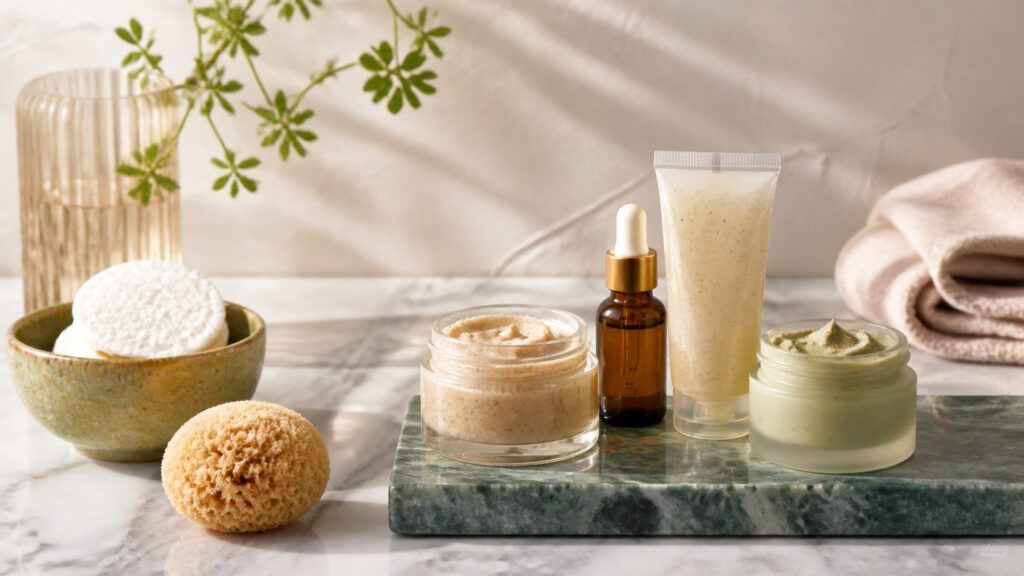
Buying framework
Define the anti-aging goals routine before comparing products
Use the setting, frequency, and skin priorities to narrow facial exfoliators logically.
Start with the use case: Choose one priority such as surface radiance, uneven tone, or rough-feeling texture.
Rank the practical tradeoffs: Review retinoids, vitamin C, professional peels, and other treatments before adding acid exposure.
Check instructions early: Plan sunscreen and recovery days as part of the purchase, not as optional aftercare.
Use profiles
Match facial exfoliators to the person and pace
Three shopper profiles expose different priorities for anti-aging goals.
Routine-focused buyer: A retinoid user may need less exfoliation rather than a stronger complementary acid.
Performance-focused buyer: A pigmentation-focused buyer should treat sun protection as central to maintaining any cosmetic improvement.
Occasional or flexible user: A mature dry-skin user can favor a hydrating acid base that does not make tightness the tradeoff.
Specifications
Read the specifications through a anti-aging goals lens
Translate technical language into visible routine benefits.
Handling lens
Separate immediate smoothness from changes requiring repeated appropriate use.
Ownership lens
Compare the exfoliator with investing in moisturizer, retinoid guidance, or sunscreen consistency.
Exfoliation Method: Glycolic and lactic acids differ in molecular size, formula behavior, and typical positioning.
Particle Or Acid Strength: Concentration and pH jointly influence AHA activity when both are disclosed.
Frequency Guidance: Leave-on contact supplies longer exposure than a wash or timed mask.
Rinse Format: Humectants and emollients can improve tolerance without proving stronger remodeling.
Barrier Compatibility: Opaque controlled packaging may support formula stability and measured use.
Common mistakes
Avoid shortcuts that undermine anti-aging goals
A good purchase can still disappoint when selection or use is based on the wrong assumption.
Buying from one metric: Do not combine a peel and retinoid merely to accelerate visible change.
Skipping compatibility checks: Avoid interpreting flakes as old skin that must be removed immediately.
Ignoring post-use care: Never market ordinary exfoliation as a substitute for procedures or medical treatment.
Decision guidance
Choose the simplest option that covers the real need
Use these decision rules to finish a shortlist for anti-aging goals.
Choose the basic format when: Choose an AHA when surface tone or texture is the defined goal and tolerance supports it.
Choose the flexible format when: Prefer a lower-burden method when the anti-aging regimen already contains strong actives.
Pause before upgrading when: Skip exfoliation if it repeatedly interferes with moisturizer, sunscreen, or retinoid adherence.
Ownership & compatibility
Plan for clean, repeatable ownership
The best value remains convenient after the first few uses.
Consumables and replacements: Record frequency and next-day response rather than relying on the application sensation.
Cleaning and storage: Store acids within labeled light and temperature limits.
Routine compatibility: Follow AHA sun-sensitivity warnings and maintain appropriate broad-spectrum protection.
FAQ
Facial Exfoliators Buying Guide for Anti-Aging Goals FAQ
Practical answers about choosing and owning facial exfoliators for anti-aging goals.
What matters most when choosing facial exfoliators for anti-aging goals?
Is the most expensive option better for anti-aging goals?
How should I compare two similar facial exfoliators options?
Bottom line
Buy for repeatable anti-aging goals results
A focused shortlist is easier to own and use well.
Prioritize fit: Connect anti-aging exfoliation to one plausible surface outcome.
Verify the limits: Protect tolerance for the more important long-term routine.
Count ownership costs: Treat sunscreen and recovery as part of the product’s true cost.
Reading Shortcuts
Jump to the key facial exfoliators decisions.
Decision Reminders
Keep these checks beside your shortlist.
- Check exfoliation method: Begin less often than the maximum label frequency and watch how skin responds.
- Check particle or acid strength: Do not use on broken, sunburned, or actively irritated skin.
- Check frequency guidance: Daily sunscreen is especially important when using products that can increase sun sensitivity.
Glossary Snippets
Plain-language facial exfoliators terms.
When to Use a Top 10 Review
Use a ranked list to identify a manageable set of strong candidates.
- You are still exploring: A ranked list can reveal the main formats and price tiers.
- You want a shortlist: Start broad, then confirm fit with this buying guide.
Have finalists? Use a Comparison.
When to Use a Comparison
Use a direct comparison when only a few candidates remain.
- Features are close: Side-by-side details clarify meaningful differences.
- Prices overlap: Compare ownership value, not only purchase price.
Still exploring? See the Top 10.