
Facial Steamers Buying Guide for Device Features and Attachments
Facial steamers may include adjustable nozzles, multiple heat modes, nano-ionic claims, magnifying mirrors, extraction kits, aromatherapy trays, timers, and face hoods. Features deserve value only when they improve mild heat control, stable positioning, or water hygiene.
Prioritize predictable output and maintainability. Attachments that promote fragrance inhalation, prolonged enclosure, or post-steam squeezing can turn a simple comfort device into a more irritating routine.
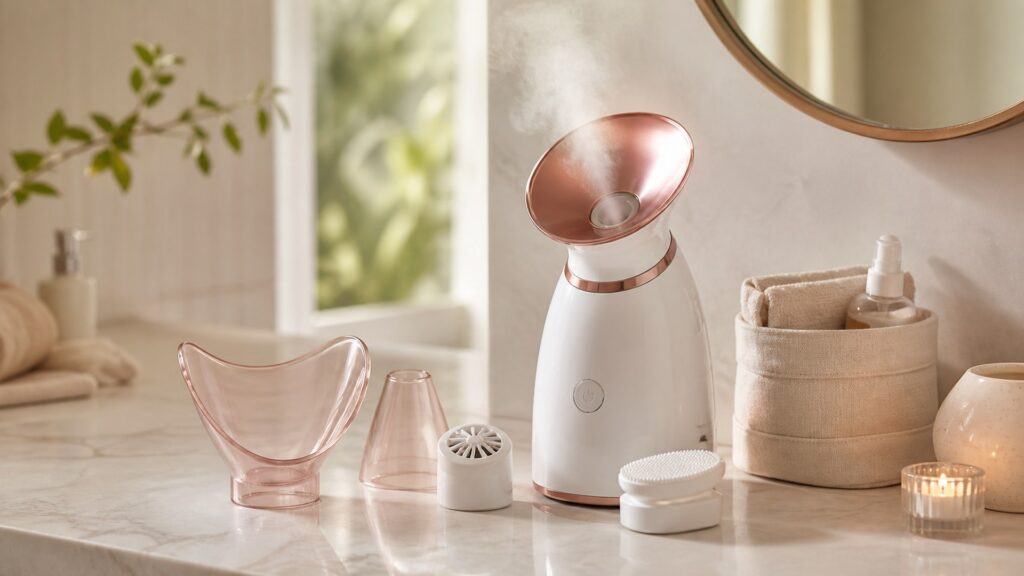
Buying framework
Define the device features and attachments routine before comparing products
Use the setting, frequency, and skin priorities to narrow facial steamers logically.
Start with the use case: Map each feature to temperature, distance, time, stability, or cleaning.
Rank the practical tradeoffs: Test nozzle position, tank lock, controls, and shutoff with cool water.
Check instructions early: Exclude accessories whose main role is extraction, fragrance, or greater heat intensity.
Use profiles
Match facial steamers to the person and pace
Three shopper profiles expose different priorities for device features and attachments.
Routine-focused buyer: A control-focused user needs distinct mild settings and an adjustable nozzle.
Performance-focused buyer: A small-space user should prioritize stable footprint and cord management.
Occasional or flexible user: A maintenance-focused buyer needs wide tank access and removable scale-prone parts.
Specifications
Read the specifications through a device features and attachments lens
Translate technical language into visible routine benefits.
Handling lens
Evaluate every feature at the mildest useful exposure.
Ownership lens
Count seams, reservoirs, and hidden surfaces added by accessories.
Steam Output: Adjustable nozzles change plume direction while retaining hotspot risk.
Temperature Control: Face hoods reduce distance flexibility and trap more heat.
Tank Capacity: Aromatherapy trays add volatile exposure unrelated to skin hydration.
Runtime And Shutoff: Magnifying mirrors encourage pore inspection after warmth.
Cleaning And Descaling: Water-level windows and drainable tanks improve maintenance visibility.
Common mistakes
Avoid shortcuts that undermine device features and attachments
A good purchase can still disappoint when selection or use is based on the wrong assumption.
Buying from one metric: Do not use an included extractor because steaming preceded it.
Skipping compatibility checks: Avoid essential oils in tanks or trays without explicit supported instructions.
Ignoring post-use care: Do not pay for a face hood when flexible distance is important.
Decision guidance
Choose the simplest option that covers the real need
Use these decision rules to finish a shortlist for device features and attachments.
Choose the basic format when: Choose adjustable mild output, stable base, timer, and accessible tank.
Choose the flexible format when: Select movable nozzle control over features that force the face closer.
Pause before upgrading when: Reject add-ons that complicate cleaning or promote unsupported treatment claims.
Ownership & compatibility
Plan for clean, repeatable ownership
The best value remains convenient after the first few uses.
Consumables and replacements: Remove accessories that are unused and keep them dry.
Cleaning and storage: Inspect tank locks, nozzle joints, and shutoff behavior periodically.
Routine compatibility: Replace scale filters only with documented compatible parts.
FAQ
Facial Steamers Buying Guide for Device Features and Attachments FAQ
Practical answers about choosing and owning facial steamers for device features and attachments.
What matters most when choosing facial steamers for device features and attachments?
Is the most expensive option better for device features and attachments?
How should I compare two similar facial steamers options?
Bottom line
Buy for repeatable device features and attachments results
A focused shortlist is easier to own and use well.
Prioritize fit: Value features only when they improve heat control or hygiene.
Verify the limits: Keep face distance adjustable rather than enclosed.
Count ownership costs: Exclude extraction and aromatherapy from the core purchase decision.
Reading Shortcuts
Jump to the key facial steamers decisions.
Decision Reminders
Keep these checks beside your shortlist.
- Check steam output: Keep a safe distance and stop if steam feels uncomfortably hot.
- Check temperature control: Avoid steaming inflamed, highly sensitive, or heat-reactive skin.
- Check tank capacity: Clean and descale the reservoir as directed.
Glossary Snippets
Plain-language facial steamers terms.
When to Use a Top 10 Review
Use a ranked list to identify a manageable set of strong candidates.
- You are still exploring: A ranked list can reveal the main formats and price tiers.
- You want a shortlist: Start broad, then confirm fit with this buying guide.
Have finalists? Use a Comparison.
When to Use a Comparison
Use a direct comparison when only a few candidates remain.
- Features are close: Side-by-side details clarify meaningful differences.
- Prices overlap: Compare ownership value, not only purchase price.
Still exploring? See the Top 10.