
Floor Protection Buying Guide for All-Weather Interior Use
All-weather protection must survive more than water. Winter introduces stiff material, packed snow, salt brine, and deep boot tread; summer adds hot-cabin expansion, edge curl, sunscreen, and dry abrasive grit. The useful product is the one that preserves its exact fit and surface behavior across that whole range.
Begin with one vehicle-specific driver piece locked to every intended retainer and clear of all controls. Test cold and hot shape, wet footwear, realistic melt volume, and the loaded exit through the door. Set an emptying trigger well below overflow, rinse salt before it concentrates, dry both sides, and inspect the original floor after severe weather and each seasonal change.
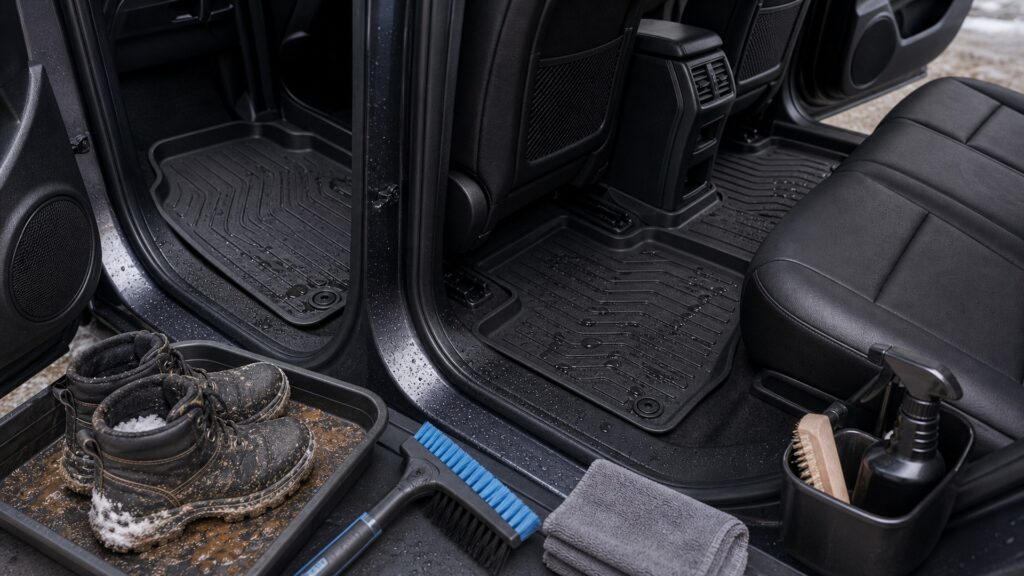
Buying framework
Set the all-weather floor protection baseline before buying
Convert the desired all-weather floor protection improvement into physical, functional, and maintenance requirements.
Build a local weather profile: List temperature range, snow depth, road treatment, rainfall, mud, sand, parking exposure, footwear, and typical time before cleanup.
Define the worst credible load: Estimate water and debris entering each zone during one trip, including passenger boots, pet paws, wet gear, and repeated winter stops.
Prove year-round geometry: Check anchors, pedal envelope, edge contact, seat travel, doors, vents, and row junctions after cold conditioning and safe hot-cabin exposure.
Schedule seasonal maintenance: Set triggers for dumping, salt rinsing, mud brushing, complete drying, under-mat inspection, shape recovery, and flat off-season storage.
Who this is for
Match the solution to the all-weather floor protection user
Different bodies, occupants, routes, climates, and cabin layouts justify different all-weather floor protection priorities.
Mild wet-climate driver: Stable low-to-moderate containment, reliable wet grip, simple carry-out, and rapid drying may matter more than extreme wall height.
Snowbelt commuter: Cold flexibility, boot clearance, brine capacity, salt-release channels, secure anchors, and frequent under-floor checks lead the decision.
Hot-summer owner: Evaluate odor, surface temperature, expansion, edge lift, heel polish, and whether storage or washing creates permanent curl.
Four-season family or work vehicle: Different row loads, repeated entries, mud, pets, and limited cleaning time favor modular pieces with conservative service triggers.
What to pay attention to
Evidence that predicts all-weather floor protection performance
Specifications matter only when translated into what changes inside the exact vehicle during all-weather floor protection use.
Weather Envelope
Test material and geometry at expected cabin temperatures with wet shoes, snowmelt, salt, mud, sand, and summer heat.
Seasonal Service
Plan conservative emptying, salt removal, complete drying, edge inspection, anchor checks, and off-season storage that preserves shape.
Temperature stability: Confirm documented range and observe stiffness, shrinking, softening, odor, edge memory, and retainer stress after realistic seasonal conditioning.
Meltwater control: Compare low-point volume, channel direction, anchor openings, foot displacement, braking movement, and the level at which removal becomes risky.
Salt-cleaning access: Brine should rinse from ribs and corners without leaving chalky deposits, slick films, trapped crystals, or inaccessible residue.
Weather traction: Test representative wet, snowy, and muddy soles on a secured surface; texture must also release contamination during cleaning.
Loaded exit behavior: A cold or liquid-filled liner needs enough support to clear seat bases, door trim, and sills without folding or pouring.
Storage and recovery: Off-season pieces should store flat or as directed, return to their intended contour, and preserve anchor and perimeter geometry.
Avoid these traps
Mistakes that compromise all-weather floor protection
Convenience becomes a defect when an add-on alters controls, restraints, airbags, visibility, airflow, or secure storage.
Filling channels to their visible maximum: Feet and vehicle motion displace liquid; empty at a conservative level before meltwater reaches edges or anchor openings.
Leaving road salt until spring: Repeated drying concentrates residue and can hide escaped brine; rinse on a practical winter schedule and inspect beneath.
Installing a cold deformed driver liner: Warm or reshape only according to product guidance, then prove anchors and controls; do not drive with a raised or curled edge.
Using shine products on the surface: Dressings may reduce traction and retain dirt; follow the maker's cleaning instructions and remove any slippery residue before use.
Decision guidance
Choose a defensible all-weather floor protection path
Select the least intrusive option that proves the required all-weather floor protection outcome under representative conditions.
Choose moderate channels for rain: Favor controlled removal and quick drying where liquid volume is limited and deep winter footwear is uncommon.
Choose shaped containment for snow and salt: Higher vehicle-specific boundaries help when cold fit, anchors, pedal clearance, and loaded carry-out all pass.
Choose accessible texture for mud and sand: Select ribs that hold debris during driving but allow brushing, vacuuming, and rinsing with the tools actually available.
Use a seasonal set only with disciplined swaps: Each set needs exact fit, clean dry storage, a labeled row and side, and a full installation check after changeover.
Ownership & compatibility
Maintain the all-weather floor protection result
Inspection, cleaning, adjustment, records, and replacement keep the original all-weather floor protection decision valid.
Inspect after major weather events: Lift pieces after heavy snowmelt, flooding rain, mud, or salt exposure to find escaped liquid, wet padding, stains, corrosion, or odor.
Track seasonal shape changes: Watch lip curl, anchor tension, surface polish, cracking, stiffness, heel wear, and control clearance as temperatures cycle.
Store without distortion: Clean and dry retired pieces, mark their locations, support them as directed, protect retainers, and verify shape before the next season.
FAQ
Questions to resolve for all-weather floor protection
Use exact vehicle documentation and product instructions to settle these points.
What makes a floor liner truly all-weather?
Can winter liners stay installed in summer?
How much snowmelt should a liner hold?
Why does road salt return after cleaning?
Are deep channels good for sand?
What if a liner becomes stiff in cold weather?
Can floor-mat cleaner improve shine?
How often should winter mats be removed?
Should all rows use the same liner depth?
Bottom line
Preserve safety while improving all-weather floor protection
A successful upgrade remains compatible, removable, understandable, and safe throughout ownership.
Test the weather envelope: Prove secure fit, pedal freedom, temperature stability, wet traction, and credible contamination capacity.
Empty before the limit: Use a conservative trigger and a supported carry-out path rather than trusting wall height alone.
Reset each season: Remove salt and debris, dry both layers, inspect hidden surfaces, check shape and anchors, and store pieces correctly.
Reading Shortcuts
Move through the seasonal contamination control decision in order.
Decision Reminders
All-weather is a tested operating range, not a material name.
- Build a local weather profile: Verify and record this requirement.
- Define the worst credible load: Verify and record this requirement.
- Prove year-round geometry: Verify and record this requirement.
- Inspect after major weather events: Verify and record this requirement.
- Track seasonal shape changes: Verify and record this requirement.
- Store without distortion: Verify and record this requirement.
Glossary Snippets
Terms used in this floor protection plan.
When to Use a Top 10 Review
Use rankings only after the requirements are fixed.
- Test the weather envelope: Use this as a shortlist filter.
- Empty before the limit: Use this as a shortlist filter.
- Reset each season: Use this as a shortlist filter.
- Exclude: Use this as a shortlist filter.
Already down to 2–3 options? A Comparison is usually the faster next step.
When to Use a Comparison
Compare finalists through the retainer, pedal, edge, seat, console, vent, removal, cleaning, and dry-floor trial; make cold flexibility an explicit recorded result.
- Build a local weather profile: Check both candidates against this requirement.
- Define the worst credible load: Record the result for each shortlisted option.
- Prove year-round geometry: Use the same operating conditions for both tests.
- Schedule seasonal maintenance: Keep the evidence with the final decision.
Still exploring? Start with a Top 10 to build a shortlist first.