
Floor Protection Buying Guide for Cabin Comfort Upgrades
Floor protection changes the cabin most when it is selected for cabin comfort, not simply by color or a generic promise of durability. The useful differences appear in comfort feel and cleanability. Comfort cannot come at the cost of a stable pedal platform or secure driver-side fit.
Begin with one correctly oriented driver mat, every intended retainer engaged, and complete clearance around accelerator, brake, clutch, seat hardware, and trim. Then simulate the title-specific use, remove the pieces without scattering their contents, clean and dry them as directed, inspect the original floor, and reinstall them visibly. That full cycle reveals value better than showroom feel.
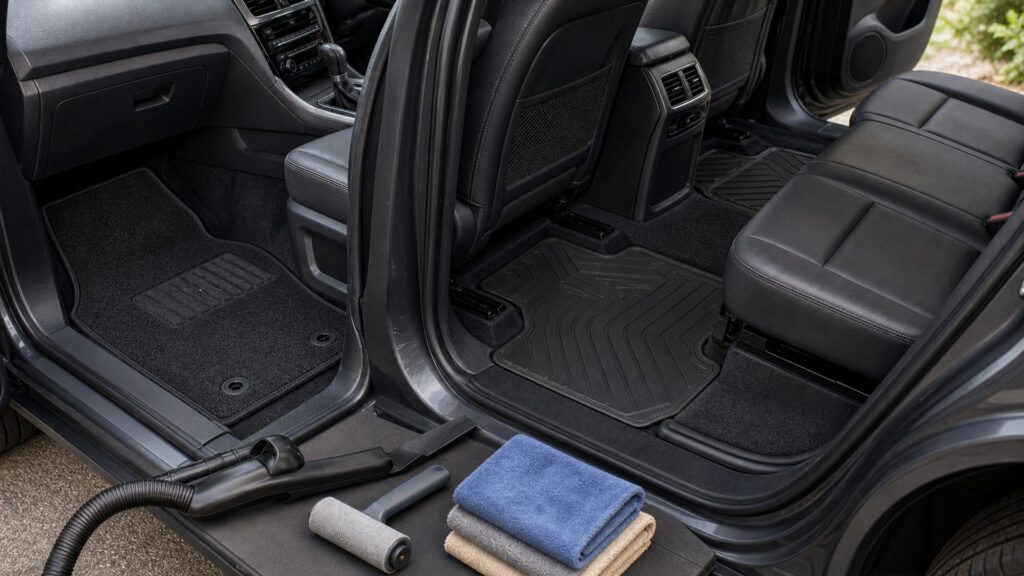
Buying framework
Comfort needs secure fit
Write the cabin comfort requirements by cabin zone before comparing brands or materials.
Map use by zone: Document driver, front passenger, rear rows, center hump, door edges, under-seat areas, and cargo floor according to comfort feel and cleanability.
Prove moving clearances: Remove old mats, secure the candidate, operate pedals, seats, doors, consoles, vents, storage lids, and folding sections through every intended position.
Simulate representative exposure: Use realistic shoes, passengers, loads, debris, moisture, and timing to test the actual cabin comfort routine rather than a clean static cabin.
Time the maintenance cycle: Release, lift, carry, empty, wash, rinse, dry, inspect beneath, and reinstall each piece while noting spill risk and vehicle downtime.
Who this is for
Match construction to cabin comfort routines
Carpet, rubber, molded liners, connected rear pieces, and cargo barriers solve different parts of comfort feel and cleanability.
Low-exposure owner: A lighter exact-fit mat may meet modest cabin comfort needs when contamination and removal frequency remain controlled.
Frequent-use driver: Prioritize secure footing, durable wear zones, easy release, quick cleaning, and predictable reinstallation for repeated cabin comfort duty.
Multi-row household: Connected coverage, rear-hump fit, seat-track clearance, row access, spill control, and separately replaceable pieces become more important.
Severe-duty user: Use shaped containment and resistant materials where comfort feel and cleanability create sustained loads, while preserving inspection and hardware access.
What to pay attention to
Specifications that change cabin comfort performance
Look beyond material names to geometry, interfaces, movement, surface behavior, removal, and upkeep.
Comfort needs secure fit
Translate comfort feel and cleanability into exact zones, measurable clearances, and observable use conditions.
Maintenance is part of performance
Compare how the chosen pieces release, carry contamination out, clean, dry, expose hidden surfaces, reinstall, and eventually wear.
Application precision: Confirm model year, body, wheelbase, seating, console, drivetrain-related floor changes, row, side, and all factory retention details.
Control-zone geometry: Inspect accelerator, brake, clutch, dead pedal, heel point, parking brake, steering base, seat travel, and any manual release near the floor.
Boundary stability: Edges should follow contours without bowing into doors, tracks, vents, trim, storage lids, or feet; temperature must not create unsafe curl.
Surface response: Evaluate grip, cushioning, texture, temperature, noise, abrasion, staining, odor, and residue under the real cabin comfort conditions.
Containment and removal: Channels and lips should hold the expected load while allowing a level lift and controlled exit that does not dump onto carpet.
Service cost: Compare wash method, drying time, replacement of one damaged piece, retainer parts, warranty, storage, and the labor or downtime required.
Avoid these traps
Mistakes that undermine cabin comfort
Convenience disappears when a piece shifts, curls, hides moisture, blocks hardware, or takes too long to service.
Adding comfort with a second layer: Stacking changes height and retention and can move material toward controls; obtain the desired surface from one correctly fitted driver piece.
Ignoring trim and hardware movement: A static outline misses seat tracks, vents, doors, folding seats, storage lids, and cargo panels that must keep operating after installation.
Choosing the deepest lip automatically: Tall edges can complicate foot movement, removal, or adjacent trim when geometry is wrong; containment must remain stable and usable.
Cleaning only the visible surface: Moisture, grit, salt, hair, and objects can collect beneath edges; remove protection and inspect the original floor on a defined schedule.
Decision guidance
Choose the right protection pattern
Select the least burdensome format that safely controls the documented cabin comfort conditions.
Use carpet when feel leads: Choose a reinforced, retained exact-fit mat where dry comfort, appearance, and manageable soil outweigh high liquid containment.
Use rubber when quick removal leads: A durable washable mat suits repeated light mess when its edges stay flat, wet grip remains sound, and dumping is controlled.
Use molded liners when boundaries lead: Vehicle-shaped coverage is useful when cabin comfort requires sidewalls and channels, provided exact contours and removal behavior pass testing.
Use modular protection for changing zones: Choose separately serviceable row or cargo pieces when one area receives disproportionate wear, passengers, spills, or configuration changes.
Ownership & compatibility
Keep the system clean and correctly positioned
Routine checks should catch movement, wear, residue, dampness, damaged retainers, and changing clearances early.
Inspect after every removal: Check retainer engagement, cracks, curl, heel wear, surface grip, edge contact, pedal space, tracks, vents, and original-floor condition.
Dry before reassembly: Rinse away material-appropriate contamination, remove cleaning residue, dry both faces and the vehicle floor, then reinstall with visible locks.
Replace before fit degrades: Retire a piece that no longer lies correctly, secures positively, clears moving parts, provides traction, contains expected mess, or cleans predictably.
FAQ
Questions about cabin comfort floor protection
Exact product and vehicle instructions govern final fit, use, and care.
What matters most for cabin comfort?
Can thicker material improve comfort safely?
How should fit be checked after installation?
Are raised edges always better?
What causes liners to smell?
Can floor protection reduce cabin noise?
How do I prevent debris from spilling during removal?
When should the vehicle floor be inspected?
Can I replace only one damaged piece?
Bottom line
Make safe fit the permanent baseline
The chosen protection should remain secure and maintainable through the full ownership pattern.
Prove safe geometry: Use one correct driver piece, engage retainers, and test controls plus every nearby moving component.
Test the real routine: Simulate comfort feel and cleanability, then observe footing, containment, removal, cleaning, drying, and downtime.
Inspect throughout ownership: Watch edges, wear, grip, locks, moisture, residue, hidden objects, hardware access, and replacement availability.
Reading Shortcuts
Move through the comfort feel and cleanability decision in order.
Decision Reminders
Safe fit comes before every cabin comfort benefit.
- Map use by zone: Verify and record this requirement.
- Prove moving clearances: Verify and record this requirement.
- Simulate representative exposure: Verify and record this requirement.
- Inspect after every removal: Verify and record this requirement.
- Dry before reassembly: Verify and record this requirement.
- Replace before fit degrades: Verify and record this requirement.
Glossary Snippets
Terms used in this floor protection plan.
When to Use a Top 10 Review
Use rankings only after the requirements are fixed.
- Prove safe geometry: Use this as a shortlist filter.
- Test the real routine: Use this as a shortlist filter.
- Inspect throughout ownership: Use this as a shortlist filter.
- Exclude: Use this as a shortlist filter.
Already down to 2–3 options? A Comparison is usually the faster next step.
When to Use a Comparison
Compare finalists through the retainer, edge, pedal, seat-track, door, removal, spill, cleaning, and dry-floor check; make heel pad an explicit recorded result.
- Map use by zone: Check both candidates against this requirement.
- Prove moving clearances: Record the result for each shortlisted option.
- Simulate representative exposure: Use the same operating conditions for both tests.
- Time the maintenance cycle: Keep the evidence with the final decision.
Still exploring? Start with a Top 10 to build a shortlist first.