
Floor Protection Buying Guide: How to Choose the Right One
Floor protection has one nonnegotiable job before it catches dirt: it must remain correctly positioned and clear every control. The driver mat should match the exact footwell, engage the intended retainers, lie right-side up, and stay away from the accelerator, brake, clutch, seat tracks, and moving trim through their complete travel.
After that safety gate, choose coverage for the material entering the cabin. Carpet can prioritize appearance and dry comfort; rubber mats simplify removal; molded liners extend containment up contours. Compare how each piece installs, collects water or grit, comes out without spilling, cleans, dries, and exposes the underlying floor for inspection. Never stack a replacement over another mat.
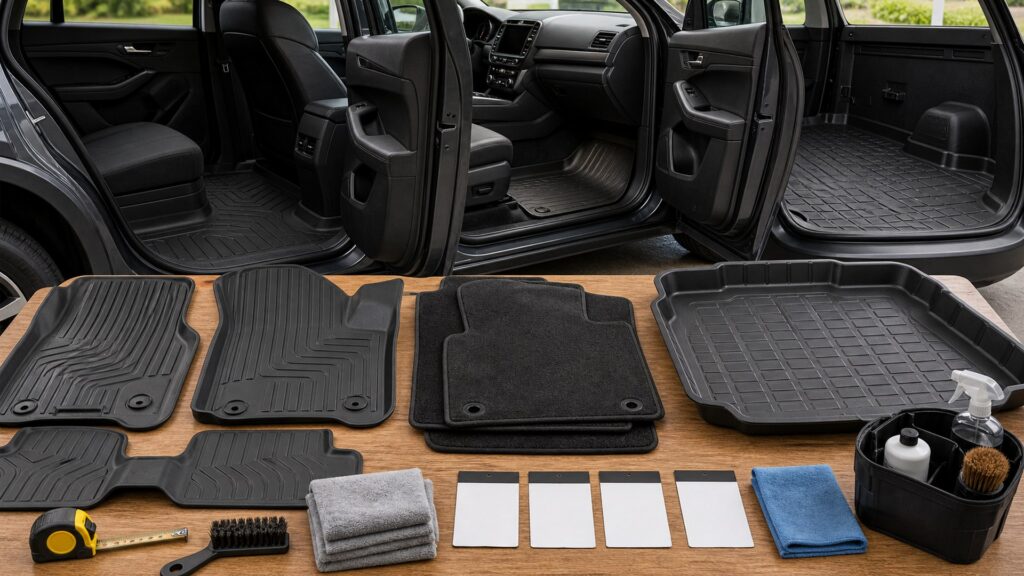
Buying framework
Start with the driver footwell
Fit, orientation, retention, and pedal sweep determine whether any candidate may remain in consideration.
Verify the exact application: Match year, make, model, body style, wheelbase, row, seating layout, transmission tunnel, console, subwoofer, hybrid battery, and cargo configuration.
Inspect the bare floor: Remove existing mats, find every factory retainer, note carpet wear and moisture, operate seats, locate vents and wiring, and photograph pedal clearances.
Define the contamination load: Estimate water, snow, salt, mud, sand, food, pet hair, work debris, heel wear, and how often the cabin can be emptied.
Plan the maintenance loop: Decide how pieces will be released, lifted level, dumped, washed, dried completely, reinstalled, and checked after every service or driver change.
Who this is for
Match construction to the contamination pattern
Dry dust, rain, snow, road salt, sand, pet debris, and cargo leaks create different containment and cleaning demands.
Dry-climate appearance buyer: Vehicle-specific carpet mats can provide a finished look and heel comfort when liquid containment and heavy grit are limited.
Wet or snowy commuter: Raised molded liners, secure retention, textured footing, side coverage, and frequent salt removal matter more than plush pile.
Family or pet vehicle: Rear coverage, spill containment, easy removal, washable surfaces, seat-track clearance, and replacement availability support repeated cleanup.
Work and cargo user: Deep channels, abrasion resistance, boot grip, connected rear coverage, load stability, and access to tie-downs or floor panels deserve priority.
What to pay attention to
Specifications that separate coverage from safe fit
Dimensions, edges, channels, backing, flexibility, surface texture, and access cutouts change daily performance.
Safe Fit
Check exact footwell shape, orientation, driver retention, pedal sweep, seat travel, trim, vents, wiring, and door closure.
Protection Cycle
Match coverage and containment to soil, then evaluate removal, dumping, washing, drying, floor inspection, and replacement.
Driver-side retention: Confirm the correct number, position, shape, engagement, release method, and condition of factory hooks or posts; generic backing is not equivalent.
Pedal and control clearance: With the mat secured, test full accelerator, brake, and clutch travel plus dead pedal, foot movement, steering column, parking brake, and seat positions.
Coverage geometry: Compare sidewalls, firewall reach, dead pedal, door edge, seat-base gaps, rear center hump, under-seat overlap, vents, tracks, and console contours.
Containment design: Raised lips and channels need sufficient volume and stable edges without creating heel catches; shallow mats favor easy dumping over pooled-liquid capacity.
Material behavior: Assess stiffness across temperature, surface grip when wet, heel abrasion, curling, odor, staining, chemical sensitivity, weight, and wash-and-dry instructions.
Access and serviceability: Pieces should release without damage, exit without dumping onto carpet, reinstall visibly, and preserve seat bolts, battery panels, tools, cargo latches, and drainage access.
Avoid these traps
Floor-protection mistakes with real consequences
Poor installation can introduce control interference, trapped moisture, spilled debris, damaged trim, or blocked hardware.
Stacking a new mat over the old one: Extra thickness changes fit and can defeat retainers or move material toward the pedals; remove every underlying mat before installation.
Buying a universal driver mat by outline: Trimming cannot create correct retainer geometry or prove pedal clearance; use a specifically supported application for the driver footwell.
Judging fit before operating the vehicle: Test every pedal and relevant seat position after securing the mat, then recheck once heat, cold, passengers, and cleaning have affected it.
Leaving captured water beneath a liner: Spills can enter at edges or during removal; lift protection periodically, dry both surfaces, and investigate odor, staining, corrosion, or wet padding.
Decision guidance
Choose by climate, use, and cleaning tolerance
The best material is the one that safely manages expected soil and will actually be removed and cleaned.
Choose carpet for controlled dry use: Select exact-fit pieces with reinforced heel areas and secure retention when appearance and comfort outweigh liquid containment.
Choose removable rubber for moderate mess: Flat or lightly dished mats suit frequent shaking and washing if they remain vehicle-specific, retained, and clear of controls.
Choose molded liners for severe contamination: Higher edges and shaped coverage help with snow, salt, mud, and family spills when contours fit accurately and removal is manageable.
Mix formats only by zone: Front, rear, and cargo areas may justify different materials, but every piece needs compatible edges, access, stability, and a separate maintenance plan.
Ownership & compatibility
Inspect beneath the protection
Protection should make the original floor easier to preserve and examine, not hide dampness indefinitely.
Recheck position routinely: Inspect retainers, edges, curling, cracks, surface grip, heel wear, pedal clearance, seat travel, vents, and overlap after cleaning or vehicle service.
Clean and dry both layers: Follow material instructions, remove abrasive grit and deicing chemicals, dry the protection fully, and inspect carpet and padding before reinstallation.
Replace compromised pieces: Retire mats with broken retainers, permanent deformation, slippery surfaces, split edges, worn-through heel zones, incorrect fit, or recurring control interference.
FAQ
Floor-mat questions before purchase
Apply manufacturer instructions to the exact vehicle and product set.
Can I place a rubber mat over carpet mats?
Are universal mats safe for the driver footwell?
Do molded liners protect better than rubber mats?
How do I check accelerator clearance?
Why is water appearing under a floor liner?
Will floor liners block under-seat vents?
How often should mats be removed?
Can raised edges curl inward?
Should cargo protection use the same material?
Bottom line
Buy exact fit, then prove clearance
A valid purchase stays secured, clears controls, fits surrounding hardware, contains expected mess, and is maintainable.
Pass the safety gate: Use one correct driver mat, engage every intended retainer, and verify unrestricted controls and seat movement.
Match the mess: Choose coverage, edges, channels, grip, and material for the actual water, grit, salt, food, pet, or work exposure.
Maintain the floor: Remove carefully, clean, dry, inspect underneath, reinstall visibly, and replace deformed or insecure pieces.
Reading Shortcuts
Move through the the complete floor-protection decision from driver safety to whole-cabin upkeep decision in order.
Decision Reminders
One secured driver mat is the starting requirement.
- Verify the exact application: Verify and record this requirement.
- Inspect the bare floor: Verify and record this requirement.
- Define the contamination load: Verify and record this requirement.
- Recheck position routinely: Verify and record this requirement.
- Clean and dry both layers: Verify and record this requirement.
- Replace compromised pieces: Verify and record this requirement.
Glossary Snippets
Terms used in this floor protection plan.
When to Use a Top 10 Review
Use rankings only after the requirements are fixed.
- Pass the safety gate: Use this as a shortlist filter.
- Match the mess: Use this as a shortlist filter.
- Maintain the floor: Use this as a shortlist filter.
- Exclude: Use this as a shortlist filter.
Already down to 2–3 options? A Comparison is usually the faster next step.
When to Use a Comparison
Compare finalists through the retainer, edge, pedal, seat-track, door, removal, spill, cleaning, and dry-floor check; make driver retainer an explicit recorded result.
- Verify the exact application: Check both candidates against this requirement.
- Inspect the bare floor: Record the result for each shortlisted option.
- Define the contamination load: Use the same operating conditions for both tests.
- Plan the maintenance loop: Keep the evidence with the final decision.
Still exploring? Start with a Top 10 to build a shortlist first.