
Fragrances Buying Guide for Men
The men’s label is a retail convention, not a rule about who can wear a scent. The useful purchase is the fragrance that fits the wearer, setting, climate, grooming products, and desired wearing radius.
Map scented wash, shaving cream, aftershave, beard products, deodorant, and hair products before testing perfume. Sample candidates with neutral supporting products first, then restore the normal grooming stack and judge the complete dry-down in actual work, commute, weekend, and evening settings. Cross-shop men’s, women’s, and unisex counters whenever the composition fits the brief.
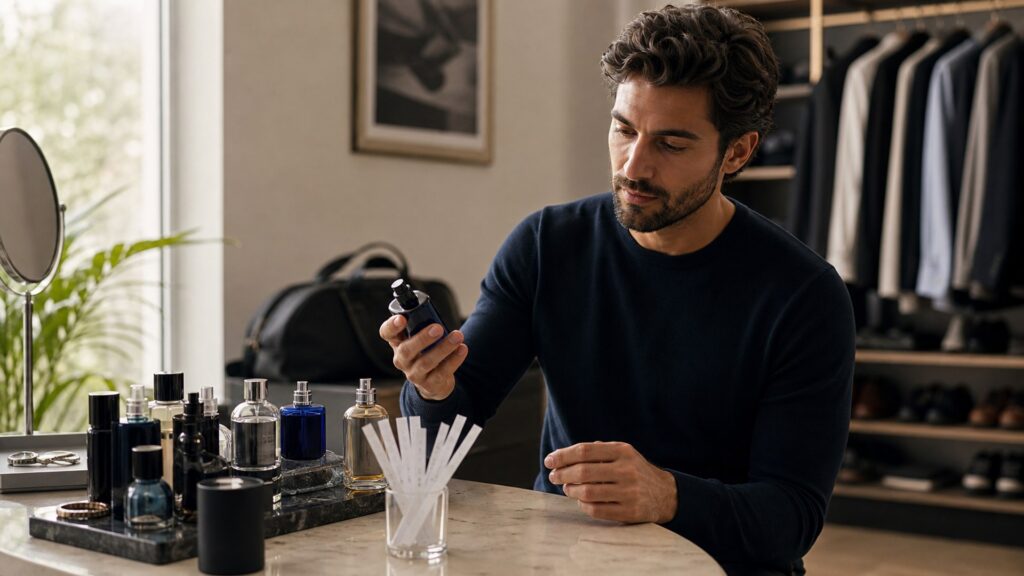
Buying framework
Build the scent wardrobe decision
Sequence scent wardrobe, office radius, system fit, and ownership cost.
Define the repeated job: Translate scent wardrobe into a repeatable action, setting, frequency, and acceptable failure boundary.
Set the non-negotiable boundary: Use office radius and grooming stack to identify the condition no appealing feature may override.
Compare the working system: Judge scent wardrobe and interacting parts together under realistic conditions, then check the consequences for grooming stack.
Price the ownership cycle: Include cleaning, consumables, office radius storage, inspection, replacement, and aftershave overlap failure recovery in value.
Who should buy what
Match office radius to the user
User situations alter the required office radius configuration.
The fragrance beginner: Needs a lean configuration for scent wardrobe; its essential action should remain easy to repeat with office radius and inspect.
The close-office professional: Benefits from greater office radius capacity, provided cleaning, storage, and grooming stack remain manageable.
The hot-climate wearer: Should prioritize environmental fit for grooming stack plus a dependable fallback when aftershave overlap creates the highest-consequence failure.
The evening social wearer: Requires controlled aftershave overlap precision and clear separation between preparation, active use, deodorant overlap, and reset.
The frequent traveler: Needs geometry, visibility, and deodorant overlap access adapted to real handling constraints and the behavior of scent wardrobe.
What to pay attention to
Read grooming stack before purchase
Specifications matter when they predict grooming stack control or care.
Grooming-stack interaction
Read scent wardrobe, office radius, and grooming stack as the characteristics controlling the immediate result.
Coordinate scented grooming products
Use aftershave overlap and deodorant overlap to preserve consistency and service life through ownership.
Grooming-stack interaction: Test scent wardrobe during the primary action; note control, grooming stack, and visible failure. Grooming-stack interaction checkpoint: scent wardrobe sets the grooming-stack interaction reference. Evaluate office radius beside grooming-stack interaction; document grooming stack after the grooming-stack interaction trial, and revisit grooming-stack interaction when aftershave overlap changes. Keep grooming-stack interaction evidence in the grooming-stack interaction decision record.
Context and scent radius: Read office radius dimensions with construction because neither predicts fit without aftershave overlap in the surrounding sequence. Context and scent radius checkpoint: office radius sets the context and scent radius reference. Evaluate grooming stack beside context and scent radius; document aftershave overlap after the context and scent radius trial, and revisit context and scent radius when deodorant overlap changes. Keep context and scent radius evidence in the context and scent radius decision record.
Opening-to-drydown character: Compare grooming stack using the intended product, pressure, timing, and target while deodorant overlap stays controlled. Opening-to-drydown character checkpoint: grooming stack sets the opening-to-drydown character reference. Evaluate aftershave overlap beside opening-to-drydown character; document deodorant overlap after the opening-to-drydown character trial, and revisit opening-to-drydown character when scent wardrobe changes. Keep opening-to-drydown character evidence in the opening-to-drydown character decision record.
Dose control: Inspect aftershave overlap contact points, closures, edges, or alignment before use and after the scent wardrobe step. Dose control checkpoint: aftershave overlap sets the dose control reference. Evaluate deodorant overlap beside dose control; document scent wardrobe after the dose control trial, and revisit dose control when office radius changes. Keep dose control evidence in the dose control decision record.
Climate behavior: Measure how deodorant overlap changes visibility, reach, stability, and the neighboring office radius operation. Climate behavior checkpoint: deodorant overlap sets the climate behavior reference. Evaluate scent wardrobe beside climate behavior; document office radius after the climate behavior trial, and revisit climate behavior when grooming stack changes. Keep climate behavior evidence in the climate behavior decision record.
Travel atomizer integrity: Repeat the care cycle for scent wardrobe, then check recovery, residue, grooming stack, damage, and time before reuse. Travel atomizer integrity checkpoint: scent wardrobe sets the travel atomizer integrity reference. Evaluate office radius beside travel atomizer integrity; document grooming stack after the travel atomizer integrity trial, and revisit travel atomizer integrity when aftershave overlap changes. Keep travel atomizer integrity evidence in the travel atomizer integrity decision record.
Avoid these traps
Prevent aftershave overlap failures
Purchasing shortcuts often hide a aftershave overlap consequence.
Buying by masculine color coding: Marketing status cannot replace a scent wardrobe map; count repeated jobs and verify office radius before buying.
Layering every scented grooming product: A convenient office radius shortcut may leave residue, damage, or transfer risk that appears when grooming stack enters the sequence.
Using evening projection at close range: Boundaries around grooming stack are functional constraints; do not let aftershave overlap turn them into optional accessories.
Assuming more sprays improve longevity: Lost aftershave overlap identity, dates, directions, or compatibility information can make a deodorant overlap setup harder to manage.
Choosing a gift from age stereotypes: Materials affecting deodorant overlap differ by conditions, so verify the procedure and its effect on scent wardrobe instead of assuming one method.
Decision guidance
Choose by deodorant overlap
Let the dominant constraint determine the deodorant overlap path.
For a first all-purpose scent: Choose enough scent wardrobe capacity for the busiest sequence without backtracking through the grooming stack boundary.
For office wear: Prioritize office radius containment wherever product, heat, or transfer makes aftershave overlap the main risk.
For heat and outdoor use: Reduce grooming stack size only after critical functions, protection, and a practical deodorant overlap fallback are secured.
For evenings: Build the permanent aftershave overlap station around visibility, stable access, and a complete scent wardrobe reset path.
For a two- or three-scent wardrobe: Standardize deodorant overlap labels, zones, and handoffs so another user can follow the same office radius system.
Ownership & compatibility
Maintain scent wardrobe reliability
Cleaning, inspection, and replacement preserve scent wardrobe performance.
Coordinate scented grooming products: Write the scent wardrobe method and trigger down so care remains dependable when office radius makes the routine busy.
Store bottles and travel sprays correctly: Physical office radius zones should make movement obvious and stop a used item from crossing the grooming stack boundary.
Track dose by context: Keep grooming stack identity, directions, and replacement cues attached while aftershave overlap remains in service.
Retest after routine or climate changes: Count aftershave overlap supplies on a schedule and remove damaged components before the next high-consequence deodorant overlap use.
FAQ
Fragrances FAQ for Men
Resolve the remaining questions about office radius and grooming stack.
What fragrance concentration is best for men?
Can men wear fragrances labeled unisex or for women?
How should cologne interact with aftershave?
What makes a fragrance office appropriate?
How many sprays should a man use?
Which scent families work in hot weather?
How should a first fragrance wardrobe be built?
Are travel sprays worth buying?
How do you choose fragrance as a gift for a man?
Bottom line
The office radius bottom line
Buy for the repeated scent wardrobe task and its complete care loop.
Keep the angle active: Let scent wardrobe, office radius, and the real setting govern the final choice instead of drifting toward a generic category winner.
Test the complete system: A scent wardrobe feature earns its place only when it improves the repeated task and remains compatible with grooming stack.
Own the maintenance: Value includes the office radius work and replacement required to keep aftershave overlap reliable.
Scent Wardrobe Shortcuts
Move from the scent wardrobe decision to specifications, user fit, and unresolved questions.
Scent Wardrobe Reminders
Keep scent wardrobe visible through the final comparison.
- Define the repeated job: Keep scent wardrobe visible while features compete for attention.
- For a first all-purpose scent: Select the path whose scent wardrobe tradeoffs fit the repeated situation.
- Coordinate scented grooming products: Confirm scent wardrobe upkeep can be performed consistently before purchase.
Scent Wardrobe Glossary
Terms that make scent wardrobe easier to compare.
Using a Fragrances Top 10
Use rankings only after defining the scent wardrobe job and ownership constraints.
- For a first all-purpose scent: Filter finalists through the primary scent wardrobe use case.
- For office wear: Check whether scent wardrobe changes the necessary configuration.
- For heat and outdoor use: Compare scent wardrobe consequences under realistic conditions.
- For evenings: Include supporting scent wardrobe supplies and upkeep in value.
A ranking is useful when test conditions resemble the buyer's scent wardrobe routine.
Comparing Fragrances Options
Hold the scent wardrobe use case steady while comparing construction, control, and care.
- Grooming-stack interaction: Observe the first scent wardrobe characteristic during the actual task.
- Context and scent radius: Record where the second scent wardrobe feature changes control.
- Opening-to-drydown character: Test the third scent wardrobe variable with the intended setting.
- Dose control: Inspect the fourth scent wardrobe factor after cleaning and storage.
Return to the scent wardrobe task when two options appear tied.